



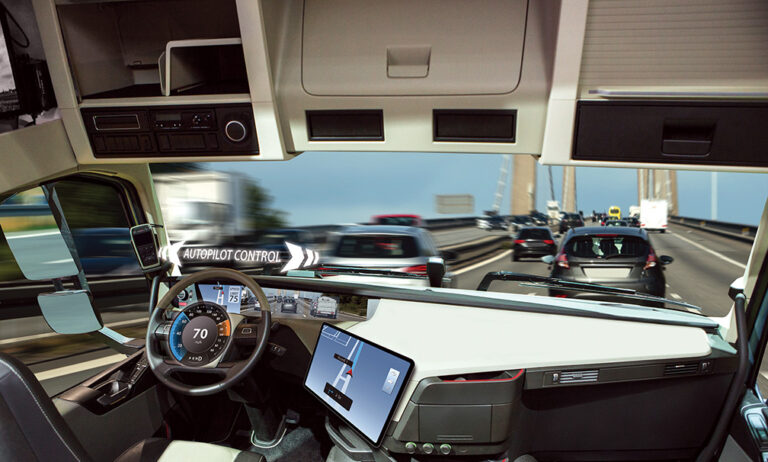
The federal government is laying out a clearer path for automated vehicles — including commercial trucks — to move from limited deployments toward broader use on U.S. highways.
On September 3, 2026, the U.S. Department of Transportation (DOT) unveiled its National Strategy for Automated Vehicles, establishing the agency’s priorities for fiscal years 2026 through 2030. The plan emphasizes safety, regulatory certainty, commercial deployment and the ability of automated vehicles to operate consistently across state lines.
For trucking, the strategy is notable not because it immediately clears autonomous trucks for nationwide operation — it doesn’t — but because it identifies several regulatory and operational questions DOT intends to tackle as automated driving systems move further into commercial freight.
“The Trump administration is committed to safely unleashing American innovation on our roads,” said Transportation Secretary Sean Duffy when announcing the plan. He said the technology holds promise for reducing roadway fatalities, improving mobility and changing how people and goods move.
Four goals guide the strategy
DOT organized the plan around four objectives — prioritizing safety, providing regulatory certainty, promoting American innovation and facilitating interoperable corridors. The strategy specifically calls for expanding the commercial availability and operation of automated technology for both passenger and freight applications.
The National Highway Traffic Safety Administration (NHTSA) will continue to monitor automated driving systems through crash reporting, defect investigations, recalls and other enforcement mechanisms. The agency is also developing objective performance standards for automated driving system competency.
For commercial vehicles, however, NHTSA is only part of the equation.
The Federal Motor Carrier Safety Administration (FMCSA) retains responsibility for regulating and overseeing commercial motor vehicles equipped with automated driving systems. DOT says FMCSA is working to modernize regulations governing the safe operation of those vehicles.
If finalized, those rules would amend portions of the Federal Motor Carrier Safety Regulations to address the introduction and federal oversight of automated commercial vehicles.
Updating rules written for humans
One of DOT’s challenges is straightforward: Much of the nation’s transportation regulatory structure was written with the assumption that a human being would be sitting behind the wheel.
Existing federal regulations generally allow automated vehicles to be developed and deployed, provided they comply with applicable standards or receive exemptions. However, DOT says some requirements can create unnecessary barriers when applied to vehicles designed to operate without a human driver.
FMCSA faces the task of determining how existing operational safety requirements should apply to commercial vehicles that may not have a conventional driver.
Hazardous materials transportation presents another challenge. The Pipeline and Hazardous Materials Safety Administration is examining potential regulatory changes that could facilitate highly automated transportation systems while maintaining safety requirements.
Crossing state lines
For interstate trucking, DOT’s focus on “interoperable corridors” could have significant long-term implications.
Automated trucks operating in interstate commerce could encounter different state requirements, roadway systems and digital environments as they cross jurisdictional lines.
DOT plans to bring federal agencies, states and industry stakeholders together to identify ways to harmonize corridor-level data structures and information-sharing protocols. The department is also pursuing an Interstate Corridor Modernization initiative supporting real-time data sharing about conditions such as emergency road closures and temporary roadway realignments.
DOT does not, however, envision highways being rebuilt specifically for autonomous vehicles. The strategy says AVs are expected to operate safely with infrastructure and communication systems as they exist today.
When something goes wrong
The strategy also tackles a practical question: How should police, firefighters and other emergency personnel interact with a commercial vehicle that may not have a driver behind the wheel?
FMCSA is developing an emergency-response framework specifically for commercial vehicles equipped with automated driving systems. The research is intended to establish more consistent procedures for first responders interacting with automated CMVs.
NHTSA is also updating its broader voluntary guidance for automated vehicles, with planned topics including remote operations and assistance, software updates, safety management systems and interactions with emergency responders.
A mixed fleet remains
Despite its push to expand automated vehicle development, DOT anticipates conventional, manually driven vehicles will remain on U.S. roads as AV adoption increases.
That means regulators, infrastructure providers and motor carriers will need to prepare for a mixed environment in which automated and human-driven trucks share the highway.
For fleets, the National AV Strategy is less a starting gun for driverless trucking than a roadmap for building the regulatory system around it.
Many details remain to be worked out through individual rulemakings, standards, guidance and research. But DOT’s direction is becoming clearer: The department wants automated freight transportation to expand, and federal regulators are working to adapt rules written for human-driven trucks to a transportation system in which the person behind the wheel may no longer always be there.
This article first appeared in the November/December 2026 print edition of Truckload Authority, the official publication of the Truckload Carriers Association.

Linda Garner-Bunch has been with The Trucker since 2020, picking up the reins as managing editor in 2022. Linda has nearly 40 years of experience in the publishing industry, covering topics from the trucking and automotive industry to employment, real estate, home decor, crafts, cooking, weddings, high school sports — you name it, she’s written about it. She is also an experienced photographer, designer and copy editor who has a heartfelt love for the trucking industry, from the driver’s seat to the C-suite.