



Every driver has heard the words, most likely starting early in their trucking career. But after hearing the same advice countless times, it’s easy to become complacent about putting it into practice. Judging from the number of injuries reported, many drivers need to revisit the words.
What are the words?
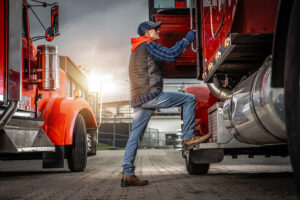
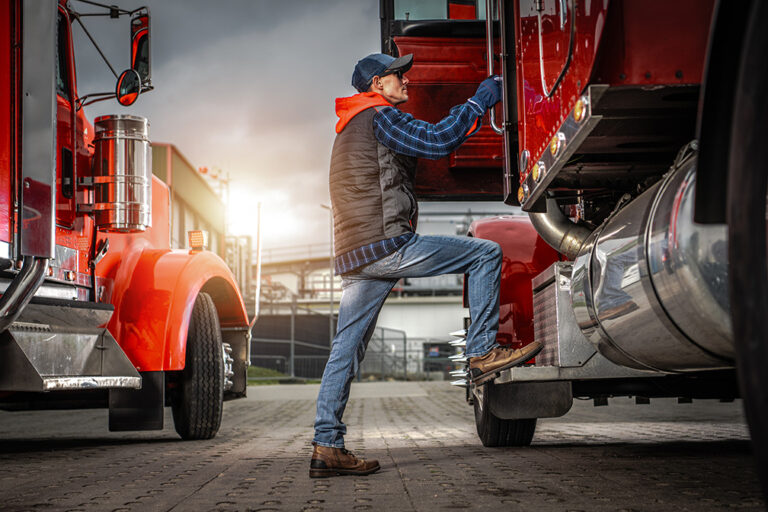
Always use three points of contact to mount or dismount equipment or cargo.
The premise is a simple one: Each driver has two hands and two feet; that’s four appendages. Three of those appendages should be in contact with something that supports your weight at all times. When one foot is moving to another step, the other foot should be planted somewhere solid, and both hands should be gripping something that will hold your weight if the step fails. If you’re moving a hand to a better (or higher or lower) grip, the other hand should be holding on to something and both feet should be planted.
Most truck drivers are “get-it-done” type of people. Their independence motivates them to figure out problems without assistance, especially in situations where help isn’t available. Often, the task to be completed isn’t at ground level and requires climbing of some sort.
If someone needs to climb up on the trailer to secure a load, it’s most likely going to be the driver. Cleaning the mirrors or the windshield requires climbing. Likewise, repairing a light, or removing snow from the top of the vehicle, or untangling air lines, or whatever, is likely to require climbing.
In addition, the job is full of freight that moves around, rolls, shifts and falls — and it’s often the driver’s job to keep it from happening or fix it after it happens.
It’s not Momma’s front porch
Using three points of contact, however, isn’t always the most expedient way to move.
The steps provided for getting in and out of the truck, for example, are often designed like stairs. Who descends a staircase backwards, keeping both hands on the rails whenever a foot is moving to the next stair down? Many drivers take the two or three steps to the driver’s seat at almost a run. Exiting the cab is often done with the driver’s back to the cab, descending the stairs as if it were three steps on Momma’s front porch.
Momma’s front porch, however, probably isn’t made of steel. It probably isn’t covered with road spray and grime, or oily from whatever was leaking. Momma’s porch can be wet or covered with snow, but it hasn’t been moving through the weather at 65 mph, building up a layer of ice.
The real cost of a fall
Slips, trips and falls account for the third-largest number of worker’s compensation claims each year, according to the Occupational Health and Safety Administration (OSHA).
A worker’s comp injury can result in treatment but no time lost from work, or it might include a period when you can’t work. Worker’s compensation insurance can protect you from high medical bills and loss of income from an accident, but the pay is never as good as your salary — and what good is time off if you’re injured and can’t enjoy it?
In 2024, employers reported 2.5 million injury and illness cases in private industry.
That’s a lot of injuries.
In trucking, the Federal Motor Carrier Safety Administration (FMCSA) rules may determine that an injury that results in time off from your driving job may call for a new DOT physical exam before you can return to work.
According to OSHA, the annual average number of hospitalizations for workers in the transportation and warehousing industry between 2015 and 2023 was 785. That’s fewer than in the construction and manufacturing industries, but more than every other profession.
Over that same period, OSHA received reports of 29,816 severe injuries due to falls.
Obviously, traffic accidents aren’t the only hazard in trucking.
When a slip becomes a strain
Overexertion and bodily reaction represents the largest category of worker’s comp claims. While many of these are of the repetitive motion type injuries, such as carpal tunnel syndrome, overexertion can occur when climbing as well. If a foot slips, for example, the driver might try to “catch” themself by holding on with hands and arms. A driver that may not be capable of a single pull-up, however, is likely to overexert joints and muscles.
Even when an injury doesn’t require treatment or result in a worker’s compensation claim, it can still impact a driver’s performance. Many drivers have healed up on the job, limping through it until things “got better.” Some turn to pain medication to deal with issues, which can lead to a whole new set of issues.
Not every climb is the same
The problem in trucking is that everything isn’t uniform.
Tractors are generally designed with enough steps and hand holds to keep the driver secure while getting in and out. Trailers, on the other hand, are often not designed for climbing, since they are often loaded by forklifts or other equipment.
Climbing into the back of a van trailer can be an adventure. Closing and latching one door can provide a needed handhold, but finding two might be impossible.
Climbing on flatbed trailers is easier at some points than at others, but areas where securement or tarping is needed might be far from the easiest spot to climb. Ladders are a necessary tool, but they require three points of contact, too. Often, drivers decide that it’s easier to make the difficult climb than to unsecure and carry the ladder, putting it back when done.
Tank and other trailer types often come with built-in ladders, but due to vehicle size and weight requirements, these ladders often have small steps and thin handholds. Be especially careful when using them.
Unfortunately, there are times when enough steps and handholds just aren’t available, such as when climbing on a load is necessary. A little planning can make the process safer. Is a suitable ladder or platform available? Can the task be completed from the ground using an extension tool? If the climb can’t be made safely, it’s worth taking the time to find another solution rather than risking an injury.
Drivers know that three points of contact isn’t always possible, but doing your best to keep your footing and hand holds secure is one way of reducing your risk of injury.

Cliff Abbott is an experienced commercial vehicle driver and owner-operator who still holds a CDL in his home state of Alabama. In nearly 40 years in trucking, he’s been an instructor and trainer and has managed safety and recruiting operations for several carriers. Having never lost his love of the road, Cliff has written a book and hundreds of songs and has been writing for The Trucker for more than a decade.