



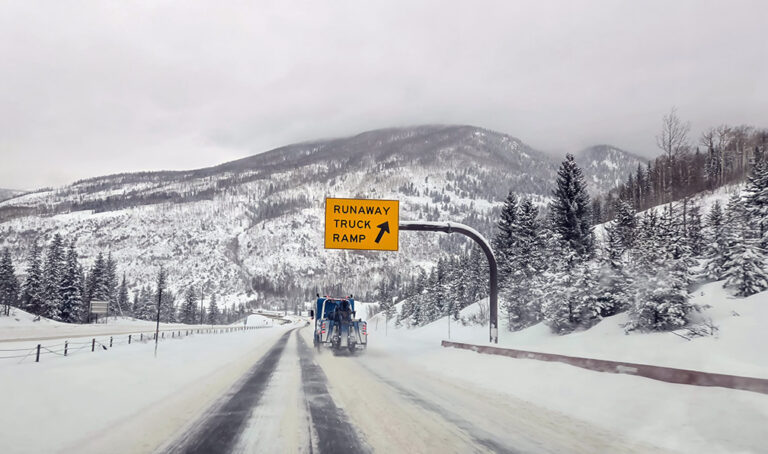
DENVER — Truck drivers navigating Colorado’s snow-covered mountain highways could soon have the option of paying someone else to install and remove their tire chains.
On Nov. 19, the Colorado Transportation Commission adopted updated chain law regulations, paving the way for private businesses to offer paid roadside chain-up services at designated locations.
The move follows the passage of Senate Bill 25-069, which was signed into law May 15, 2025. The legislation is designed to improve highway safety and reduce traffic congestion along Colorado’s mountain corridors during winter weather.
While both commercial and passenger vehicle drivers stand to benefit from the program, the availability of roadside chain-up assistance could be particularly welcome news for truckers who regularly haul freight through the state.
How will the program work?
Under the legislation, the Colorado Department of Transportation (CDOT) is authorized to issue permits to private vendors and companies to install, remove and sell tire chains and alternative traction devices (ATDs) at approved roadside locations.
The legislation directs CDOT to avoid granting permits in a way that would effectively give a single vendor a monopoly at a particular location.
Service providers also will be subject to safety requirements, including the use of reflective clothing, signage and traffic control equipment.
The updated regulations were adopted following an Oct. 22 public hearing and subsequent revisions to the proposed rules.
A timeline for the launch of services, initial locations and pricing has yet to be confirmed.
Why it matters to truckers
Chaining up is a time-consuming and physically demanding task, often performed in freezing temperatures, poor visibility and close proximity to passing traffic.
For commercial drivers traveling through Colorado, the process may need to be repeated multiple times during a single trip as road and weather conditions change.
According to data released by CDOT in October 2025:
- Commercial motor vehicles account for approximately 10% of traffic on Interstate 70.
- More than 1,400 miles of Colorado highways are subject to the state’s must-carry chain law.
- The state has 130 designated chain stations, including 22 along I-70’s mountain corridor.
- Law enforcement officers issued more than 1,300 citations for violations of the must-carry chain law during the 2024-25 season.
Trucks that lose traction on steep mountain grades can block travel lanes, resulting in lengthy delays for other motorists and disrupting the movement of freight.
Existing chain requirements remain in place
The introduction of paid chain-up services does not relieve truck drivers of their responsibility to comply with Colorado’s chain laws.
From Sept. 1 through May 31 each year, commercial motor vehicles weighing more than 16,000 pounds must carry tire chains or approved alternative traction devices when traveling on designated stretches of Colorado highways, regardless of weather conditions.
Drivers must be prepared to install those devices when chain restrictions are activated.
Failure to carry the required equipment can result in a $500 fine, while drivers who block a roadway because they failed to comply with chain requirements can face fines of up to $1,000, plus surcharges.
For more information about Colorado’s commercial vehicle chain requirements, including maps and instructional videos, visit CDOT’s freight mobility website.
Drivers can monitor current road conditions, closures and chain law activations at COtrip.org.

Linda Garner-Bunch has been with The Trucker since 2020, picking up the reins as managing editor in 2022. Linda has nearly 40 years of experience in the publishing industry, covering topics from the trucking and automotive industry to employment, real estate, home decor, crafts, cooking, weddings, high school sports — you name it, she’s written about it. She is also an experienced photographer, designer and copy editor who has a heartfelt love for the trucking industry, from the driver’s seat to the C-suite.