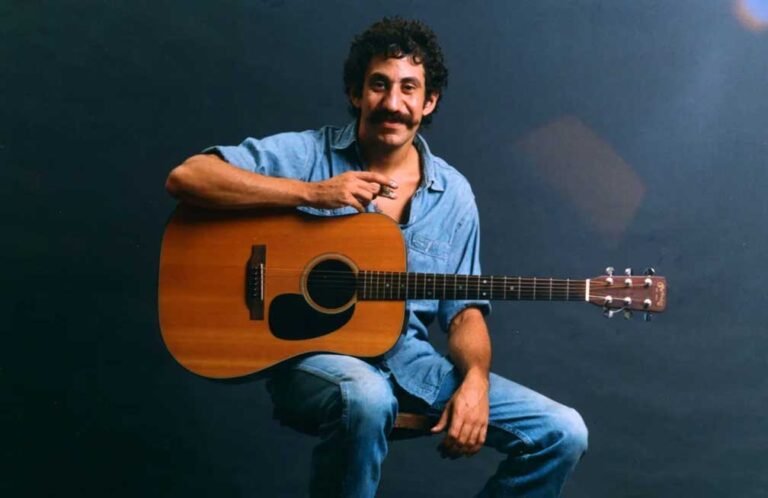
When folk-soft rock singer Jim Croce died in a plane crash in 1973, his career as a musician had barely started.
Since embarking on a musical career in 1966, he had only released five studio albums but still met with commercial success. Until 1972, he worked a series of odd-jobs — including driving a truck — to make ends meet as he wrote songs and performed at small venues in the northeastern U.S.
While Croce was never marketed as a pure country singer, his work was influenced by — and went on to influence — the genre.
Born in Philadelphia, Pennsylvania, in 1943, Croce didn’t take music seriously as a child, although he undoubtedly enjoyed listening to a variety of genres. He grew up in a home where both reggae and country music (including a healthy dose of Hank Williams) regularly played on the radio.
A winding path to music
It wasn’t until college that he began showing interest in a musical career. He attended Villanova University, where he majored in psychology and studied the German language … neither of which were weighted with much of a curriculum in music. Even so, it was at Villanova that Croce got his start in the music business. He formed the Villanova singers, a band that played local events like fraternity parties and off-campus venues.
Croce’s parents were reportedly less than supportive of his musical ambitions. In 1966, in hopes it would destroy Croce’s dreams of a career in music and send him down a more stable path in life, his parents gave him $500 to cut an album. Their experiment backfired.
The $500 was used to record an album. The manufacturer pressed 500 copies, and Croce sold them for $5 apiece. He sold every record and profited $2,000 on the venture (in 2025 dollars, that equates to nearly $20,000). Croce proved to himself that he could have success as a musician, and he worked toward that success the remainder of his short life.
Country influences
As I noted in the beginning, Croce was not a country singer, and I’m not trying to make him into something he wasn’t. But you can’t listen to his music and not recognize the influence of country music genre on Croce’s songwriting and phrasing.
At its core, country music tells stories. You’ll find a story of some sort within and behind every country song you hear. The lyrics of country songs mean something, and they are, in most cases, far more important than the instrumentals.
Songs of love lost and pride gained are the staple of country music, as are the occasional humorous songs that display the genre’s versatility. Versatility is something Croce built into his body of work.
Among Croce’s earliest recordings — and one that was released posthumously — was a cover of Merle Haggard’s “Mama Tried.” Haggard and his songs of the lives and experiences of the working man and working families (even if they DO end up in prison doing life without parole) grew from country music’s roots. Young Jim Croce’s version, while comparable to Haggard’s in terms of lyrics and phrasing, clearly showcases the soft vocal inflection that made Croce into the unique lyricist he became.
When it came to humorous songs of the late 1960s, few did it better than Roger Miller. Some of his songs — including “Dang Me,” with its seemingly meaningless lyrics — influenced Croce’s “Bad, Bad Leroy Brown” and “Workin’ at the Car Wash Blues.”
It’s hard to listen to a song like “Operator” without conjuring up visions of Fred Knoblach’s country hit “Memphis” in which he too is begging an operator for help making a phone call. Likewise, the song “You Don’t Mess Around with Jim,” is reminiscent of the country hit “Big, Bad John” that’s been covered by various artists, most notably Jimmy Dean.
“You Don’t Mess Around with Jim” also clearly went on to influence another country group, The Charlie Daniels Band, in their megahit “The Devil Went Down to Georgia.”
Influences between Croce and country music continued after his death until today. Kenny Chesney could release a double album filled with songs about “time,” and many could be easily traced back to Croce’s “Time in a Bottle” if one went looking for influence.
Storytelling legacy
Country storytellers like Tom T. Hall, David Allan Coe, John Denver and even Jerry Jeff Walker shared the spotlight with Croce, who was a well-known storyteller in his soft rock genre. Like country music, soft rock often incorporates the best attributes of folk music throughout the middle half of the 20th century.
Another comparison between Jim Croce’s songs and those of country music during the height of his popularity is song length. At the time, you’d seldom find a country song longer than three minutes. In fact, in the early ’70s, two and a half minutes was an even more popular length for a country song. The formula was rather simple. First verse, chorus, second verse, chorus.
While Croce’s songs often differ from the formula, they maintain the beauty of the short recording. The lyrics are what is important. Instrumentals, typically of the acoustic variety, make up the rest of the song and may substitute for a verse on occasion.
Career cut short
Croce did not have a long career. In fact, some historians will claim he never got real break until he died on an airplane traveling from Natchitoches, Louisiana, to Sherman, Texas, on Sept. 20, 1973. One day later “I Got a Name,” the lead song from his fifth album, was released and shot to the Top 10 on the U.S. Billboard Charts.
In all — during his lifetime and posthumously — Croce released five studio albums that gave rise to a dozen singles. Two of these, “Bad, Bad Leroy Brown” and “Time in a Bottle,” made it to the coveted No. 1 spot on the charts. He had three additional Top 10 singles and a handful of songs released after his death that only made it to middle chart positions.
Regardless of the length of Croce’s career and quantity of music he produced, all genres are indebted to him. His influence lives on more than 50 years after his death. Country music, in particular, can be credited for helping to form Croce’s style, and the content of many songs released over the past half-century arguably track back to some of Croce’s popular storytelling tracks.
While classic country will never let you down, now and then it’s worth exploring a similar style from another genre. You might be surprised at the artists who influenced the songs that have helped build a century of country music. Some of them, like Jim Croce, even drove a truck!

Since retiring from a career as an outdoor recreation professional from the State of Arkansas, Kris Rutherford has worked as a freelance writer and, with his wife, owns and publishes a small Northeast Texas newspaper, The Roxton Progress. Kris has worked as a ghostwriter and editor and has authored seven books of his own. He became interested in the trucking industry as a child in the 1970s when his family traveled the interstates twice a year between their home in Maine and their native Texas. He has been a classic country music enthusiast since the age of nine when he developed a special interest in trucking songs.