



With winter weather settling in across parts of the country and icy, snow-covered roads becoming a daily concern, knowing the rules around tire chain use is essential.
The following is a guide to states with specific chain law regulations. Alway check with a state’s Department of Transportation for updates as the regulations can often change.
Alabama
The use of tire chains shall be permitted upon any vehicle when required for safety because of snow, rain, or other conditions tending to cause a vehicle to slide or skid. If chains are mandated, commercial vehicles must put them on at least two drive wheels on opposite sides of the same axle
Alaska
Drivers are not permitted to use chains from May 1 through Sept. 15 when north of 60 North Latitude.
Drivers are not permitted to use chains from April 15 through Sept. 30 when south of 60 North Latitude.
If drivers are operating a vehicle on Sterling Highway, they are not permitted to use chains from May 1 through Sept. 15.
Drivers will need to obtain a special permit from the Department of Administration if they would like to use chains in one of these prohibited zones.
Arizona
The use of tire chains are allowed when required for safety during a time of snow, ice or another condition that might cause slippery highways.
Arkansas
The use of tire chains are allowed when required for safety during a time of snow, ice or another condition that might cause slippery highways.
California
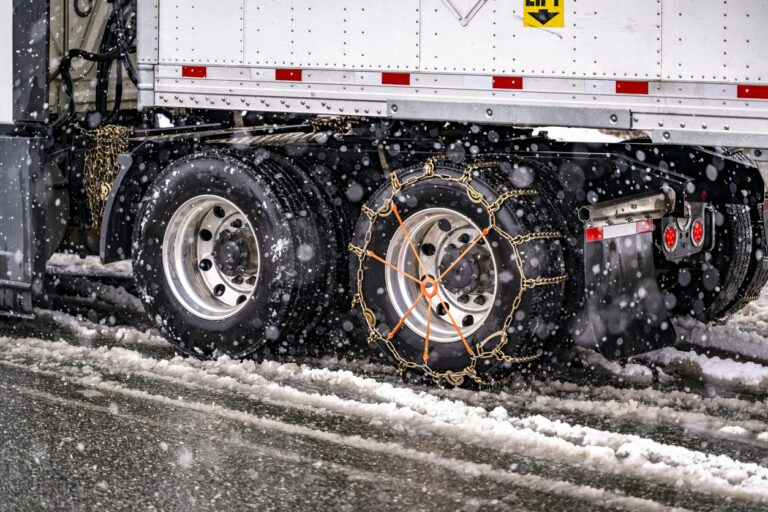
California does not require trucks to carry chains during any specified time period. When the weather hits, though, it takes at least eight chains for a standard tractor-trailer configuration to comply with the regulations.
During the winter months, there might be traction chain controls in the mountain areas. When these are established, drivers will see signs posted along the highway. These signs will also include the type of requirement, which will include one of the following:
- R1 – Chains, traction devices or snow tires are required on the drive axle of all vehicles except four wheel/ all wheel drive vehicles.
- R2 – Chains or traction devices are required on all vehicles except four wheel/ all wheel drive vehicles with snow-tread tires on all four wheels.
- R3 – Chains or traction devices are required on all vehicles, no exceptions.
Colorado
All commercial motor vehicle drivers must carry chains from Sept. 1 to May 31. This applies to vehicles with a combined weight of more than 16,000 lbs used in commerce or as transport for at least 16 passengers (including the driver) on public highways. The Commercial Motor Vehicle Chain Law is a requirement for all large vehicles to affix chains or alternate traction devices (ATDs) to all drive tires (up to four). Even though it has “commercial” in the name, the requirement is based on the Gross Vehicle Weight Rating (GVWR) or Gross Combined Weight Rating (GCWR) for the vehicle regardless of its use (private or commercial).
Penalty for non-compliance with winter driving restrictions:
Up to a $500 fine plus a $79 surcharge or, if the vehicles is stuck and blocking any traveled portion of the roadway the fine is $1,000 plus a $157 surcharge.
Commercial vehicles and buses have a larger footprint on roadways where chains are required.
CMVs must carry chains or ATDs on all the following roads regardless of current weather:
- I-70 west of milepost 259 (Morrison) to the Utah border.
- Colorado Highway 9 mile post 63 to milepost 97 (Frisco to Fairplay).
- Route 40 milepost 256 (Empire) to the Utah border.
- U.S. Route 50 milepost 225 (Salida) to the Utah border.
- U.S. Route 160 milepost 304 (Walsenburg) to the New Mexico border.
- U.S. Route 285 milepost 250 (Morrison) to the New Mexico border.
- All of U.S Route 550.
There are two levels CMV drivers should be aware of when driving in Colorado.
Level 1 — Single-axle combination commercial vehicles must chain up. Trucks must have all four drive tires in chains. When level 1 is in effect, all other commercial vehicles must have snow tires or chains.
Level 2 — When level 2 is in effect, all commercial vehicles are required to chain up the four drive tires.
hose required to chain 4 drive tires:
Those required to chain 4 drive tires:
- Straight Trucks: 4 tire chains, 4 AutoSocks, 4 tire cables 0.415 diameters or greater, auto chains, or sanders.
- Single Drive Axle Combinations: 4 tire chains, 4 AutoSocks, auto chains, or sanders. No cables are allowed.
- Tandem Drive Axle Combinations: 4 tire chains, 4 AutoSocks, 4 tire cables 0.415 diameter or greater, auto chains, or sanders. If chains are on the 2 outside tires of one drive axle, any tire cable may be used to cover 2 tires on the other drive axle. AutoSocks may be used to cover 2 tires on the other drive axle. AutoSocks and tire cables cannot be used together.
- Auto Transporters: 4 tire chains, 4 AutoSocks, 4 tire cables 0.415 or greater, auto chains, or sanders. Do not use chains if use places hydraulic lines at risk of damage (alternative traction devices (ATDs) may be used to mitigate the risk). Travel will be restricted if the vehicle is unable to chain.
Connecticut
Chains are permitted during hazardous weather from Nov. 15 through April 30. The chains can not be damaging to the highway’s surface.
Delaware
Drivers are permitted to use chains on highways from Oct. 15 through April 15.
Georgia
At any time the Georgia Department of Transportation may close or limit access to certain highways during inclement weather. If this occurs, signage will be placed to inform drivers that chains are required in order to proceed.
For commercial vehicles, chains must be placed on the outermost drive tires.
Idaho
Officials with the Idaho Department of Transportation can determine that it is unsafe to drive over Lookout Pass and Fourth of July Pass on Interstate 90, and Lolo Pass on Highway 12. If it is deemed unsafe, then drivers will be required to chain up a minimum of one tire on each drive axle and one axle at or near the rear.
Illinois
The use of tire chains are allowed when required for safety during a time of snow, ice or another condition that might cause slippery highways.
Indiana
The use of tire chains are allowed when required for safety during a time of snow, ice or another condition that might cause slippery highways.
Iowa
The use of tire chains are allowed when required for safety during a time of snow, ice or another condition that might cause slippery highways.
Kansas
The use of tire chains are allowed when required for safety during a time of snow, ice or another condition that might cause slippery highways.
Kentucky
No person shall use on a highway not covered with ice a vehicle with a chained wheel unless the wheel rests upon an ice-shoe at least 6 inches wide. When chains are used on rubber-tired vehicles, the cross chains shall be not more than three-fourths of an inch in thickness or diameter and shall be spaced not more than ten inches apart, around the circumference of the tires.
Louisiana
The use of tire chains are allowed when required for safety during a time of snow, ice or another condition that might cause slippery highways.
Maine
Vehicles cannot have tires with metal studs, wires, spikes or other metal protruding from the tire tread from May 1 through Oct. 1. Other than that the use of tire chains are allowed when required for safety during a time of snow, ice or another condition that might cause slippery highways.
Maryland
The use of tire chains are allowed when required for safety during a time of snow, ice or another condition that might cause slippery highways.
Massachusetts
Massachusetts prohibits the use of studded tires and chains between May 1 and Nov. 1 without a permit. The use of tire chains are allowed when required for safety during a time of snow, ice or another condition that might cause slippery highways.
Michigan
The use of chains is allowed for safety when snow, ice or other condition are present. If chains are used, they must not come in direct contact with the roads surface.
Minnesota
The use of tire chains are allowed when required for safety during a time of snow, ice or another condition that might cause slippery highways.
Mississippi
The use of tire chains are allowed when required for safety during a time of snow, ice or another condition that might cause slippery highways.
Missouri
No person shall operate any motor vehicle upon any road or highway of this state between the first day of April and the first day of November while the motor vehicle is equipped with tires containing metal or carbide studs. The use of tire chains are allowed when required for safety during a time of snow, ice or another condition that might cause slippery highways.
Montana
If the Montana Department of Transportation determines that highways are too dangerous for travel, they may establish the following recommendations on traction devices:
- Chains or other approved traction devices recommended for drive wheels.
- Chains or other approved traction devices required for drive wheels.
- Chains required for driver wheels.
Nebraska
The use of tire chains are allowed when required for safety during a time of snow, ice, or another condition that might cause slippery highways.
Nevada
It is unlawful for any person to operate a motor vehicle, whether it is an emergency vehicle or otherwise, without traction devices, tire chains or snow tires upon any street or highway, under icy or snowy conditions, when the highway is marked or posted with signs for the requirement of traction devices, chains or snow tires.
If a highway is marked or posted with signs requiring the use of traction devices, tire chains or snow tires, a motor vehicle or combination of vehicles must be equipped with:
Traction devices, tire chains or snow tires if it has a gross weight or combined gross weight of 10,000 pounds or less.
Tire chains if it has a gross weight or combined gross weight of more than 10,000 pounds.
New Hampshire
The use of tire chains are allowed when required for safety during a time of snow, ice or another condition that might cause slippery highways.
New Jersey
The use of tire chains are allowed when required for safety during a time of snow, ice or another condition that might cause slippery highways.
New Mexico
The use of tire chains are allowed when required for safety during a time of snow, ice or another condition that might cause slippery highways.
New York
The use of tire chains are allowed when required for safety during a time of snow, ice or another condition that might cause slippery highways.
North Carolina
The use of tire chains are allowed when required for safety during a time of snow, ice or another condition that might cause slippery highways.
North Dakota
North Dakota also allows metal studs within 1/16 inch beyond tread from Oct. 15 through April 15. The use of tire chains are allowed when required for safety during a time of snow, ice or another condition that might cause slippery highways.
Ohio
The use of tire chains are allowed when required for safety during a time of snow, ice or another condition that might cause slippery highways.
Oklahoma
The use of tire chains are allowed when required for safety during a time of snow, ice or another condition that might cause slippery highways.
Oregon
Oregon’s law applies to all highways in the state. Signs will tell drivers when they are required to carry chains and when they are required to use them. Drivers will need to have six chains on hand to comply in Oregon. The use of tire chains are allowed when required for safety during a time of snow, ice or another condition that might cause slippery highways.
Pennsylvania
The use of tire chains are allowed when required for safety during a time of snow, ice or another condition that might cause slippery highways.
Rhode Island
The use of tire chains are allowed when required for safety during a time of snow, ice or another condition that might cause slippery highways.
South Carolina
The use of tire chains are allowed when required for safety during a time of snow, ice or another condition that might cause slippery highways.
South Dakota
The South Dakota DOT has the authority to restrict travel on roads. Signs will alert drivers to these restrictions. The use of tire chains are allowed when required for safety during a time of snow, ice or another condition that might cause slippery highways.
Tennessee
The use of tire chains are allowed when required for safety during a time of snow, ice or another condition that might cause slippery highways.
Texas
The use of tire chains are allowed when required for safety during a time of snow, ice or another condition that might cause slippery highways.
Utah
When any designated highway is so restricted no vehicle shall be allowed or permitted the use of the highway, during the period between Oct. 1 and April 30, or when conditions warrant due to adverse, or hazardous weather or roadway conditions, as determined by the Utah Department of Transportation, unless:
An operator of a commercial vehicle with four or more drive wheels, other than a bus, shall affix tire chains to at least four of the drive wheel tires.
Vermont
Vermont has a traffic committee that will decide if use of chains will be required. The use of tire chains are allowed when required for safety during a time of snow, ice or another condition that might cause slippery highways.
Vehicles with semi-trailers or trailers that have a tandem-drive axle towing a trailer shall have chains:
- On two tires on each side of the primary drive axle, or if both axles of the vehicle are powered by the drive line, one tire on each side of each drive axle.
- On one tire of the front axle and one tire on one of the rear axles of the trailer.
Virginia
The use of tire chains are allowed when required for safety during a time of snow, ice or another condition that might cause slippery highways.
Washington
Any commercial vehicle over 10,000 pounds. Gross vehicle weight rating should carry chains from Nov. 1 to April 1 when driving on one of the following routes:
Blewett Pass
- SR-97 between MP 145 and Milepost 185
Chinook Pass
- SR-410 Enumclaw (MP 25) to SR-12 (MP 342)
Cle Elum to Teanaway
- SR-970 Cle Elum (MP 0) to Teanaway (MP 10)
Gibbons Creek to intersection of Cliffs Road
- SR-14 Gibbons Creek (MP 18) to intersection of Cliffs Rd. (MP 108)
Mt. Baker Highway (Ellensburg to Selah)
- SR-542 (MP22) to (MP 57)
- Interstate 82 from Ellensburg (MP 3) to Selah (MP 26)
Newhalem to Winthrop
- SR-20 Newhalem (MP 120) to Winthrop (MP 192)
Omak to Nespelem
- SR-155 Omak (MP 79) to Nespelem (MP 45)
Satus Pass
- SR-97 Columbia River (MP 00) to Toppenish (MP 59)
Sherman Pass
- SR-20 Tonasket (MP 262) to Kettle Falls (MP 342)
Snoqualmie Pass
- Interstate 90 North Bend (MP 32) and Ellensburg (MP 101)
Stevens Pass
- SR-2 Dryden (MP 108) to Index (MP 36)
White Pass
- SR-12 Packwood (MP 135) to Naches (MP 187)
West Virginia
The use of chains is allowed for safety when snow, ice or other condition are present. If chains are used, they must not come in direct contact with the roads surface.
Wisconsin
The use of chains is allowed for safety when snow, ice or other condition are present. If chains are used, they must not come in direct contact with the roads surface.
Wyoming
When the chain law is in effect due to snow, ice or other conditions, travel on a highway may be restricted to use only by motor vehicles utilizing adequate snow tires or tire chains.
There are two levels:
Level 1: When conditions are hazardous, travel can be restricted to vehicles equipped with tire chains, vehicles with adequate snow tires or all-wheel-drive vehicles.
Level 2: When conditions are extremely hazardous, travel can be restricted to vehicles equipped with tire chains or all-wheel-drive vehicles equipped with adequate mud and snow or all-weather-rated tires.
The operator of a commercial vehicle shall affix tire chains to at least two of the drive wheels of the vehicle at opposite ends of the same drive axle when the vehicle is required to utilize tire chains under this subsection.
Any driver that is in violation will face a fine of no more than $250. If the violation results in the closure of all lanes in one or both directions of a highway, the driver will face a fine of no more than $750.
States not included in this list do not have specific chain law regulations.

Dana Guthrie is an award-winning journalist who has been featured in multiple newspapers, books and magazines across the globe. She is currently based in the Atlanta, Georgia, area.