




While celebrating progress, most carriers wish recovery would happen more quickly.
After one of the longest freight rate droughts in trucking history, attendees at the Truckload Carriers Association’s (TCA) annual convention, held Feb. 28-March 3 in Orlando, Florida, were hungry for some positive news.
During the general session Monday morning, March 2, the crowd heard from Federal Motor Carrier Safety Administration Administrator Derek Barrs about the core values of trucking and the agency’s efforts to revamp the system. Click here to read the story.
State of Freight
Following Barrs’ address, the group quieted for an economic update from Bob Costello, chief economist for the American Trucking Associations (ATA).
Costello’s view of the current state of freight is positive — but cautious.
“We’re moving in the right direction. That’s why you’re starting to feel better,” Costello said.
“But I feel like it is also necessary to give you the full picture,” he continued. “And while we are absolutely moving in the right direction on supply, there’s not a ton of demand percolating up at this point.”
Capacity is dropping.
Capacity — the industry’s supply of trucks available to haul cargo — has been on the decline for the past year. Large carrier closings and acquisitions have made the news, but many smaller carriers have simply shut down, unable to survive years of low freight rates.
That lowered supply has begun pushing rates upward. However, without a corresponding uptick in freight to haul (demand), the recovery is slow. That leads to Costello’s first caution:
“What does this industry almost always do? When things start to be better, they start buying trucks,” he said. “And what I tell you is, I don’t think there’s going to be a lot more freight out there to support it, if everybody starts doing that.”
The economist displayed a chart showing Personal Consumption of Goods and Services contributions to Real GDP, published by the U.S. Bureau of Economic Analysis.
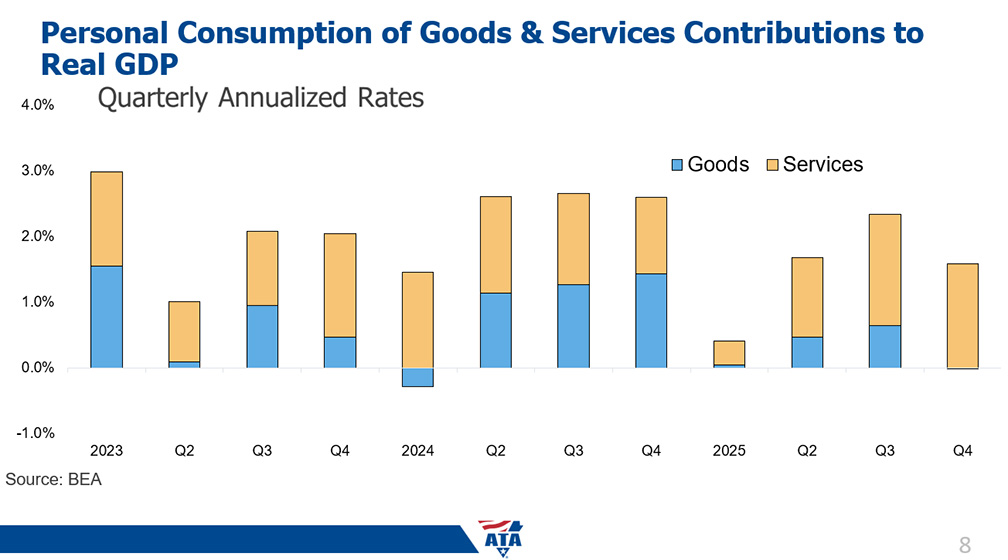
“The numbers aren’t too bad, actually, right?” he said, pointing out a GDP increase of over 2% for 2025. The chart clearly showed that most of the gains were from the services side of the economy.
“Remember, you’re not putting services in trailers,” he continued. “You’re putting goods in trailers. In the fourth quarter, notice goods did not add to GDP at all.”
Costello continued tempering the positives with caution.
Another slide showed U.S. Manufacturing Output Data published by the Federal Reserve. Again, the overall message was positive.
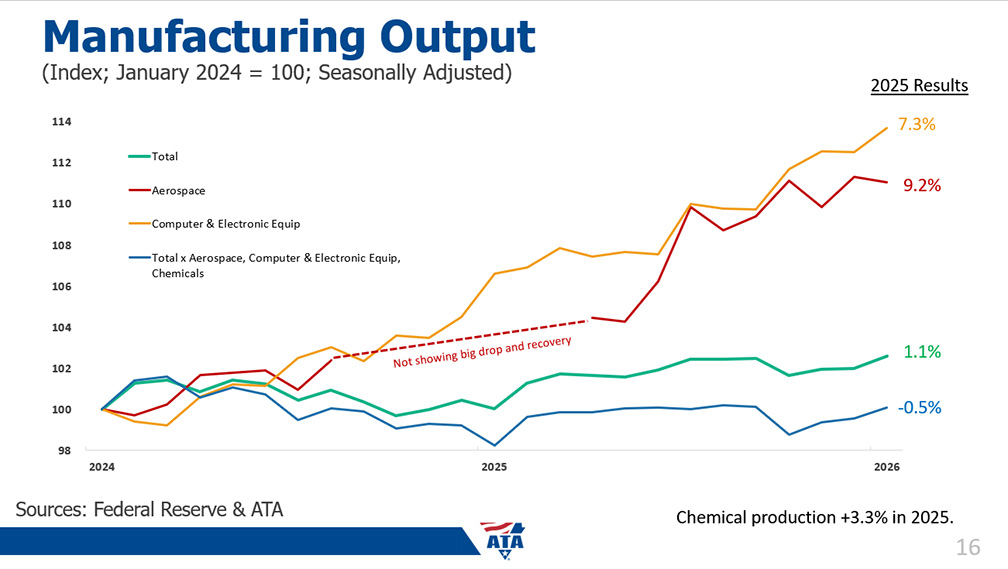
“In 2025 total manufacturing production, according to the Federal Reserve, increased 1.1%. OK, not great, but certainly not terrible,” Costello said. “But if you start peeling back the onion just a little bit, what you find is it was really attributable to three patterns.”
According to Costello, there were three segments of the economy that showed growth in 2025:
- Aerospace;
- Computers and electronics equipment; and
- Chemicals.
“If you’re in those three areas, good for you,” he said. “But if you take those three areas out of total production, guess what? It went down.”
Without those three segments of the economy, he said, manufacturing production actually declined by one-half percent.
“So you can certainly find some positive strength, but it is not across the board,” he concluded.
Fallout from tariffs had a significant impact.
Of course, tariffs were a large part of the picture in 2025, and Costello didn’t neglect the topic.
“Listen, we — all of us in this room — want free and fair trade,” he said. “It is not happening across the board, no doubt about it, but we are also the reality is we are at the highest level of tariff rates in the United States since the 1930’s.”
Referring the recent Supreme Court decision denying the Trump administration’s authority to impose tariffs under the International Emergency Economic Powers Act (IEEPA), he noted:
“We were at roughly 16%, but once we get the new stuff coming in out of the administration, we’re forecasting it to be closer to 14%. Most of those tariffs will be replaced, right?”
Costello explained how tariffs impact U.S. manufacturing.
“Fifty percent of what we import into the U.S. are to U.S. manufacturers that choose to manufacture finished goods here,” he said. “When those have a higher tariff rate, what happens to their competitiveness? What happens to their production?”
Federal rate increases have limited impact.
Much has been said about interest rates set by the Federal Reserve and the potential impact on housing starts and construction in general.
“I fully anticipate two more rate decreases this year that would put the Fed funds rate at 3%,” Costello said, but with another caution: “I also want you to remember the Federal Reserve changes the short-term interest rate — not long-term interest rates, not mortgage rates.”
If the economy is dependent upon spending for growth, then product prices will have greater impact than interest rates, he explained.
“(Consumers are) looking at the level of prices when they go to the store,” he said. “The level of the prices are still very high — up almost 28% since 2020.
Costello also pointed out that tariff-related price increases may have been delayed by pre-tariff inventory buildup, when retailers stocked up on products before tariffs became effective. With those inventories dwindling, higher prices are now hitting the shelves.
Unemployment statistics can be misleading.
Unemployment was next on Costello’s topic list.
“I’m putting less stock in the unemployment numbers,” he said, adding that those statistics are compiled using data obtained by calling U.S. households and conducting surveys.
He explained that employees who lose jobs often accept work from the gig economy to maintain income. Contracting to drive for Uber or to make food deliveries may be counted as “employed” in official calculations — but those people are operating on shoestring budgets, not spending and investing at their previous levels.
Freight recovery is slow — but it IS happening.
Finally, Costello spoke on trucking conditions, noting that freight rates have been subdued, “while costs have gone up significantly.”
“If I told you that the economy was contracted and inflation was going up at the same time, that’s a situation we call stagflation,” he explained. “That is the worst place to be. It’s exactly, as an industry, where we have been over the last few years.”
After discussing driver employment and cabotage by Mexico-based carriers, Costello wrapped up:
“Supply based recoveries are more difficult. It’s slower. It takes a while, but it is happening,” he concluded.

Cliff Abbott is an experienced commercial vehicle driver and owner-operator who still holds a CDL in his home state of Alabama. In nearly 40 years in trucking, he’s been an instructor and trainer and has managed safety and recruiting operations for several carriers. Having never lost his love of the road, Cliff has written a book and hundreds of songs and has been writing for The Trucker for more than a decade.