



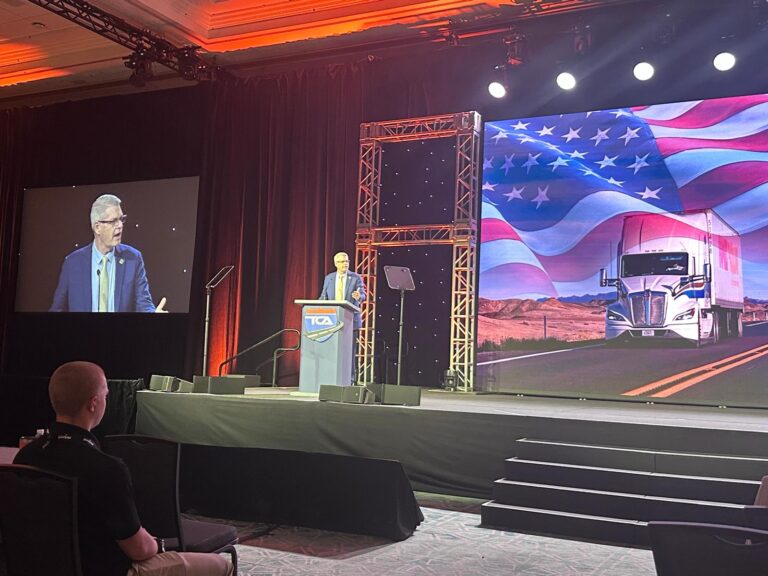
ORLANDO, Fla. — During the Truckload Carriers Association’s (TCA) annual convention, Federal Motor Carrier Safety Administration (FMCSA) administrator Derek Barrs addressed the attendees about the core values of trucking and how FMCSA is revamping the system.
“What are the values of your drivers? What are the values of your companies?” Barrs asked. “For me, it has to be faith. It has to be family. It has to be my community and responsibility and service.
“I have to live by those principles every single day as I go through and lead this organization,” he said of his mission at the FMCSA. “We have a lot of work to do. We’ve done a lot of work over the last few months, but that’s just the beginning of the things that we have planned and the things that we need to do to help clean up the mess that is inside this organ, inside this industry. And we all know that. But we have a great team that is working hard every single day to do that.”
Keeping America Moving
Barrs emphasized the importance of the trucking industry in keeping goods and services moving.
“You move freight that keeps store shelves stocked,” Barrs said. “It keeps stores stocked, factories running and families supplied. That responsibility is enormous and I thank you all so much for that.”
A Common Responsibility
Speaking to the drivers and companies in attendance, Barrs praised their dedication and highlighted the importance of safety.
“I want to thank you for your professionalism, your discipline and your consistency,” he said. “A safety culture, when taken seriously, produces measurable results. This drives what we need to see in every single organization.”
Protecting standards, he says, bring the various facets and sectors of the transportation industry together.
“Whether you’re running a fleet, managing compliance, leading a trade association or being a federal regulator, we share a common responsibility — protecting the lives of Americans on our roadways. For me, that responsibility is real,” Barrs said, adding that he’s experienced firsthand the impact of unsafe drivers on the nation’s roadways.
“Before coming to FMCSA, I spent more than 30 years in law enforcement, rising to the rank of chief of the Florida Highway Patrol,” he shared. “I’ve stood on highways in the middle of the night after the major event or a crash. I’ve seen the aftermath of that crash. And I’ve spoken to families like whose lives will change in an instant because of somebody’s stupidity.
“I’ve said this before and I’ll say it again: Those are things that you can unsee in your life,” he continued. “When I talk about reducing crashes, injuries and fatalities involving large trucks and buses — which is our mission at FMCSA — I’m not just speaking in general terms.”
It’s these experiences, Barrs says, that shapes his leadership of the FMCSA.
“It also shapes how I think about the partnerships with the industry that we have,” he noted.
“I know this: The overwhelming majority of professional drivers and carriers out here take that responsibility seriously as well. You operate with care, you represent your companies and you do it with pride,” he said. “But when standards are weakened … catastrophic things can happen. That’s why integrity matters.”
Fighting CDL Fraud
Barrs stressed that earning a commercial driver’s license (CDL) is an accomplishment that should not be taken lightly.
“We all understand — or we should understand — that your CDL actually should mean something,” he said, noting that “fly-by-night” training providers and less-than-reputable carriers give the entire industry a bad name.
“Your CDL should represent real training, real qualifications, real competency — and it must be issued in a way that is consistent resistant to fraud,” he said. And that brings me to several areas where FMCSA has taken deliberate action.”
English Language Proficiency
English Language Proficiency (ELP) is a key point being addressed by the FMCSA — specifically, the ability to read road signs, understand safety instructions and communicate effectively.
“When that standard is applied inconsistently, it creates risk not only to the public but also to the professional drivers operating along alongside someone who may not fully understand their critical instructions,” Barrs said. “And I can tell you, it’s difficult whenever you’re doing roadside inspections and (drivers) can’t understand what you’re saying.
“We are ensuring this requirement is applied as it is written and it is as it is intended — not selectively, not unevenly, but consistently,” he continued.
Non-Domiciled CDLs
Barrs also spoke on the issue of non-domiciled CDLs, noting that the FMCSA has noted inconsistencies in the way states issue licenses.
“Of course, that raised concerns about documentation, identity verification and whether federal standards were being applied uniformly across jurisdictions,” he said.
In response, the FMCSA is working to strengthen safeguards, clarify state expectations and reinforce verification requirements across the board.
“When loopholes exist, bad actors will find a way to get into them, as you all know,” he said. And when bad actors exploit the system, good carriers like yourself pay the price.”
“You all invest in compliance, you invest in training, you invest in safety technologies,” he continued. “The regulatory system must protect the investment by ensuring a level play in field. And that brings me to what we need to be talking about even more — entry level driver training.”
Investing in Safety and Entry Level Driver Training
The FMCSA requires all would-be CDL holders to complete standard entry-level driver training before they ever climb behind the wheel of a commercial vehicle — and that this training be conducted by a legitimate provider.
“But as we found out real quick after I got here, that’s a problem. Some providers were not meeting those standards. Some could not demonstrate that the training was even being delivered,” he noted.
“So we’ve removed over 7,000 providers from the training registry to date (as of March 2, 2026), and we have so many more,” he continued. “We are working right now on a consistent basis to remove these bad actors from our driver training schools.”
Can the FMCSA’s training provider registry be salvaged?
“To be honest with you, I would just as soon go through and just clear all of them out and start all over again,” he said. “We have a systematic problem here that we have to work through to ensure … we are putting the right drivers behind the wheel of commercial motor vehicles.”
Ensuring that CDL holders receive proper preparation and training is vital to laying the foundation for a safe, efficient trucking industry. To that end, Barrs says, professional drivers deserve real training, not just a paper certificate.
“Training is where professionalism begins; it’s the foundation,” Barrs said. “If the foundation is weak, the structure above it is also compromised.”
“Carriers deserve confidence that when they hire a newly licensed driver, the driver has been properly trained,” he said. “Everyone traveling on local American roads deserves assurance that when someone earns a CDL, it represents real competency.
“The truckload sector is too important to allow weak standards and there’s more work to be done,” he continued.
Registration Fraud
As recent headlines note, the FMCSA is confronting fraud on numerous levels of transportation, including the registration system.
“We’re addressing shell entities and chameleon carriers,” he said. “We are modernizing legacy data systems that were built decades ago. We were adapting to new technologies involving operational modes.”
It’s a monumental task.
“This is critical work. It is ambitious, it’s complex, and we are approaching it methodically; we’re doing this step by step” Barrs said.
Hours-of-service Pilot Programs
“Part of that modernization includes something that many (motor carriers) have asked for for years — and that’s greater flexibility for hours of service,” he noted.
To that end, the FMCSA recently launched two hours-of-service pilot program designed to evaluate whether additional flexibility can improve driver wellbeing and operational efficiency while maintaining safety.
The first pilot program will allow participating drivers to pause their 14-hour “on-duty” driving window for a period of ranging from 30 minutes to three hours.
“That could help drivers avoid congestion, wait on unsafe conditions or rest when fatigue without penalizing their clock,” Barrs said.
The second pilot explores additional sleeper birth options for drivers, allowing participants to break their berth time into either a 6/4 or 5/5 hour configuration.
Barrs noted that the pilot programs allows FMCSA to use real-world data to provide real-word solutions.
“This is responsible data-driven evaluation. We will collect and analyze safety and fatigue and operational data for participants to determine whether these flexibilities enhance driver safety,” Barrs said. “Here’s where I need (motor carriers to) help. We are currently recruiting 18 drivers for our initial phase of this effort.”
Of course, for drivers to accurately track their hours of service, it’s vital that the electronic logging devices (ELDs) they use be up to FMCSA standards. As with training providers, the agency is systematically evaluating each device on the registration list to ensure they meet all requirements.
“We’ve removed over 80 ELDS in the past six months that should not be on our system,” he said. We’ve had over 400 applications (for) new ELDs (to be added) the system. We’ve not allowed the first one into the system through our own internal vetting process (as of March 2, 2026).”
Looking Ahead
“I hope that you’ll get the point: We have a lot of work to do at FMCSA,” Barrs said. “I value and appreciate the partnership that we have with (motor carriers) as we drive this industry forward.
“We (must) take the bad actors out so the good can prevail. We cannot forget the good folks in this industry,” he continued.
While cleaning up the transportation industry will not be easy, Barrs stressed that there are many “good actors” in the system.
“Our enforcement efforts will be able to take the bad out so the good will rise, and the cream will come to the top. So thank you all very much for what you do for this industry and God bless you,” he concluded.

Dana Guthrie is an award-winning journalist who has been featured in multiple newspapers, books and magazines across the globe. She is currently based in the Atlanta, Georgia, area.