



Oil prices jumped to more than $100 a barrel again and Wall Street was appears to be following global markets lower Monday as the U.S. military prepared to blockade traffic to and from Iranian ports and the Strait of Hormuz, where most shipping has been stalled since the start of the war.
Futures for the S&P 500 and Dow Jones Industrial Average each fell 0.7% before the opening bell. Nasdaq futures slid 1%.
President Donald Trump announced the planned blockade after U.S.-Iran ceasefire talks in Pakistan ended without an agreement, and the U.S. military said the blockade involving all Iranian ports would begin Monday at 10 a.m. EDT, or 5:30 p.m. in Iran.
Iran immediately responded with threats on all ports in the Persian Gulf and the Gulf of Oman.
“Security in the Persian Gulf and the Sea of Oman is either for everyone or for NO ONE,” the Islamic Republic of Iran Broadcasting reported Monday. “NO PORT in the region will be safe,” according to a statement from the Iranian military and the Revolutionary Guards.
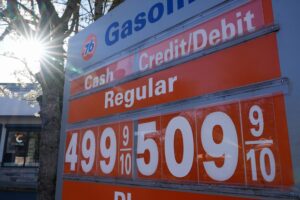
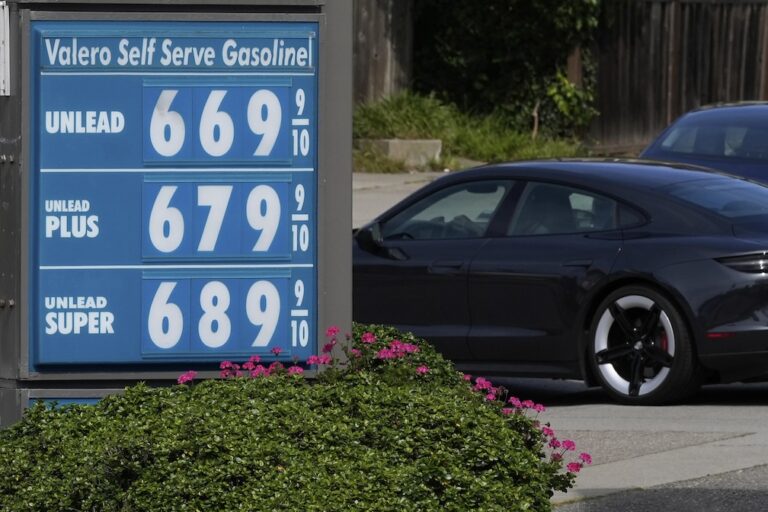
Oil prices have soared as shipping through the strait has essentially stalled since late February. Brent crude oil, the international standard, has gone from roughly $70 per barrel before the war in late February to more than $119 at times.
On Monday, benchmark U.S. crude jumped $7.69, nearly 8%, to $104.26 a barrel. That’s up 55% since the war in Iran began. Brent crude, the international standard, rose $7.02 or 7.4%, to $102.22 a barrel.
This week major U.S. banks will begin reporting quarterly earnings.
Goldman Sachs slid 4.3% despite reporting better-than-expected profit and revenue for the second quarter than Wall Street forecast. The New York investment bank said revenue from its fixed income, currency and commodities trading fell 10% from the first quarter.
Investors also have been wary of big banks’ exposure to private credit in recent months along with the uncertainty the U.S. and global economies face because of the Iran war and rising energy costs.
JPMorgan, Wells Fargo, Citigroup and Bank of America all report later this week, as do Johnson & Johnson, Netflix and PepsiCo.
Coming later Monday is the latest U.S. housing market data. Analysts are forecasting that existing home sales declined slightly from February to March after interest rates climbed five straight weeks to their highest level in seven months.
In Europe at midday, France’s CAC 40 dropped 1.1%, the German DAX lost 1.2% and Britain’s FTSE 100 slipped 0.7%.
In Asia, Japan’s benchmark Nikkei 225 lost 0.7% to finish at 56,502.77. Australia’s S&P/ASX 200 shed 0.4% to 8,926.00. South Korea’s Kospi dipped 0.9% to 5,808.62. Hong Kong’s Hang Seng slipped 0.9% to 25,660.85, while the Shanghai Composite was little changed, inching up less than 0.1% to 3,988.56.
Analysts said global trading was expected to remain turbulent for some time.
“The outcome of the talks was not really what people were hoping for, that’s for certain,” Neil Newman, Managing Director, Head of Strategy at Astris Advisory Japan, said in Hong Kong.
“As we stand here at the moment, it doesn’t look very nice. Certainly, the oil prices are a big concern.”

The Associated Press is an independent global news organization dedicated to factual reporting. Founded in 1846, AP today remains the most trusted source of fast, accurate, unbiased news in all formats and the essential provider of the technology and services vital to the news business. The Trucker Media Group is subscriber of The Associated Press has been granted the license to use this content on TheTrucker.com and The Trucker newspaper in accordance with its Content License Agreement with The Associated Press.