



The statistics are telling. According to the Federal Railroad Administration, 94 people have died so far in 2026 as a result of vehicle-train collisions. In 2025 there were 286 fatalities, and 262 in 2024. In the U.S., a person or vehicle is hit by a train every three hours, according to Operation Lifesaver, a rail safety organization.
All too often, these collisions involve commercial vehicles driven by people who don’t follow common-sense railroad crossing rules.
The professional driver brochure issued by Operation Lifesaver points out that a freight train traveling at 55 mph can take a mile or more to stop. In many cases, that’s farther ahead than the engineer can see over a hill or around a curve. While some collisions are caused by drivers who know a train is coming and think they can get across the tracks “in plenty of time,” many are the result of rigs getting stuck on the tracks when no train is in sight.
Basic safety rules at railroad crossings
Allow ample space.
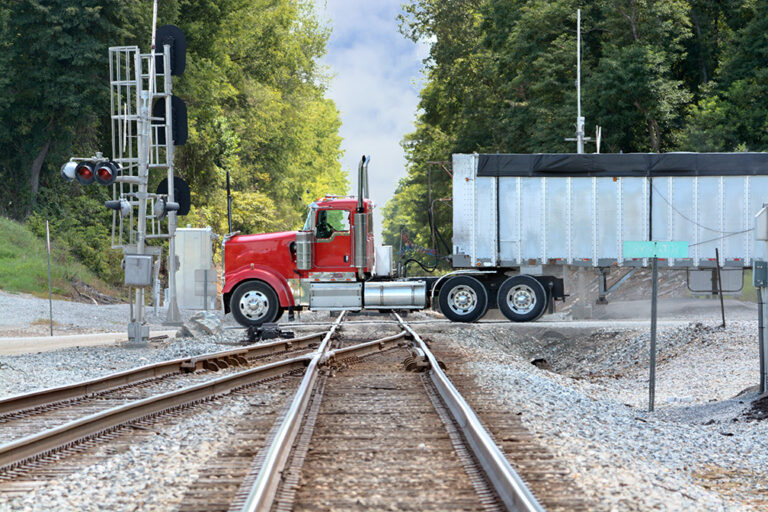
Starting across the tracks when there isn’t enough room on the other side to completely clear the crossing is a major cause of accidents.
If you can’t get completely across without stopping, don’t start across the tracks. Trains don’t care if you were there first. Wait, at least 15 feet from the tracks, until you can safely get your vehicle all the way across.
Trains are wider than the tracks, too, so make sure you leave 15 feet behind your trailer after you cross the tracks.
Don’t shift gears.
If you’re driving a truck with a manual transmission, don’t shift gears while crossing tracks. Crossings can be bumpy and missing a gear could mean a stop to restart the shift pattern, or the engine could stall. Remember that wet or icy crossings can cause a loss of traction, as can loose gravel or dirt on the roadway.
Consider clearance issues.
Another common railroad crossing issue for truckers is trailer clearance. Railroad considerations often take precedence at crossings. Trains can’t handle abrupt elevation changes as well as trucks can, resulting in a “hump” at many crossings where the roadway is lower.
Some trailers — like lowboys and drop decks — are closer to the ground and may not clear tracks that are higher than the road surface. It’s the driver’s responsibility to make sure their equipment can clear the tracks
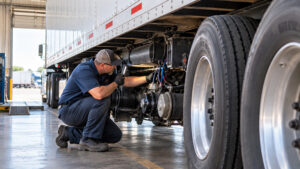
Another clearance issue involves the trailer’s landing gear. Drivers often don’t crank the trailer supports all the way up when hooking to a trailer. The clearance may be fine for running down the Interstate highway … but low enough to hang up on RR crossings.
According to the Federal Motor Carrier Safety Regulations, getting hung up on the tracks is an offense that can result in a CDL suspension of up to 60 days for the first offense. That’s a steep penalty for something caused by not giving the trailer landing gear a few more cranks.
Look carefully.
Some railroad crossings offer limited visibility. It may be impossible to look very far down the tracks to see if a train is coming. That’s why it’s necessary to look both ways as far as possible.
Don’t just look; listen.
Rolling down windows to provide better hearing can help you identify a train long before you can see it. Turn down the music, fans or any other noise that could mask the sound of a train. In cases of multiple tracks, a train on the near track can obscure another train on an adjacent track.
Make sure you can verify that no train is coming before driving onto the tracks. Many crossings use the yellow RR crossing sign far in advance of the actual crossing. That gives you more time to look and listen as you approach the tracks.
Be patient.
It’s easy to get impatient at railroad crossings. Every driver has sat at a crossing where the lights are flashing, the gates are down and a train isn’t even in sight yet — or the train is visible but moving at a very slow speed.
It’s tempting to go ahead and cross anyway. Don’t. The train could be going faster than you estimated, or there could be another train on another track.
Be aware of regulations.
Vehicles hauling hazardous materials are required to stop before crossing tracks. Failing to do so could result in a suspension of your CDL.
Never stop on the tracks.
Occasionally, the lights start flashing and the bells ringing while you are in the middle of a crossing. If it happens, never stop. Continue across the tracks until you are clear.
What to do in an emergency
If you do get stuck on the tracks, Operation Lifesaver advises drivers to immediately evacuate the vehicle and move away from it. Attempting to regain traction or waiting for help to arrive could cost your life.
Each crossing is equipped with an “Emergency Notification System” sign, typically in blue and white. IMMEDIATELY call the number on that sign if you are stuck. The sign should also have a location identification number that you’ll need to identify which crossing you’re on. You can call the same number to report other unsafe conditions, such as people or debris on the tracks or damaged signs or crossing signals.
The Operation Lifesaver webpage (oli.org) has educational materials, including posters, videos and comments from rail and trucking personnel. All are free for public use.
Pay close attention
For many professional drivers who spend most of their time on interstate highways and limited access roads, crossing railroad tracks is a rarity. That’s all the more reason to pay close attention when one is encountered.
- Avoid distractions at each crossing.
- Turn off the music and other noise and roll down windows.
- Make sure your vehicle has enough clearance and your trailer landing gear is cranked all the way up.
- If you see gouges in the pavement near the rails, it’s a sure sign that others before you have had difficulty clearing the crossing.
- Carefully look both ways, then look again
- When it’s safe to go, get all the way across before stopping.
Above all, keep in mind the most important statistic of all when it comes to truck-train collisions: The train wins 100% of the time.

Cliff Abbott is an experienced commercial vehicle driver and owner-operator who still holds a CDL in his home state of Alabama. In nearly 40 years in trucking, he’s been an instructor and trainer and has managed safety and recruiting operations for several carriers. Having never lost his love of the road, Cliff has written a book and hundreds of songs and has been writing for The Trucker for more than a decade.