For decades, the trucking industry has treated driver recruitment as a labor problem.
That’s true, but it is also a geography problem.
A carrier may need 40 drivers at a distribution center outside Dallas, 25 at a terminal in rural Georgia and another 30 at a facility in North Carolina. Yet the CDL schools capable of producing those drivers may be 30, 50 or 100 miles away — and recruiting students for an entirely different set of employers.
That geographic disconnect has quietly constrained the industry for years.
Traditional CDL schools are fixed assets. Carriers are not.
Freight networks expand, customers change, distribution centers open, manufacturing moves, and driver demand shifts from one market to another. But training capacity historically stays where someone happened to build a school.
FleetForce Truck Driver Training is changing that equation by making Entry-Level Driver Training deployable … nationwide.
Instead of asking carriers to find drivers near CDL schools, we bring CDL training to the carrier.
CDL training where the job actually exists
Our model begins with the carrier’s operation — not our campus.
FleetForce works with a carrier to determine where drivers are needed, how many are needed, the required hiring cadence and whether the best candidates already work inside the organization. We then design the training program around those requirements.
If a company has qualified warehouse associates, forklift operators, technicians or other incumbent employees ready for advancement, we can train them. If it doesn’t, we can build a sovereign pipeline fed by external recruitment.
FleetForce recruits aspiring drivers within the carrier’s market, screens them against mutually established employment criteria, and sends qualified candidates to the carrier for approval before we or carriers invest in training them. Once approved, FleetForce handles permitting, enrollment, ELDT-compliant instruction, skills preparation, testing and licensure before transitioning the newly licensed driver into the carrier’s finishing program.
The carrier isn’t forced to inherit whatever a nearby CDL school happens to produce:
It gets a pipeline engineered specifically for its operation.
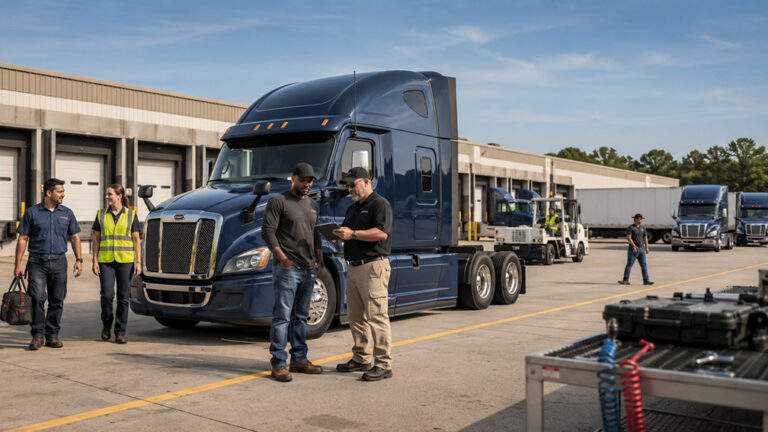
And the training can happen at the carrier’s own terminal or distribution center, using the equipment those drivers will ultimately operate.
That distinction matters. FleetForce’s on-site model was built around the idea that training can be integrated directly into an employer’s infrastructure rather than forcing the employer and its people to adapt to an external training provider.
Before we deploy, we find the labor
Bringing training to a carrier only solves half the geographic problem.
You still need to know whether or not the right candidates are there and where they live.
FleetForce has developed a proprietary market-assessment methodology that evaluates the density of aspiring commercial drivers at the neighborhood level. Rather than relying exclusively on generic unemployment statistics or broad workforce reports, we analyze where prospective drivers actually live.
Our model compares the socioeconomic and demographic characteristics of prospective markets against a dataset of approximately 20,000 students who have previously pursued CDL training with FleetForce.
The result is something much more useful than a traditional labor study: a geographic picture of where driver-development potential is currently concentrated.
Our Dallas-Fort Worth market analysis, for example, maps that opportunity across the metro area in individual square mile hotspot grids—allowing FleetForce to visualize meaningful differences in prospective-driver density even within the same metropolitan market.
That allows us to answer a fundamentally different question. It’s not simply, “Where can we open a CDL school?” It’s, “Where does this carrier need drivers, and is there sufficient aspiring-driver density surrounding that facility to create a sustainable pipeline?”
That is a far more powerful workforce-development tool. It is the perfect combination of supply-driven analysis and demand-driven deployment, and it is unlike anything else currently being executed at scale in CDL training.
From recruiting drivers to producing them
This represents a fundamental shift in the relationship between carriers and the CDL training industry.
Historically, carriers have competed downstream for a finite population of already licensed drivers. One carrier offers a signing bonus. Another increases mileage pay. Then another carrier steals the first carrier’s driver six months later.
Everyone spends more money. Nobody creates more drivers.
The Sovereign Pipeline model changes the point at which the carrier enters the process.
Instead of competing for the finished product, the carrier participates in creating it.
FleetForce has already demonstrated the power of this model at scale. Their work with Publix grew from the recognition that major employers often have talented people already working inside their distribution centers who lack an accessible pathway from their current position into the driver’s seat.
FleetForce now brings the CDL training infrastructure directly to private fleets across the nation.
For those who do not have existing team members to upskill, FleetForce now applies the same principle beyond the walls of the company: quantify employer demand, identify the geographic sub-markets where aspiring drivers live, recruit specifically for the carrier, vet candidates against the carrier’s standards, obtain approval to then train those future employees where the jobs actually exist.
The result is what we call a sovereign driver pipeline — a repeatable source of new drivers designed around a carrier’s geography, equipment, employment standards, and workforce requirements rather than the location or priorities of a traditional CDL school.
CDL training should follow demand
America doesn’t necessarily have a shortage of people willing to become professional drivers. In most markets, we have a shortage of accessible pathways connecting those people to the companies that need them.
FleetForce saw evidence of that years ago when more than 5,000 aspiring drivers responded to early collaborative training programs in Florida.
The opportunity now is to stop assuming that tomorrow’s drivers will somehow find their way to yesterday’s training infrastructure.
A distribution center shouldn’t be constrained because the nearest quality CDL school is 90 miles away. A carrier shouldn’t have to decide where it can grow based upon where training capacity already exists.
Training capacity should move to where the opportunity is.
That’s precisely how FleetForce is changing the game.
We can identify the market. We can find the people. We can qualify them against the carrier’s standards. We can deploy the instructors. We can train on the carrier’s property and equipment. And we can hand back licensed drivers ready to enter the carrier’s finishing program.
The industry has spent decades delivering freight to where America needs it.
FleetForce now delivers CDL driver training to where carriers need it. Visit fleetforcetruckdrivertraining.com, and reach out to see how FleetForce can get to work finding, qualifying and training drivers for you.
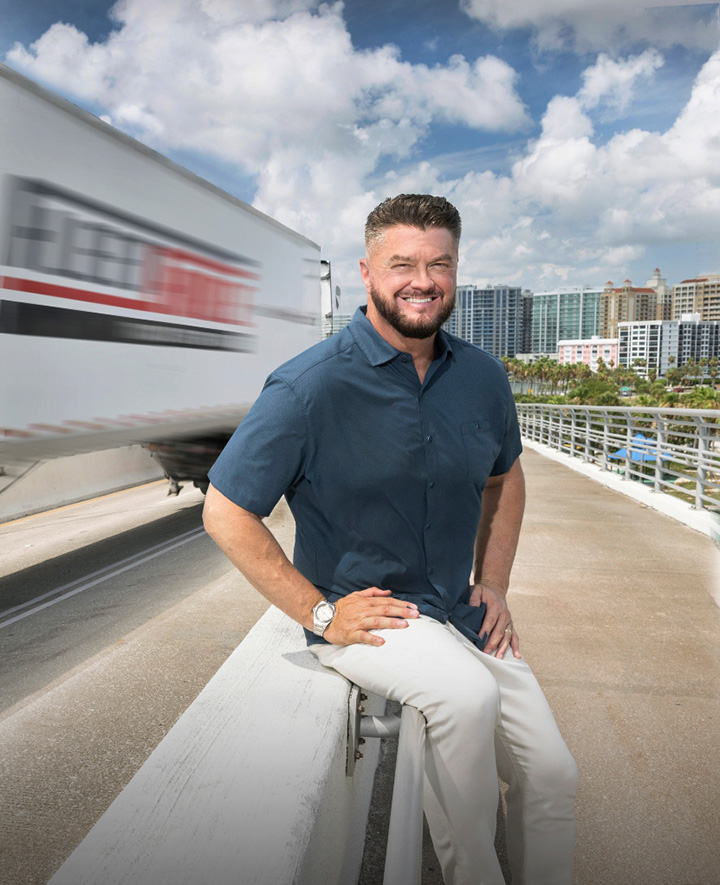
Tra Williams is the founder and CEO of FleetForce Truck Driver Training and ParkPro, two companies focused on solving critical workforce and infrastructure challenges in the trucking industry. He’s also the author of Boss Brain, he’s a nationally recognized speaker and business strategist, and he’s has been featured in publications including Forbes and Bloomberg. A graduate of the University of Georgia, Tra has spent his career building and scaling businesses and developing innovative solutions to complex industry challenges.