



Editor’s note: Since Dolly Parton’s death in August, numerous individuals and groups have suggested honoring Dolly every September 25 (9-2-5). It seemed only appropriate to share this tribute, written by The Trucker’s “Rhythm of the Road” columnist Kris Rutherford, on this date.
When Dolly Parton died Aug. 25, 2026, at age 80, one word stood out above all others in the many attempts to describe her legacy as an entertainment superstar: Inspirational.
“Dolly,” as she was universally known, impacted an industry of glitz and glamor with a country charm like few others. Despite the fame that came with her career, she did so with grace and a down-to-earth personality that resonated among her fans.
Whether Dolly was spinning a tale of growing up on a poor Tennessee farm or singing her heart out on a nationally televised football game halftime show, she did so with a pride and presence that had been built over decades of experience.
The limelight could not get enough of Dolly, and she answered with a desire to satisfy and give back to those who helped create the legend she became.
Humble beginnings
Dolly’s rise to fame from a poverty-stricken childhood in Appalachia is well chronicled both in story and song.
Her family, which included 11 brothers and sisters, was guided by her father Robert Lee Parton Sr., a sharecropper who could not read or write. Despite his lack of formal education, he managed to feed and provide for a large family on woefully little money.
Dolly’s mother served as the family’s musical influence, singing folk songs and hymns to her children, who helped raise one another in the hills of eastern Tennessee.
Later, Dolly would put the early years of her life to music in songs like “Coat of Many Colors” and “My Tennessee Mountain Home.” In fact, the more than 3,000 songs she is credited with writing often recall the trials and tribulations of a life that despite poverty was on the fast track to success.
Then came Music City
Then one day, after graduating high school, Dolly moved to Nashville, where she caught on as a songwriter. She quickly found success, co-writing a Top 10 country single and having her music recorded and performed by the likes of Hank Williams Jr., Skeeter Davis and Kitty Wells.
It didn’t take long for Porter Wagoner, a country superstar of the late 1960s, to recognize Dolly’s potential and sign her on to his television and road show. In fact, it was Wagoner who convinced RCA to sign Dolly to a recording contract, and several of her first successful singles were duets with her rhinestone-studded singing partner.
Eventually, she broke out on her own as a solo artist, by the mid-1970s producing songs like “Joshua,” “Jolene,” “Love is Like a Butterfly,” “The Bargain Store” and her signature song, “I Will Always Love You.”
She also continued songwriting, and artists across multiple genres recorded her music. Her own music crossed over into the pop realm in the latter half of the 1970s with songs like “Two Doors Down” and 1983’s “Islands in the Stream” (with Kenny Rogers) reaching the heights of the charts in both country and pop music.
While Dolly became a household name in music and television, by 1980 the big screen came calling.
From the stage to the big screen
Aside from writing songs for the movies, Dolly starred in several motion pictures including titles like “The Best Little Whorehouse in Texas” and — perhaps her best-known role — “9 to 5,” a movie whose success moved Dolly from the status of a widely known entertainer to beloved superstar.
Starring Dolly, along with Lily Tomlin, Jane Fonda and Dabney Coleman, “9 to 5” was a top movie of 1980, grossing over $100 million. Likewise, the theme song, which Dolly wrote and recorded, scored the trifecta, appearing at No. 1 on the country, pop and adult contemporary music charts.
Accolades for “9 to 5” ranged from an Academy Award nomination for its title song to two Grammys, with Dolly at the heart of it all.
Although the movie was set in the big city and its plot revolved around corporate working women, its theme resonated with viewers across the country. Perhaps some of Dolly’s childhood as the daughter of a hard-working sharecropper crept into her mind as she wrote the words to the theme song and performed her role as secretary Doralee.
Working people held a special place in Dolly’s heart, and they made up a huge segment of her astronomically growing fan base.
Dolly meant business
Dolly’s name became synonymous with “success.” Her ventures capitalized on her popularity as an entertainer, including “Dollywood,” the theme park near her childhood home in eastern Tennessee.
She saw rewards in the up-and-coming country music paradise of Branson, Missouri, with her “Stampede” dinner show venue, a venture that also spread to Myrtle Beach, South Carolina.
She partly owned a film and television production business that met with award-winning success. Dolly, it seemed, had a nose for business as well as entertainment. Virtually every venture she entered, whether solo or as a partner, had its day in the sun.
Even her literacy campaign, “Dolly Parton’s Imagination Library,” through which millions of free books are sent to children from birth to age 5, flourished as each registered child received a new book in the mail every month.
And for homeowners, Dolly even entered business with a signature line of foods and decor available at prices the average working family can afford.
A friend to truckers
When it came to trucker country, Dolly didn’t record truck driving songs; few would even be categorized as “road songs.” Even so, it wouldn’t be an understatement to say that her singles and albums provided a soundtrack for millions of hard-driving trucking miles.
With 25 No. 1 country singles, scores of other charted songs and dozens of albums, the sheer volume of material Dolly created during her career is staggering. Whether on FM or satellite radio or in personal playlists, Dolly is a mainstay of the highways from coast to coast — and she will no doubt remain that way for decades to come.
But it wasn’t until recently that truck drivers learned just what a good friend they had in Dolly Parton.
In what turned out to be her last in-person public appearance, Dolly opened a new travel stop — possibly the first of a chain — just south of Nashville.
Dolly’s Tennessean Travel Stop, located in Cornersville, Tennessee — just off Interstate 65 at exit 22 — opened in June of this year. “Dolly’s” caters to truck drivers, in addition to other travelers. The travel center features 25,000 square feet of space and is open 24/7. Truckers are welcomed with lounges, showers, laundry facilities, trucker-related supplies and even EV charging stations.
If Dolly’s Tennessean Travel Stop catches on, truckers will always be reminded that Dolly supported and respected their work, just as she did millions of other working Americans.
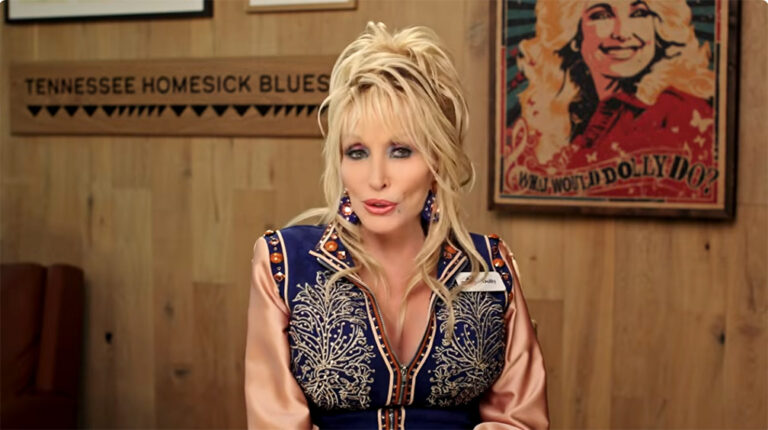
In a previously unseen video, recorded during Dolly’s June appearance and released by Dolly’s Tennessean Travel Stop to celebrate National Truck Driver Appreciation Week (Sept. 13-19, 2026), Dolly explains her deep appreciation for members of the trucking industry.
If you’d like to hear the jingle Dolly wrote and recorded for the travel stop, click here.
Always one of us
With Dolly’s death, the entertainment industry has lost an icon.
But America has lost even more.
Away from the spotlight, Dolly had a reputation for being as down-home, friendly and upbeat as she was on stage, and tales of greeting fans with her country charm are countless. Many have sung her praises for never losing touch with her fan base despite her fame. She was willing to pose for a photo or sign an autograph, whether on the Strip in Vegas or an escalator in a Nashville shopping center.
Dolly, it seemed, was always one of us, and we could see our own swagger in her endless appeal. After all, if a poor mountain girl could reach the pinnacle of success, what should keep the rest of us from doing the same?

Since retiring from a career as an outdoor recreation professional from the State of Arkansas, Kris Rutherford has worked as a freelance writer and, with his wife, owns and publishes a small Northeast Texas newspaper, The Roxton Progress. Kris has worked as a ghostwriter and editor and has authored seven books of his own. He became interested in the trucking industry as a child in the 1970s when his family traveled the interstates twice a year between their home in Maine and their native Texas. He has been a classic country music enthusiast since the age of nine when he developed a special interest in trucking songs.