



Defense Against the Cyber Dark Arts, Part 2
This is Part 2 of a three-part series: Defense Against the Cyber Dark Arts. Click here to read Part 1.
Solitude is a fundamental aspect of trucking. You may enjoy independence, your view of the country as you roll by and the feeling of satisfaction for a job well-done. Still, it’s lonely out there on North America’s highways.
Thankfully, mobile phones have given you the ability to connect no matter where you are at the time.
But imagine this:
A direct message hits your social media chat feed. The message asks if you went to the same high school that they did.
Regardless of your answer, they give you a thumbs up or heart emoji. Then, a few minutes later you get another message asking about you and what your profession is. You may tell them you’re a professional trucker.
A couple of days later, in the early morning hours you get another message from them. They mention that they also work weird hours, saying that work that night is slow and they are bored. They appreciate your company, no matter how remote you two are physically.
The conversation continues, mutual jokes are shared and plans to meet are set up — though unfortunately both of your schedules change so often that every planned get-together is canceled.
Then one day your new friend calls and asks you to send $20 so they can buy gas to get home. The next time they tell you about a class they took about investing in crypto and wonder if you want to get in on the action. They’ll even take care of the details while you drive.
You’ve just been introduced to the “romance baiting” scam.
In Part 1 of this series, we looked at the “distressed relative” scam, a short con built on panic that plays out in minutes.
This scam, on the other hand, requires time. It builds trust over weeks or months, and when the trap finally springs, the scammer can take everything you’ve saved.
The numbers are staggering.
According to the FBI’s 2025 Internet Crime Report, Americans reported losing $929 million to confidence/romance scams last year.
That figure is dwarfed by cryptocurrency investment fraud, which is where many of these “relationships” end up. More than 61,000 complaints report a total of $7.2 billion in reported losses. And according to the Federal Trade Commission, almost 60% of romance scam losses began on social media.
Truckers can be especially vulnerable to this scam.
The nature of life on the road can make professional drivers particularly attractive targets for scammers. Several factors can make it easier for criminals to establish contact, build trust and eventually gain access to a driver’s money.
• Loneliness. You spend weeks away from home. A friendly voice or a daily text can start to feel like a lifeline.
• Odd hours. You’re awake at 3 a.m. So are the scam operations based in Southeast Asia, where it’s the middle of the afternoon.
• Unknown numbers are normal. Brokers, shippers and receivers call and text you from numbers you’ve never seen. A “wrong number” usually won’t raise alarms.
• Your savings. Truckers work hard to build a nest egg for retirement or a truck of their own. That is exactly what the scammer is after.
How does it work?
Step 1: The chance meeting
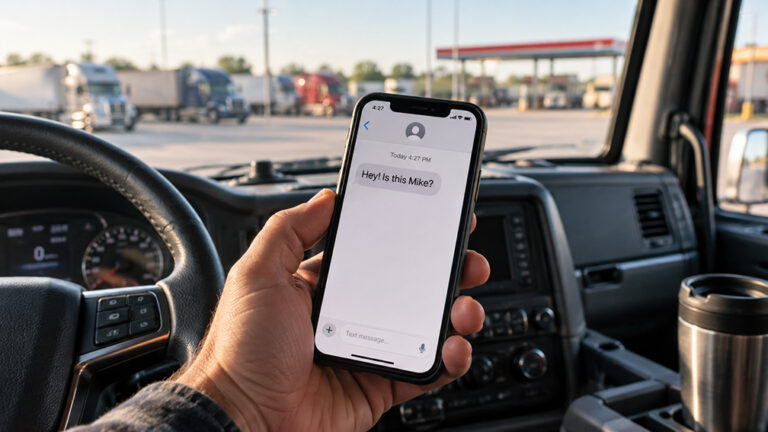
Contact starts with a “wrong number” phone call or text, or perhaps a friend request, a dating app match or a comment in a trucking group on social media. If there’s a photo in their profile, they’re generally attractive and close to your age. These are either artificial intelligence (AI) generated or simply stolen from a real person’s profile.
Step 2: The courtship
Weeks of regular contact follow, first on the public social media message boards; then there’s a move to private encrypted messaging apps like WhatsApp, Telegram or Signal. There’s always a reason not to video chat or meet in person — job schedule conflicts, a broken camera, a sick relative.
Step 3: The opportunity
Your new friend might ask for a small amount of money. Then they want to pay you back by helping you make money through a trading app or website that they recommend.
Step 4: The hook
You start small. The “investment” platform shows impressive gains, and you may even be allowed to withdraw a small amount of money from your burgeoning trading account, which convinces you it is real. So, you invest more, with even greater apparent returns.
Step 5: The harvest
Finally, it’s time to buy your truck or some other high-dollar item. You decide to use your investments, so you try to cash out. First, you’re told that your account has grown beyond a certain value and that you’ll need to pay taxes or additional fees before you can withdraw your money.
Importantly, all of that must be done before you get your money. Since your investments did so well, this demand sounds reasonable — so you pay. Eventually your patience wears out … and then both the platform and your new friend vanish.
Often a sixth step follows
Someone contacts you claiming they can recover your lost money — for a fee. It’s the same criminals coming back for a second helping.
So, what can you do?
The good news is that knowing how these scams work can help you spot the warning signs before you lose money. A few simple precautions can help protect both your personal information and your hard-earned savings.
• Don’t answer “wrong number” texts. Don’t reply at all. Block the number and report it as spam. Then delete it and forget it.
• Be wary of contacts on social media. Social media is intended to connect people, especially dating apps. Take a few extra steps to verify the information on your new friend’s social media profile.
• Insist on a live video call or a meeting in person. If there’s always an excuse why it can’t happen, consider it a warning sign. Keep in mind that even video calls can be manipulated using AI.
• Check their photos. Do a reverse image search with tools like Google Lens or TinEye to find out if the pictures on their social media site belong to someone else.
• Watch for the deadly combination. Someone you’ve never met in person who brings up investing or cryptocurrency is the biggest red flag of all.
• Never use an app or website an online friend sends you. If you want to invest, research the platform yourself and talk to a licensed financial professional you’ve met face to face.
• It’s your money. Don’t pay to withdraw it. Legitimate investment platforms don’t hold your funds hostage.
• Don’t keep secrets. Scammers want the relationship and the investment kept quiet. Tell someone you know and trust about your new friend. They might help you come up with some good questions to ask.
What if you’re already caught?
Stop sending money. Save any messages, crypto wallet addresses and transaction records. Contact your bank or credit union right away to cancel pending transactions. Report the scam to the FBI at ic3.gov and to the FTC at ReportFraud.ftc.gov. Ignore anyone who reaches out to you to recover your money for a fee.
Scammers call this con “pig butchering” — the deliberate “fattening up” and eventual “slaughter” of the target — and that term is intended to insult people. Don’t be ashamed. You were targeted by professional criminals who work from scripts refined on thousands of victims.
The most important thing you can do is recognize the pattern and share what you learned with your fellow drivers. If a buddy at the fuel island mentions the online sweetheart who’s teaching them to trade crypto or investing online, say something. That conversation may save them a lot more than money.
This is Part 2 of a three-part series: Defense Against the Cyber Dark Arts. Check back next month for Part 3.

Ken Heskett is a cybersecurity engineer at the National Motor Freight Traffic Association Inc. (NMFTA).
Ken collaborates closely with industry partners, academic institutions and government agencies to strengthen cybersecurity practices and knowledge sharing across the transportation sector.
He holds the Certified Information Security Auditor (CISA), Certified Internal Auditor (CIA), and Certified in Risk Management Assurance (CRMA) designations, and is a regular presenter at cybersecurity conferences and contributor to professional journals.
Ken brings more than 30 years of experience in leadership, risk management, IT operations, IT Audit and project management to his work as a cybersecurity engineer. He combines ethical leadership and hands-on experience with a risk-informed approach to provide practical recommendations to build and preserve business value while implementing cybersecurity best practices.