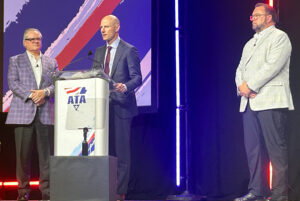




This year’s TCA Call on Washington set new records for both number of meetings (146) and TCA member participation (117). While 23 members from the Senate and House of Representatives attended the meetings, many more legislators were represented by members of their staff, as well as representatives of various federal agencies.
“The Call on Washington puts TCA on the roadmap in terms of talking about our biggest issues,” said Dave Heller, TCA’s senior vice president of safety and government affairs.
Among TCA’s top priorities was supporting the Federal Motor Carrier Safety Administration (FMCSA) and its recent efforts to strengthen enforcement. The agency has cracked down on driver English language proficiency (ELP) rules, issuance of non-domiciled CDLs, non-compliant CDL trainers and schools, and other issues, with a goal of strengthening existing regulations and stepping up enforcement.
“It’s no secret that the agency is doing a great job,” Heller said. “We want to be able to support them, give them the resources to continue doing that job.”
Holding the line
Another familiar issue returned to the forefront: Proposals to allow heavier trucks on U.S. highways.
“It was playing defense for the proposal for 91,000 pound vehicles on six axles,” he said. “In our segment of the industry, it’s a non-starter.”
One reason for TCA’s opposition to heavier six-axle trucks is the constant need for infrastructure improvement.
“It’s what we see on our highways every day. We’ve got issues like infrastructure that needs dramatic investment for repair in this country. We don’t want to degrade that infrastructure even further by putting out heavier equipment,” Heller said. “It makes sense to make sure that our infrastructure can reach new heights and can maintain our current freight needs.”
Paying for progress
Keeping the nation’s highways in good repair takes money, and finding a fair way to pay for those improvements remains a challenge.
“The Highway Trust Fund is underfunded to the needs of this nation, so we’re always going to have those conversations,” Heller said. “We need a funding mechanism that makes sense for everybody and is equal for everybody.”
As vehicle mileage has improved and alternative vehicle power systems, such as battery electric, have become more popular, fuel taxes have not been adapted to include owners of the new vehicle types. The Build America 250 Act, introduced in May and not yet enacted, calls for user fees on electric vehicles, “so your Toyota Priuses would have to pay something, which they currently do not,” Heller said.
For TCA, the solution starts with a funding system that spreads the cost fairly among highway users.
“Right now, building on a Fuel-Based User Fee, (FBUF) or Gallons-Based User Fee (GBUF) makes the most sense,” he said. “It’s equitable. It’s pay as you go, so it’s timely. You don’t have to have any up front costs, and it would certainly help support the Highway Trust Fund, because it needs it.”
Explaining that cash transfers from the nation’s general fund are an ineffective way to address infrastructure funding, he said, “You can’t rely on that to have a funding mechanism that’s meaningful.”
Testing takes time
More than a decade after Congress addressed hair testing for controlled substances, the trucking industry is still waiting for federal approval of its use and a way to report positive results to FMCSA’s Drug and Alcohol Clearinghouse.
“We still have to talk about hair testing, still need to bring the timeline forward,” he said. “It appeared in the FAST Act 11 years ago, yet the industry still does not have the ability to put positive results in the Clearinghouse.”
Drivers make their case
Lawmakers also heard directly from some of the people most affected by transportation policy: TCA’s 2026 Professional Drivers of the Year.
“There are no better ambassadors to this industry than TCA’s Professional Drivers of the Year,” he said.
“When they go to Capitol Hill, they certainly get the attention of those that legislate, and this year was no different. They continue to attend and continue to be instrumental in helping explain the TCA position on the issues,” he continued. “Their experience of actually being on our nation’s highways provides a perspective that decision-makers respect.”
Politics and priorities
Although the upcoming midterm elections weren’t on the Call on Washington agenda, the possibility of a shift in congressional leadership raises questions about the future of TCA-backed initiatives.
“When you read the tea leaves, there could be some change in the wind,” he said. “For instance, if you look at the Senate race in Texas, it basically tells a story with a Democrat actually pulling ahead of the Republican Party there.
“There are definitely changes that could result. The power base could change dramatically for the next Congress, especially in the House,” he continued. “It’s anybody’s ball game.”
While some of the players may change, Heller says TCA’s mission remains the same.
“We will always remain committed to working with any member of the House and Senate, regardless of who wins the election and where they are,” he said.
“In our industry, infrastructure and delivering freight consistently remain bipartisan issues. Transportation and infrastructure don’t necessarily follow party lines,” Heller continued. “There are no Democrat bridges or Republican roads, so we’re neutral when it comes to party favoritism. We have to work with everybody involved to make sure that we get things done correctly for our industry, regardless of who has the power in the House and Senate.”
Regardless of which party controls Congress, Heller believes the trucking industry’s voice will continue to carry weight on Capitol Hill.
“Everybody recognizes the value that our industry has and brings to the table when supporting this nation’s economy,” he said. “We’ll make certain that everybody can get behind what we really need to do. I think history will demonstrate that. We’ll continue to demonstrate that.
With a growing number of TCA members participating in each Call on Washington — including carriers, shippers, industry experts and current TCA Professional Drivers of the Year — Heller’s team will have plenty of help on The Hill.
This article first appeared in the November/December 2026 print edition of Truckload Authority, the official publication of the Truckload Carriers Association.

Cliff Abbott is an experienced commercial vehicle driver and owner-operator who still holds a CDL in his home state of Alabama. In nearly 40 years in trucking, he’s been an instructor and trainer and has managed safety and recruiting operations for several carriers. Having never lost his love of the road, Cliff has written a book and hundreds of songs and has been writing for The Trucker for more than a decade.