




On May 21, 2026, the House Transportation and Infrastructure Committee met to mark up the newly released Build America 250 Act, the long-awaited five-year Surface Transportation Reauthorization bill that the transportation industry has anticipated for more than a year.
The legislation included several significant victories for the trucking industry. Among them were meaningful investments in truck parking initiatives and long-sought language allowing hair testing results to be incorporated into the Drug and Alcohol Clearinghouse. For more information about the act as a whole, along with insights from the Truckload Carriers Association’s (TCA) government affairs team, click here.
Weight Limit Provisions
However, the markup also included several amendments to increase federal truck weight limits, many of which were approved by the committee.
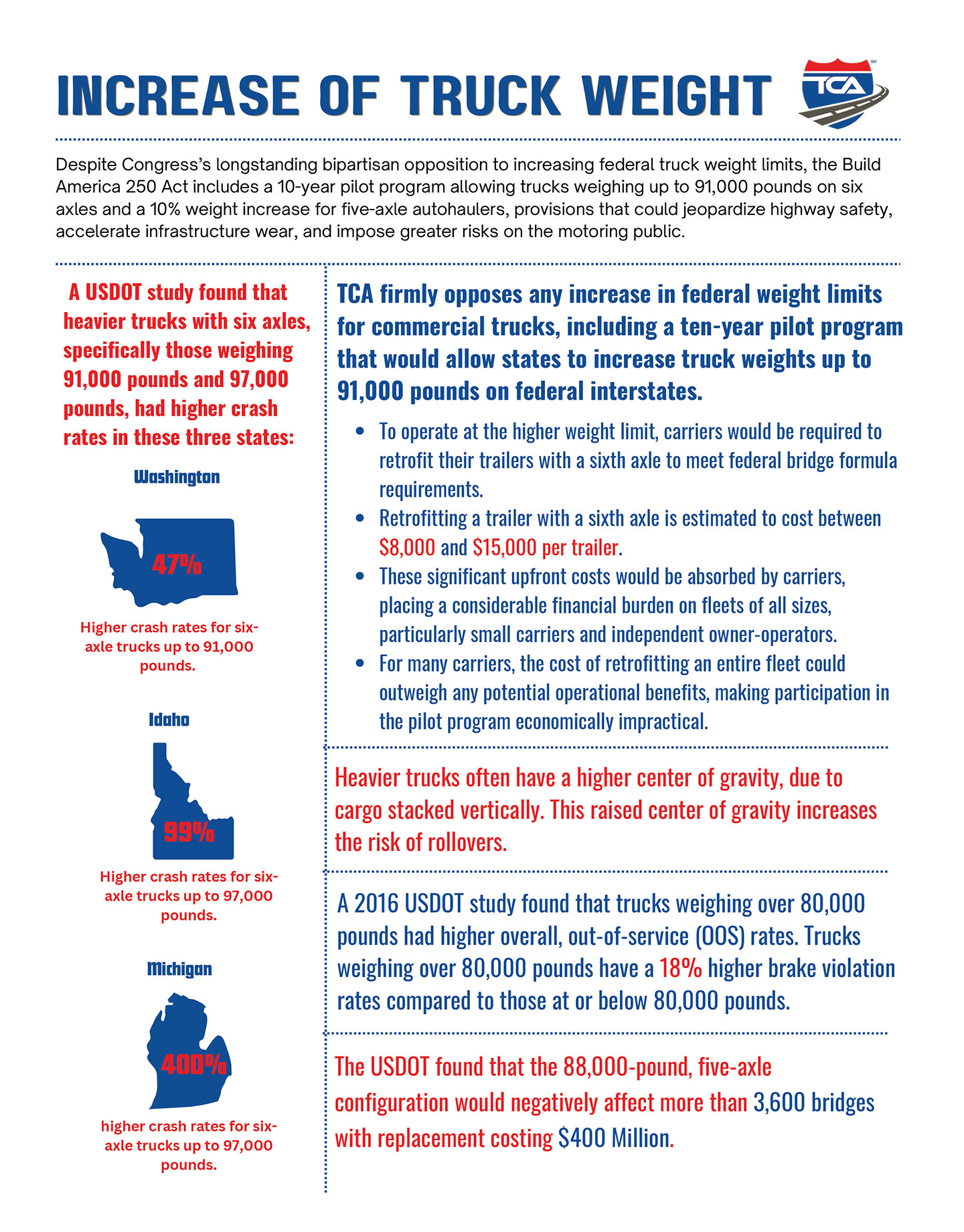
The amendment that drew the most attention was Rep. Dusty Johnson’s (R-SD) proposal to establish a pilot program for 91,000-pound, six-axle trucks. The amendment passed and would permit an unlimited number of states to raise interstate truck weight limits from the current federal standard of 91,000 pounds on six axles to 91,000 pounds on six axles for up to 10 years.
Although supporters characterize the proposal as a “pilot program,” many in the trucking industry view it as a major step toward permanently increasing federal truck weight limits. A decade-long pilot involving potentially dozens of states would likely normalize operations at 91,000 pounds, making it difficult to return to current standards once the program concludes.
For many TCA members and other carriers across the country, this generates serious concerns about cost, competitiveness, and operational impacts.
Financial Impact
The financial cost alone could be significant. If heavier weight limits are adopted, carriers may be forced to retrofit existing trailers with a sixth axle, an expense estimated at $3,000 to $10,000 per trailer for parts and professional installation. For large fleets, these costs could quickly add up to millions of dollars. For small and mid-sized carriers operating on thin margins, the investment may be unaffordable.
For many carriers, this concern is not hypothetical. Some TCA members remember the changes that followed the 1982 Surface Transportation Assistance Act, when the industry began transitioning to 53-foot trailers.
While the move may look routine today, it required major investments at the time. Companies had to purchase new equipment, adapt their operations and absorb high costs. Not every carrier could afford to make that transition. Some were forced to shut their doors, while others struggled for years to recover from the expense.
That history is one reason many carriers are wary of proposals to increase truck weights to 91,000 pounds. While larger carriers may have the resources to adapt, smaller fleets could face difficult financial decisions to remain competitive.
Organized Opposition
Leading the opposition to higher federal truck weight limits is the Coalition Against Bigger Trucks (CABT). Despite its name, the coalition is a broad, diverse alliance of stakeholders committed to maintaining current federal truck size and weight standards.
CABT’s membership includes trucking organizations such as TCA, the Owner-Operator Independent Drivers Association (OOIDA) and the International Brotherhood of Teamsters, as well as representatives from the rail industry, local governments, law enforcement organizations and transportation safety advocates.
Following the House Committee’s approval of the 91,000-pound pilot program, CABT and its members, including TCA, are now focused on the Senate.
The coalition will work closely with Sen. Roger Wicker (R-MS), who has consistently opposed increases in federal truck size and weight limits, to ensure similar language is not included in the Senate’s bill. Together, the coalition, TCA, and Wicker will continue to deliver a clear message to lawmakers:
When it comes to truck size and weight, Congress should say no to bigger trucks and focus on policies that support safety, infrastructure preservation and a competitive trucking industry.
This article first appeared in the September/October 2026 print edition of Truckload Authority, the official publication of the Truckload Carriers Association.

Hailey Betham serves as the manager of government affairs for the Truckload Carriers Association (TCA), where she leads the association’s federal and state legislative and regulatory efforts. In this role, Hailey is responsible for interpreting and communicating critical trucking-related regulations — including safety, labor and environmental policies — to TCA’s membership and congressional stakeholders on Capitol Hill.
Hailey regularly drafts and submits public comments on federal rulemakings, ensuring the voice of the truckload industry is heard and reflected in policy decisions. She also serves as the staff liaison on all matters related to the U.S. Department of Transportation (USDOT) and other key federal agencies. A core focus of her work is on independent contractor (IC) policy, an area she has consistently championed throughout her career.
Hailey’s work is rooted in her experience engaging with local, state and national communities. She has used her experiences and community engagement as her backbone to push legislative goals at the state and federal levels. Because of this, she has well-rounded expertise in grassroots organizing, PAC fundraising, political campaigns and lobbying at the state and federal levels.
She describes herself as a compassionate, assertive and determined individual who thrives off the energy of others.
Hailey earned her bachelor’s degree in political science from Cabrini University. Hailey is married to her husband, Michael, whose family has deep roots in the trucking industry. Together, they have two happy kids, Reagan and Reid. Outside of work, you can find Hailey hiking, reading a good book or just spending time with her family.