




In May the House Transportation and Infrastructure Committee unveiled a massive bipartisan piece of legislation known as the BUILD America 250 Act.
With trucking companies and drivers laser-focused on how this piece of legislation could impact business, we sat down with the Truckload Carriers Association’s (TCA) government affairs team. Dave Heller, senior vice president of safety and government affairs, and Hailey Betham, manager of government affairs, shared an insiders’ view of the bill.
The BUILD America 250 Act — the full name is Building Unrivaled Infrastructure and Long-term Development for America’s 250th Act — emphasizes moving people, goods and freight safely and efficiently across the country.
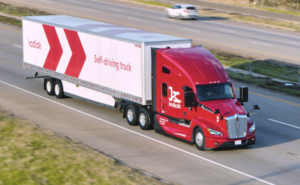
The bill provides the largest-ever investment in America’s bridges, focuses on proven surface transportation infrastructure programs, provides passenger rail investments and reforms, improves rail safety, ensures that transportation projects and programs are more efficient, encourages innovation, and provides the first-ever autonomous commercial motor vehicle framework.
The bill also strengthens the Highway Trust Fund by ensuring all highway users pay their share for the use and improvement of the nation’s roads. As a result, the BUILD America 250 Act injects the Highway Trust Fund with its first new stream of revenue for infrastructure in over three decades.
Infrastructure and parking
“There are a lot of really good things in this bill that we like quite a bit,” Heller said, pointing to the $580 billion allotted for infrastructure.
“That’s a large amount of money that you don’t carry in your wallet. We’ve got to fix our roads and bridges, and we have to make it a first-class driving experience for the drivers out there,” he said. “That’ll go a long way to doing so.”
BUILD America 250 designates $750 million to fund truck parking.
“Safe, available parking has been a huge issue for drivers across this country, and $750 million is a lot of money to help fix this growing problem,” Heller said.
Hair follicle testing
Heller and Betham agree that the inclusion of hair follicle testing results in the Drug and Alcohol Clearinghouse would be a big win for motor carriers.
“This is something that we’ve been waiting for 10 years since the 2015 FAST Act,” Betham said. “This is something Rep. Rick Crawford (R-AR) is really trying to push.
“He made sure the language in the bill specifies that HHS (Department of Health and Human Services) has a year of implementation of hair testing to allow it in the Clearinghouse,” she continued.
That one-year time frame is vital, she says, noting that the past decade has seen “too many cooks in the kitchen” as far as setting standards for the Clearinghouse goes.
CDL Mills
In the past year alone, the FMCSA has effectively shut down between 7,000 and 7,500 CDL training facilities in the U.S., citing the schools for falsifying training data, using fake addresses, lacking qualified instructors and refusing to release audit records.
Many of these schools have been described as “CDL mills,” churning out drivers with little or no training. Heller says many of the so-called training facilities offer an insubstantial “fast-food” version of education.
“Removing non-compliant CDL mills from the driver training provider registry is paramount,” Heller said. “It certainly makes sense that Congress would back the FMCSA on this.”
In addition, he says, weeding out substandard training facilities will allow the FMCSA to focus its efforts on supporting CDL schools that ARE working to provide safe, qualified drivers.
“Having quality schools that have quality curriculum and abide by the entry-level driver training rules established by the FMCSA will help ensure commercial vehicles are operated by drivers that meet required standards,” Heller said.
“Right now, anyone who wants to start a trucking company can basically spend $300 to get operating authority, buy a truck and start driving — without proving they know what the safety regulations are,” he continued.
Poison Pills?
Of course, as with any piece of legislation, the BUILD America 250 Act includes a few items. For TCA, say Heller and Betham, those items include allowing increased axle weight for commercial trucks and certain language used in the predatory leasing regulations.
“We’re not necessarily super fans of a pilot program for additional weight for commercial trucks — 91,000 pounds on six axles,” Heller said. “Traditionally, this is not a measure to improve productivity. To us, increasing vehicle weight is not a great way to do things.”
Heller brings up another point:
“Another thing is the language used in defining predatory lease-purchase programs; it doesn’t really define what ‘predatory’ is,” Heller noted. “There are some good motor carriers out there that have great lease-purchase programs that lead to business ownership for drivers. They have to define what predatory means, which becomes problematic.”
What’s not in BUILD
The BUILD America Act includes too many components to list here, but one item that is noticeably absent from the legislation is Dalilah’s law, which would restrict CDL issuance to legal U.S. residents and mandate English-only testing for drivers.
“I’m surprised it didn’t make the cut” Heller said, adding that he believes the trucking industry as a whole is supportive of enforcing English language proficiency and non-domiciled CDL regulations. “I think there are five versions of Dalilah’s law are floating around the halls of Congress right now, but surprisingly, none of them made this highway bill.”
Betham echoed Heller’s thoughts and offered an insight into the possible “why.”
“It’s such a surprise (that the law was omitted),” she said. “But at the same time, Chairman Sam Graves (R-MO), who is one of the Dalilah’s Law’s sponsors, wants a bipartisan bill. He wants to make sure that it comes out as ‘purple’ rather than a ‘red’ bill,” Betham said.
Heller still believes the legislation could easily have been included, saying, “There are no Republican or Democrat highways, only American highways.”
Timing is everything
According to Heller, it all comes down to a matter of timing.
“If they’re going to extend the IIJA (Infrastructure Investment and Jobs Act), it’s just a matter of how far,” he said. “What does that signal for the BUILD Act’s survivability in terms of lasting through an extension and into the next Congress?
“Do they have to do this all over again? We don’t know how midterms are going to shake out. If midterms shake out (with a power shift), this will be an entirely different conversation.”
This article first appeared in the September/October 2026 print edition of Truckload Authority, the official publication of the Truckload Carriers Association.

Dana Guthrie is an award-winning journalist who has been featured in multiple newspapers, books and magazines across the globe. She is currently based in the Atlanta, Georgia, area.