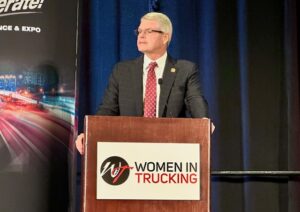




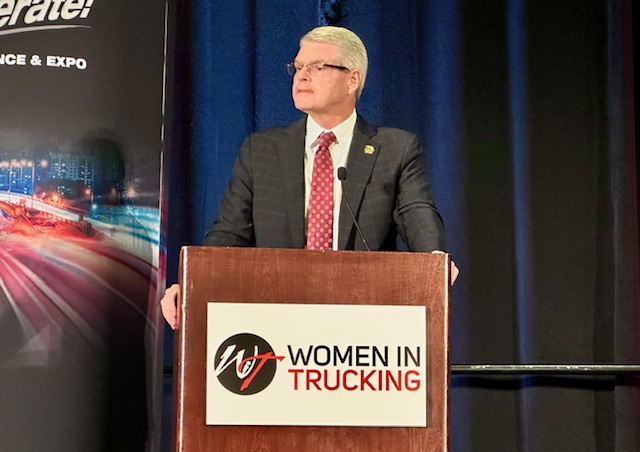
DALLAS — Federal trucking regulators are looking at changes to entry-level driver training (ELDT), electronic logging device (ELD) oversight and carrier registration as part of a broader effort to improve highway safety, Federal Motor Carrier Safety Administration (FMCSA) Administrator Derek Barrs told attendees at the Women In Trucking Association’s Accelerate! Conference & Expo.
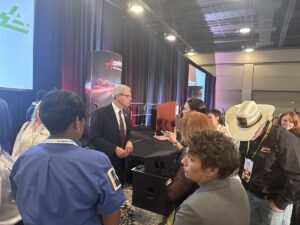
During his keynote address on Tuesday, Oct. 27, Barrs outlined the agency’s priorities and fielded questions from drivers and other industry professionals on topics ranging from training and truck parking to enforcement and fraud.
His message: Safety requires attention at every stage of a commercial vehicle’s life cycle — from driver training and licensing to carrier operations and roadside enforcement.
“We cannot address safety by looking at one regulation, one company, one driver,” Barrs said. “It has to be a holistic approach. And that looks at the training, the licensing, registration, operations.”
Training: Hours and proficiency
Some of the strongest discussion centered on the preparation new drivers receive before — and after — earning a commercial driver’s license (CDL).
Current federal ELDT regulations require drivers to demonstrate proficiency in the required behind-the-wheel skills, lbut they do not establish a minimum number of hours for that training.
Barrs said FMCSA is working on a rulemaking that would address training hours. When asked whether the agency intended to move away from proficiency-based training, he said the goal would be to include both.
“I guess you’ve got to meet both,” Barrs said. “You’ve got to have hours, but you’ve also got to show … proficiency that goes along with that.”
Completing a set number of hours alone, he added, would not necessarily be enough if a driver had not demonstrated the required skills. Barrs did not announce a proposed number of training hours or a publication date for the rulemaking.
Several audience members raised concerns about the quality and consistency of training. One longtime driver said short courses can leave new drivers unprepared for the demands of the job. Another attendee, a new CDL holder and former educator, suggested reviewing testing materials to ensure they reflect current equipment and practices.
Attendees also asked about training provided by motor carriers after a driver earns a CDL. One said she had heard from drivers whose trainers focused on accumulating miles instead of providing instruction.
Barrs acknowledged the concern but said standardizing that stage of training would be complicated by differences among large carriers, owner-operators and one-truck businesses. He also said continuing education for drivers is an issue that needs further consideration.
“I actually don’t have an answer for you for that, to be honest with you,” he said. “But it is something that we need to be looking at.”
ELD oversight and enforcement
Barrs also addressed concerns about electronic logging device manipulation after a driver asked whether the agency could prevent companies from altering electronic records.
He said FMCSA is working on a rulemaking intended to strengthen oversight of ELD providers and described the possibility of third-party testing or a testing laboratory as part of a more rigorous process.
Barrs also said the agency is investigating alleged manipulation of electronic logs and working with federal partners on related cases. Those changes remain in development; he did not provide a timeline or final details.
The administrator linked ELD oversight to a broader effort to identify fraud throughout the industry, including among motor carriers, driver training providers and other participants in federal safety programs.
“We have to be strong enforcers,” he said.
Barrs said he was headed to West Memphis, Arkansas, after the conference to join an enforcement operation involving federal and law enforcement partners in Arkansas and Tennessee.
Registration and licensing
FMCSA is also working to strengthen its registration process and requirements for new motor carriers, Barrs said.
He pointed to the agency’s new registration system as a tool for identifying potential fraud and said the agency is working on changes intended to make it more difficult for carriers to enter the industry without demonstrating appropriate qualifications.
Barrs also discussed English-language requirements, citing his experience conducting roadside inspections. He said the agency is working on a rulemaking addressing CDL standards, including the language used for the written knowledge test.
He did not provide a publication date or details of a proposed rule during the session.
Parking and other priorities
Barrs acknowledged that drivers face challenges beyond training and enforcement, including finding safe parking and access to clean, secure restrooms. He also said harassment and discrimination should not be part of anyone’s work experience.
He pointed to the U.S. Department of Transportation’s October announcement of approximately $200 million for truck parking projects. The funding is intended to support 14 projects in 12 states and more than 2,400 additional truck parking spaces.
Barrs also mentioned FMCSA’s hours-of-service (pilot efforts, including research into sleeper-berth flexibility. Those studies do not change the existing hours-of-service rules for drivers.
During the question-and-answer session, Barrs said work is continuing on changes to the Compliance, Safety, Accountability (CSA) scoring system, but he did not provide a release date. He also said he had signed a document related to appointments to the Motor Carrier Safety Advisory Committee and forwarded it for the transportation secretary’s signature.
‘We need your input’
As the agency develops proposals, Barrs encouraged drivers and other industry stakeholders to submit comments when rulemakings are published.
He said input from individuals can help regulators identify concerns that may have been missed during development.
“We need your input individually,” Barrs said.
He emphasized the role professional drivers play in the industry and asked the audience to recognize the drivers in the room.
“This right here is the backbone of America,” he said. “And we need to make sure that we continue to do everything that we can to strengthen what they do every single day.”

Linda Garner-Bunch has been with The Trucker since 2020, picking up the reins as managing editor in 2022. Linda has nearly 40 years of experience in the publishing industry, covering topics from the trucking and automotive industry to employment, real estate, home decor, crafts, cooking, weddings, high school sports — you name it, she’s written about it. She is also an experienced photographer, designer and copy editor who has a heartfelt love for the trucking industry, from the driver’s seat to the C-suite.