



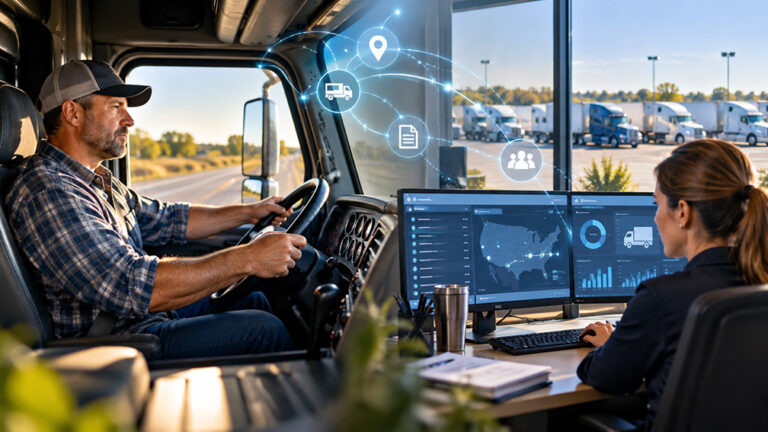
Artificial intelligence (AI) has generated plenty of buzz throughout the trucking industry, but for some motor carriers, the technology is already becoming part of everyday operations. From the back office to the driver’s seat, AI is helping companies work more efficiently while freeing employees from time-consuming tasks. And while concerns about automation replacing workers haven’t disappeared, some trucking executives say the technology is creating opportunities for employees to put their experience and skills to better use.
During an Oct. 27 discussion titled “The AI-Powered Fleet: Moving from Hype to the Back-Office and Shop Floor,” executives from two motor carriers shared how they’re incorporating AI into daily operations, along with the benefits, challenges and lessons learned along the way.
The session, hosted by fleet payment and technology provider WEX, featured Patrick Cozzens, president and CEO of Modern Transportation Services; Shawn Hicklen, chief operating officer of Venture Express; and Ahmad Kakar, CEO and founder of AI technology provider Euclid. The discussion was moderated by Karen Stroup, chief digital officer for WEX.
Less paperwork, faster results
For Modern Transportation Services, one of the most successful AI applications has been automating a time-consuming accounting process. When customers pay for shipments, employees must match payments with individual loads, rates and accessorial charges. For carriers handling thousands of loads each week, the work can be tedious, and delays can slow the accounting process.
Cozzens said his company worked with Euclid to develop an AI-powered system that now handles approximately 85% to 90% of its cash application work.
“It’s freeing up those people to do other things,” he said.
The company is also applying AI to driver log auditing, another task that requires employees to review large amounts of information for potential violations or discrepancies. According to Cozzens, log audits that previously took days — sometimes weeks — can now be completed in hours with AI assistance.
Venture Express is pursuing similar applications, including automated log reviews, driver recruiting and customer communications. Hicklen said his company’s approach is to identify repetitive tasks that consume employees’ time without necessarily making the best use of their skills.
“Our objective is to work smarter, not harder,” he said.
Getting drivers into the seat
Recruiting is another area where carriers see opportunities to improve efficiency, particularly when it comes to responding quickly to applicants.
Cozzens said Modern Transportation tracks the time between a driver’s application and the company’s initial response. Depending on the location, that delay can sometimes stretch to 48 hours.
“Sometimes it’s 48 hours, and you’re going to lose that driver,” he said.
An AI-powered recruiting agent could contact applicants within five minutes, help them complete missing information and arrange follow-up conversations with human recruiters. The technology could also accommodate applicants who prefer to communicate outside normal business hours.
Hicklen said Venture Express is evaluating similar capabilities, with the goal of moving qualified applicants through recruiting and onboarding more quickly without sacrificing the integrity of the process.
Although both companies are enthusiastic about the potential, recruiting automation is still being developed or expanded rather than operating as a fully implemented solution.
Changing jobs, not just eliminating them
While automation raises understandable concerns about job security, the executives emphasized that reducing headcount isn’t necessarily the goal. In fact, eliminating repetitive work can help carriers retain talented employees who might otherwise leave for more challenging opportunities.
Cozzens pointed to log auditing, where young employees may spend their early careers reviewing records instead of developing broader safety and operational skills. Automating routine reviews can allow those employees to take on more complex responsibilities.
The transition hasn’t always been easy.
Cozzens acknowledged that some employees initially feared their jobs would disappear. In hindsight, he said, the company should have involved those workers earlier in the implementation process. Once employees saw the technology in action and understood how it could reduce their workload, attitudes began to change.
Hicklen said Venture Express has emphasized transparency about the company’s goals.
“They know we’re not doing this just to cut heads,” he said.
Both executives also acknowledged that AI is changing the skills carriers need.
Cozzens described an employee who moved from data analysis into developing applications with AI-assisted coding tools. The company increased her pay by approximately 30% to 40% to retain her newly developed skills.
Hicklen said Venture Express has doubled the size of its IT development and analytics team over the past 12 months.
However, adapting to new technology is becoming increasingly important. Cozzens acknowledged that employees unwilling to develop new skills could find themselves left behind.
Making more time for drivers
One of the more promising aspects of AI adoption may be its potential to give fleet managers and safety personnel more time to interact directly with drivers. Instead of spending hours reviewing logs, videos and other records, managers can use AI-assisted systems to identify situations that require their attention.
Cozzens said technology has already transformed driver safety monitoring, with AI-enabled cameras providing real-time feedback about potentially unsafe behaviors. Additional systems can analyze driving records, hours-of-service information and safety data to identify patterns that may warrant closer attention.
The technology doesn’t eliminate the need for experienced safety personnel. Instead, it can help them determine which drivers may benefit from additional coaching.
Hicklen said retaining experienced drivers is just as important as recruiting new ones.
“What’s better than hiring a new driver and putting them in a truck is retaining one,” he said.
He emphasized that identifying potential problems should also create opportunities to provide guidance and support rather than immediately resorting to disciplinary action.
For carriers, that approach could translate into improved safety, stronger driver relationships and reduced turnover.
AI still needs a human touch
Despite the potential benefits, panelists cautioned against allowing AI systems to make every decision independently.
Kakar explained that so-called agentic AI differs from familiar tools that generate text or answer questions. AI agents can access business systems and complete specific tasks, often with limited human intervention.
But not every task is suitable for full automation.
Routine processes with clear rules may be appropriate for AI, while unusual circumstances and complex decisions still require human judgment.
Cozzens said Modern Transportation continues to use a “human-in-the-loop” approach, particularly when transactions or operational questions fall outside established parameters. He also acknowledged that AI-generated analysis can contain errors and must be reviewed.
Security is another consideration.
Kakar recommended limiting AI systems to the specific information and tools required for their assigned tasks, rather than granting broad access to company networks and data.
Hicklen said Venture Express reviews potential applications through its technology and executive teams and has established internal policies governing AI use.
Cost is also part of the equation.
Carriers must evaluate whether a proposed application delivers measurable results and whether developing a system internally or working with an outside provider makes better financial sense.
Start small; then build
For carriers interested in AI but unsure where to begin, the panelists offered a relatively simple recommendation: Start with a repetitive, low-risk task.
Kakar suggested looking for processes involving large volumes of documents, routine communications or predictable data entry — work that consumes time but requires relatively little independent judgment.
The first project doesn’t have to transform an entire operation. Instead, it should give employees and management an opportunity to learn how the technology works, identify potential problems and evaluate the results.
Cozzens stressed that investments must produce a measurable return, whether through faster accounting, quicker log audits, improved recruiting or better use of employees’ time.
For smaller carriers without extensive technology departments, partnerships may provide access to capabilities they cannot economically develop on their own. However, the panelists emphasized the importance of choosing providers carefully and maintaining oversight.
Ultimately, the message wasn’t that AI is ready to run a trucking company without human involvement. Rather, the technology is becoming another tool carriers can use to improve operations, support employees and strengthen relationships with drivers and customers.
And as the panelists repeatedly emphasized, the greatest value may come not from replacing people, but from giving them more time to do the work that people do best.


Linda Garner-Bunch has been with The Trucker since 2020, picking up the reins as managing editor in 2022. Linda has nearly 40 years of experience in the publishing industry, covering topics from the trucking and automotive industry to employment, real estate, home decor, crafts, cooking, weddings, high school sports — you name it, she’s written about it. She is also an experienced photographer, designer and copy editor who has a heartfelt love for the trucking industry, from the driver’s seat to the C-suite.