



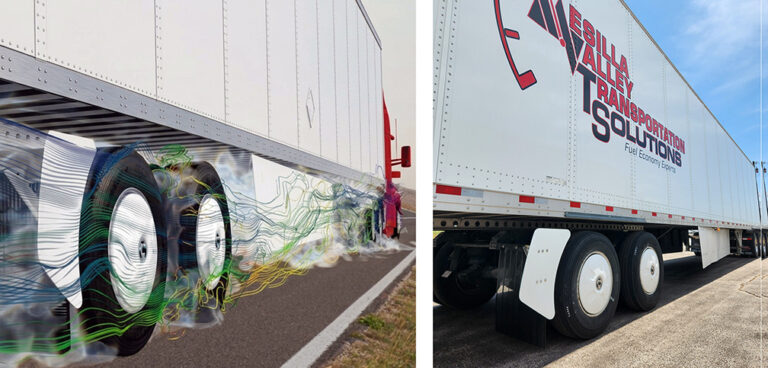
Small improvements in aerodynamics can add up to significant fuel savings for trucking fleets, especially when diesel prices are high.
With that in mind, FlowBelow Aero Inc. has launched its redesigned Trailer AeroSlider System, an aerodynamic solution designed to save up to 3 gallons of fuel per 1,000 miles traveled.
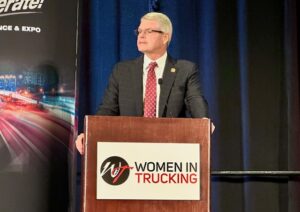
The company introduced the system during the American Trucking Associations’ Management Conference & Exhibition (MCE), held Oct. 17-20 in Charlotte, N.C.
The launch comes as fleets contend with near-record-high diesel prices. The national average on-highway diesel price was $6.179 a gallon on Oct. 12, according to the U.S. Energy Information Administration, after reaching a record $6.529 on Sept. 21.
Based on a diesel price of $6.18 per gallon and the company’s projected fuel savings, the AeroSlider could save fleets approximately $18.54 in fuel costs for every 1,000 miles a trailer travels.
How the AeroSlider works
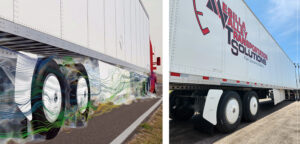
The trailer AeroSlider targets one of the most aerodynamically complex areas of a tractor-trailer — the exposed wheels, suspension and underbody surrounding the trailer tandem. The system combines FlowBelow trailer wheel covers, flow-through mud flaps and optimized rear fairings.
Rather than simply shielding components from airflow, the rear fairings direct air leaving the tandem slightly outward and rearward. This helps reduce turbulence around the wheels and suspension while directing airflow away from the trailer’s rear bumper and license plate area, reducing drag in the trailer’s wake.
Because the system mounts to and travels with the sliding suspension, it continues to deliver fuel savings as fleets reposition the tandem for different loads and axle-weight requirements.
Redesigned for simplicity and durability
FlowBelow first introduced the AeroSlider in 2017. According to the company, the newly launched system delivers greater fuel savings with a single fairing than the previous design achieved with separate center and rear fairings.
The result is a smaller, more durable package that costs less, installs faster and fits virtually any make or model of dry van or reefer trailer.
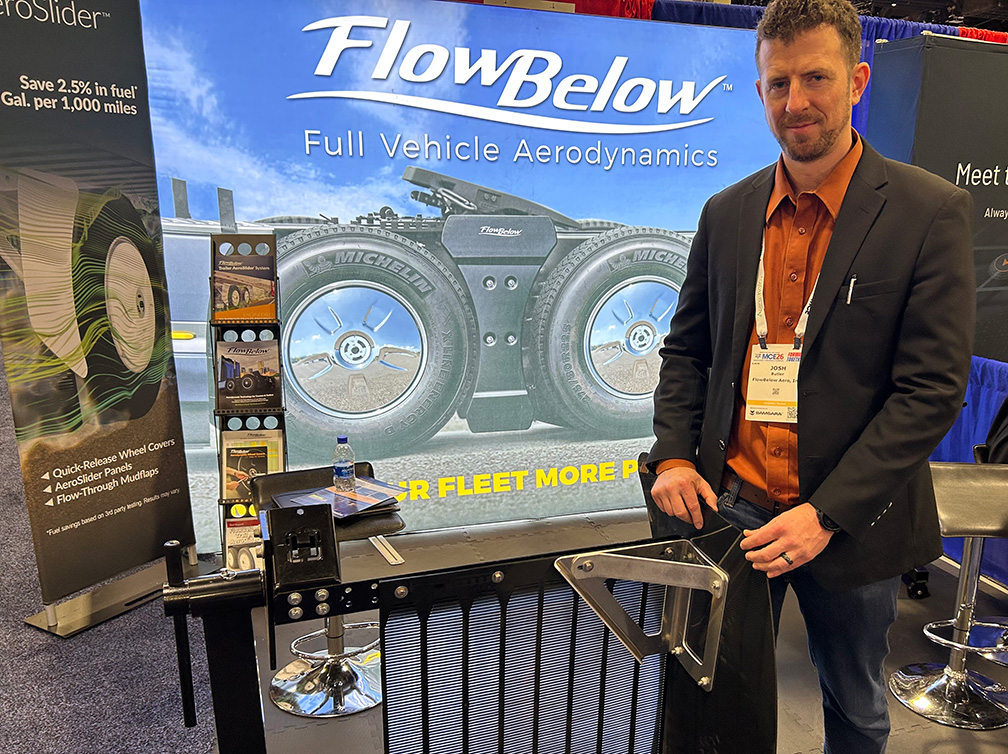
According to Josh Butler, FlowBelow’s president and chief technology officer, ease of installation was a priority throughout the development process, particularly as fleets and trailer manufacturers contend with labor shortages.
“Labor is a premium these days,” Butler said during an interview with The Trucker at MCE, noting that both fleets and trailer manufacturers face shortages of mechanics and other skilled workers.
In his own words: FlowBelow’s president and chief technology officer, Josh Butler, shares more details about the trailer AeroSlider in this Podwheels podcast. Click here to listen.
The AeroSlider fairing mounts to the trailer’s mudflap hanger and can be installed in approximately 15 minutes, Butler explained. Installing the wheel covers requires another 15 to 30 minutes.
The complete system weighs less than 30 pounds and can be installed on existing trailers in less than 45 minutes. Butler said factory installations could take as little as 30 minutes per trailer with appropriate installation equipment and procedures.
Durability was another important consideration.
Butler noted that fleets typically keep trailers in service for years, and some trailers may go as long as a year without returning to a company’s maintenance facility. As a result, equipment added to trailers must be durable, relatively inexpensive and require minimal attention.
Once installed, the AeroSlider requires no driver involvement.
Independently tested fuel savings
FlowBelow optimized the system through computational fluid dynamics (CFD) modeling, wind-tunnel testing and track testing.
Butler said the company has spent the past three years expanding its internal aerodynamic engineering capabilities, allowing engineers to evaluate numerous configurations through advanced computer simulations before validating the results in wind tunnels and on the test track.
In June 2026, MVT Solutions conducted independent fuel economy testing using 2019 International LT tractors pulling loaded 53-foot dry van trailers. The baseline test configuration included side skirts and trailer wheel covers. Adding the AeroSlider’s rear fairings and flow-through mud flaps saved 1.77 gallons of fuel per 1,000 miles compared to baseline.
In separate testing, MVT Solutions verified fuel savings of 1.23 gallons per 1,000 miles from FlowBelow trailer wheel covers.
Combined, these independently measured improvements represent potential fuel savings of 3.0 gallons per 1,000 miles, according to FlowBelow.
Butler emphasized that track testing is particularly important because it introduces real-world variables that cannot always be fully replicated in computer simulations or wind-tunnel testing.
Designed around fleet ROI
“Our goal with the AeroSlider was to develop an aerodynamic system that could pay for itself in less than 18 months for a typical regional or long-haul fleet at $3.00 per gallon diesel,” Butler said. “At today’s fuel prices, payback can be less than 12 months, even for fleets whose trailers travel as little as 30,000 miles per year.”
Actual payback periods will vary depending on trailer utilization, operating conditions and fuel costs.
During an interview with Greg Thompson, founder and executive producer of Podwheels and a contributing writer for The Trucker, Butler said some refrigerated fleets could see particularly favorable returns compared with dry van operations, with certain applications potentially recovering the investment in as little as six months.
He noted that FlowBelow deliberately based its original payback target on diesel costing $3 per gallon rather than today’s higher prices, recognizing that fuel costs fluctuate over the service life of a trailer.
For fleets, those savings can be measured in a variety of ways, including gallons saved per 1,000 miles, cents per mile, annual fuel expenditures and the time required to recover the initial investment.
Butler noted that aerodynamic products such as trailer side skirts have gained widespread acceptance because they deliver substantial fuel savings relative to their cost. He believes the AeroSlider could become another practical option for fleets seeking to reduce trailer drag without adding significant weight, maintenance requirements or driver involvement.
Early fleet interest
Butler said the redesigned system generated considerable interest during its introduction at MCE, including inquiries from some of the nation’s largest trucking fleets. He expects at least 10 fleets contacted during the event to begin testing the AeroSlider or adding it to new equipment.
Some operators, he noted, will want to independently evaluate the system’s fuel savings and durability before committing to broader installation.
The Trailer AeroSlider is available directly from FlowBelow for retrofit installation and can be spec’d on new trailers through participating trailer manufacturers.

Linda Garner-Bunch has been with The Trucker since 2020, picking up the reins as managing editor in 2022. Linda has nearly 40 years of experience in the publishing industry, covering topics from the trucking and automotive industry to employment, real estate, home decor, crafts, cooking, weddings, high school sports — you name it, she’s written about it. She is also an experienced photographer, designer and copy editor who has a heartfelt love for the trucking industry, from the driver’s seat to the C-suite.

Greg Thompson is an award-winning writer and producer who has worked in the trucking industry in a variety of roles since 1998. With more than a decade’s worth of experience as a journalist prior entering trucking, Greg is the founder and executive producer of PodWheels.com, a podcast network dedicated to spotlighting the trucking industry.
Since 2019, PodWheels has provided specialized coverage of the National Truck Driving and National Step Van Driving Championships. Over its history, the NTDC Podcast Series has provided more than 150 hours of podcast content highlighting the competitors, organizers and volunteers involved with the Truck Driving Championships at both the state and national levels. The NTDC program, which is hosted annually by the American Trucking Associations, has a history that dates back to 1937.
Beginning in 2025, PodWheels was chosen by the ATA to serve as the Official Podcaster for the NTDC. PodWheels’ coverage of the NTDC, including state competitions and other features, is available through RoadToNTDC.com.