



CHARLOTTE, N.C. — It didn’t take long for the topic of artificial intelligence (AI) to take center stage at the American Trucking Associations’ (ATA) annual Management Conference and Exhibition (MCE).
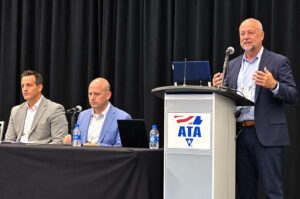
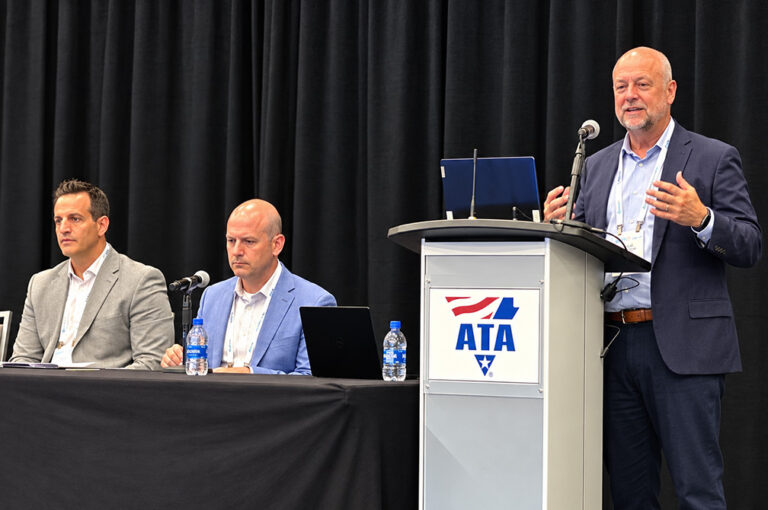
During Saturday’s first round of educational sessions for MCE 2026 at the Charlotte Convention Center, Bob Costello, ATA’s chief economist and senior vice president, highlighted the impact of AI within the freight economy and the nation’s overall economic growth while opening a panel discussion that he moderated.
Joining Costello for “From Market Signals to Strategic Action: A Shipper, Carrier and Economist Perspective” were Seth Runser, ArcBest president and CEO, and Nick Palmucci, vice president of global logistics at Ferguson Enterprises.
In his opening comments, Costello noted that GDP growth has typically been running at a 2.1% rate per year. The ATA forecasts show this growth rate at 2.4%, but Costello took the session attendees inside how the explosion of AI development has served as a principal driver of the nation’s economic growth over the past year.
As he walked through his explanation, Costello said that, if you remove the investments in data centers, software development and other aspects of AI, the 2.4% growth rate would actually fall to a growth rate of 0.6% for the year.
While illustrating the seismic role of AI with overall economic growth, Costello did add a qualifier: “If companies weren’t investing in AI, they’d probably be investing in something else. But that’s how big this investment is. This AI stuff is real and it is massive.”
AI drives pockets of manufacturing growth
Costello, in reviewing a slide on factory output during the first three quarters of 2026, told the audience he’s seen “pockets of strength” found in the current economic and freight landscape.
He then shared some insights on how AI played a central role in pushing the year-over-year total manufacturing output growth rate to 1.3%. According to Costello, if the 1.3% rate holds through the fourth quarter of 2026, it will be the best growth result for manufacturing output in the past four years.
When looking inside what’s happening on the manufacturing front, Costello highlighted three sectors that are responsible for 10.1% of all production. Two of those sectors are computer and electrical equipment related to AI and data center growth, while the other growth sector has been the area of commercial and defense aircraft production — with Costello noting that Airbus has recently begun boosting production of commercial planes.
Once again illustrating the impact of AI on the economy, Costello pointed out that excluding those three sectors — electrical equipment, computer equipment, and commercial and defense aircraft production — would leave manufacturing output essentially flat, despite the overall 1.3% increase.
In this cycle, a carrier’s experience within the freight economy has become more dependent than ever on the industry verticals they serve. Costello noted this point when talking about manufacturing output.
“I could get up here and go, ‘Hey, we’re growing 1.3% this year, the best year in four years,’” he said. “Some of you might go, ‘I’m certainly not seeing that.’ Well, you’re not, if you’re not in those three categories. Again, it’s the pockets of strength.”
ArcBest’s Runser, who noted that his company has seen a variety of different freight cycles during its 103-year history, shared that the complexities involved with the AI buildout related to cost and infrastructure are throwing off some of the traditional measurements related to trucking demand.
“It’s just been really interesting because some of those leading indicators you used to look at in the past sometimes aren’t holding true,” he shared with the audience before offering a note of advice: Carriers should stay close to their customers and compare what they’re experiencing firsthand with what economic indicators suggest is happening in the market.
Exiting capacity, ELP and North American trade
The panel spent some time noting the changing landscape with capacity coming out of the market as part of the freight recession as well as increased enforcement of English language proficiency (ELP) and other requirements.
Runser offered an example of how those changes are affecting freight movement across the US-Mexico border:
About a month before the conference, he said, a customer contacted ArcBest after encountering difficulty securing capacity to move 100 truckloads from Mexico City to a distribution facility in Dallas. Runser attributed the shortage to increased enforcement of English-language proficiency requirements and its effect on B-1 driver capacity.
Within a week, ArcBest arranged a warehouse operation in Laredo, Texas, where freight arriving from Mexico was transferred to U.S. drivers for delivery to Dallas.
The experience, Runser said, illustrates how regulatory changes are creating real-world challenges for shippers and carriers.
Palmucci, who leads international and domestic logistics, final mile, fleet operations and driver safety at Ferguson, told the audience that he and his team are “spending a tremendous amount of energy and time on tariffs and making sure we get our refunds.”
Palmucci said Ferguson has increased its scrutiny of carrier safety records, insurance and risk-management strategies, with those considerations becoming an increasingly important part of its carrier relationships.
Costello asked Palmucci to talk about the flow of trade related to North America compared to the rest of the world.
“A lot of our vendors work internationally and they’re trying to bring them to Canada and Mexico for a number of different reasons, just because it’s cheaper and it’s easier to do business with right now with where the administration is going,” Palmucci said. “You’ve got to find capacity very fast for where you’re going to move that from overseas to, say, Mexico.
“Overseas, everybody is trying to move out of China and find other countries to manufacture in, but you have to make sure that they’re doing it in good faith,” he added. “There’s a lot of time and energy that goes into making sure that we’re staying within the rules.”
Broker scrutiny and AI’s potential in trucking
Over the course of the hour-long session, the panel discussed a collection of timely topics, including working with brokers in the post-Montgomery landscape. On the subject of brokers, Palmucci told the audience:
“We look at a lot of different pieces of information right around their safety. I spend more time with my legal partners now on terms and conditions than I ever have,” he said. “I feel like that was just a standard we had and it’s changing and evolving all the time.
“It’s not just about rates and service,” he added. “Are you doing the right thing for your drivers? Do you have the right risk? Do you have a plan from that perspective?”
As the session closed with a question related to the use of AI as a tool to unlock value creation, Runser discussed its potential as his company and the trucking industry moves further into leveraging the ability to process massive amounts of data.
“When you think about our network, we have 240 service center facilities, almost 10,000 drivers, dock workers, all those different things. When you try to run network simulations, sometimes they just weren’t fast enough and able to actually recognize patterns,” explained Runser. “We’re in year three of this. Once we turn on some of this compute power that’s going on, there’ll be trillion-parameter models that will be able to evaluate entire industries. And that’s never been done before.
As one example, Runser pointed to digital twinning, a technology that uses virtual models to simulate real-world operations. He said advances in computing power could make it easier for carriers to analyze dock, yard and pickup-and-delivery operations, identifying efficiencies that are difficult to measure with existing technology.
“This is going to say what’s going on in the entire logistics industry and that’s going to allow for pattern recognition,” he added. “It’s going to allow you to optimize supply chains much more advanced than we’ve ever thought before. I do feel like it’s going to change our industry, and we might just not be thinking big enough.”

Greg Thompson is an award-winning writer and producer who has worked in the trucking industry in a variety of roles since 1998. With more than a decade’s worth of experience as a journalist prior entering trucking, Greg is the founder and executive producer of PodWheels.com, a podcast network dedicated to spotlighting the trucking industry.
Since 2019, PodWheels has provided specialized coverage of the National Truck Driving and National Step Van Driving Championships. Over its history, the NTDC Podcast Series has provided more than 150 hours of podcast content highlighting the competitors, organizers and volunteers involved with the Truck Driving Championships at both the state and national levels. The NTDC program, which is hosted annually by the American Trucking Associations, has a history that dates back to 1937.
Beginning in 2025, PodWheels was chosen by the ATA to serve as the Official Podcaster for the NTDC. PodWheels’ coverage of the NTDC, including state competitions and other features, is available through RoadToNTDC.com.