




For trucking companies, building a good reputation takes years of hard work — but criminals looking to steal freight may need only a compromised email account or stolen business identity to put that reputation at risk.
As freight fraud schemes become more sophisticated, criminals are finding ways to exploit established carriers’ identities rather than creating fraudulent trucking companies from scratch.
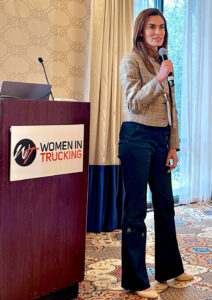
That was among the concerns discussed by Brittany Graft, chief operating officer of freight verification technology provider Highway, during the Women In Trucking Association’s 2026 Accelerate! Conference & Expo in Dallas.
Graft described changing fraud tactics and outlined steps carriers and brokers can take to protect their businesses, shipments and customers.
According to data presented by Highway, cyber-related schemes accounted for 52% of stolen-load investigations reported to the company in September 2026, while direct theft accounted for 46%. Cases involving changes in carrier ownership represented the remaining 2%. (Note: These figures reflect investigations reported to Highway rather than the freight industry as a whole.)
The company’s third-quarter data also showed that its systems blocked 670,230 fraudulent inbound emails and 119,022 fraudulent or spoofed telephone calls.
A carrier’s reputation becomes a target
One tactic involves criminals acquiring control of an established carrier’s operating authority and contact information, allowing them to impersonate a legitimate trucking company when arranging shipments.
Graft said criminals may offer carriers thousands of dollars for access to their business identities … without any interest in purchasing trucks or other equipment.
The attraction, she explained, is the carrier’s existing reputation and relationships with freight brokers: A criminal posing as an established carrier may be able to secure shipments that a newly registered, unfamiliar business would have difficulty obtaining.
For the legitimate carrier, the consequences can extend beyond the loss of freight. When a shipment disappears, the carrier whose identity was used may face questions from brokers and customers about its involvement.
The Federal Motor Carrier Safety Administration (FMCSA) has also warned against improper sales or transfers of USDOT numbers and operating authority.
In a March 2026 bulletin, FMCSA warned carriers not to sell, purchase or lease USDOT or MC numbers outside legitimate corporate transactions. The agency noted that certain business sales and corporate transactions are permitted, but operating authority cannot simply be sold or leased as a standalone commodity.
When an email account becomes the weak link
Another growing concern is the use of phishing schemes to gain access to carriers’ email accounts. Criminals may send messages that appear to originate from trusted business partners, directing recipients to fraudulent websites designed to capture login credentials.
Once inside an email account, a criminal can monitor communications, learn how the company conducts business and intercept information about upcoming shipments.
Graft described scenarios in which criminals access rate confirmations, delete the original messages before the intended recipients see them and arrange to collect freight while posing as the legitimate carrier.
The broker may believe it is communicating with a trusted trucking company, while the actual carrier remains unaware that its identity has been compromised.
Such schemes demonstrate why protecting business communications is increasingly important to cargo security.
Graft cautioned against routinely sending sensitive shipment information, including rate confirmations, as unsecured email attachments. She encouraged brokers and carriers to use authenticated methods of exchanging shipment documents.
Simple steps can help protect freight
Graft emphasized that several basic cybersecurity practices can reduce the risk of unauthorized access. Among the most important is enabling multifactor authentication on email accounts and other business platforms.
She recommended passkeys where available, explaining that they provide stronger protection against phishing than verification codes delivered by text message. Authenticator applications also provide an additional layer of security.
Graft also outlined several practices carriers and brokers should avoid:
• Don’t share login credentials. Give employees and contractors individual accounts so access to sensitive information can be controlled and permissions revoked when necessary.
• Don’t give out verification codes. Never share passwords or authentication codes with callers or anyone requesting access to an account, even if they claim to represent a trusted business partner.
• Don’t automatically trust emails or links. Be cautious of unexpected messages, particularly those involving shipment details, payment information or changes to established procedures.
• Don’t assume caller ID is legitimate. Criminals can manipulate caller ID information to make fraudulent calls appear to originate from established businesses.
• Don’t rely on contact information provided in a suspicious message. Contact the broker, shipper or business partner directly using a previously verified telephone number.
The importance of taking these precautions was underscored when one attendee described receiving a suspicious telephone call that appeared to come from a well-known freight broker. Rather than trusting the caller ID, the attendee contacted the brokerage directly and determined that the call was fraudulent.
Graft also encouraged businesses to investigate security features offered by their telephone providers to help prevent unauthorized SIM card changes or telephone number transfers.
It was a legitimate load, but who hauled it?
During the session’s question-and-answer period, an attendee described a freight transaction that illustrated how difficult identifying fraudulent activity can become.
The attendee said a shipment had been picked up and delivered, with documentation showing the load was completed.
The issue? The motor carrier whose USDOT and MC numbers had been used reportedly denied any involvement. The legitimate carrier, described as a small Michigan-based operation, indicated that it had received multiple inquiries about shipments it had not hauled. The company that arranged the freight was attempting to determine who actually transported the shipment and who should receive payment.
The discussion raised the possibility of unauthorized double brokering or carrier identity theft, although the circumstances had not been fully resolved.
The example illustrated that freight fraud does not always end with a missing shipment. A load can reach its destination while questions remain about who arranged the transportation, who performed the work and who should be paid.
Balancing security with everyday business
Although tighter verification procedures can help prevent fraud, they can also create complications for legitimate trucking companies.
During the session, one carrier representative explained that changing a business email address associated with FMCSA records had raised concerns about potential fraud alerts.
Graft acknowledged that verification requirements can create additional steps for carriers conducting routine business and said Highway was working to reduce unnecessary alerts in certain circumstances.
The exchange highlighted a broader challenge for the industry: Establishing safeguards strong enough to discourage fraudulent activity without making it unnecessarily difficult for legitimate carriers and brokers to work together.
As criminals continue developing new methods of impersonation and deception, carriers face growing pressure to verify business relationships and protect the information used to arrange shipments.
For trucking companies of any size, maintaining control of their digital identities may be just as important as protecting the trucks and freight themselves.

Linda Garner-Bunch has been with The Trucker since 2020, picking up the reins as managing editor in 2022. Linda has nearly 40 years of experience in the publishing industry, covering topics from the trucking and automotive industry to employment, real estate, home decor, crafts, cooking, weddings, high school sports — you name it, she’s written about it. She is also an experienced photographer, designer and copy editor who has a heartfelt love for the trucking industry, from the driver’s seat to the C-suite.