




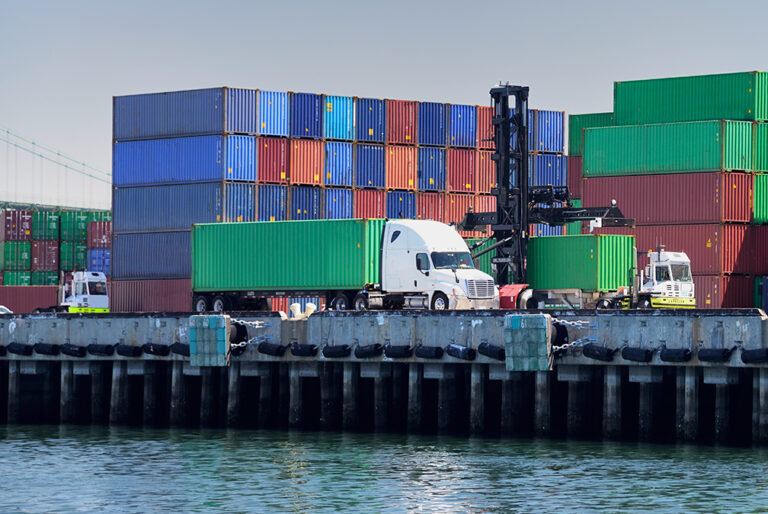
Tightening truck capacity is helping drive freight from highways to intermodal rail service, but industry analysts say the shift may slow in 2027 as trucking adjusts to regulatory changes and transportation providers compete to retain freight.
During an Oct. 27 webinar hosted by the Intermodal Association of North America (IANA), Andrew Seibold, IANA’s director of economics, and Larry Gross, president of Gross Transportation Consulting, examined the forces behind this year’s intermodal growth and the challenges that could affect the market in the months ahead.
While elevated diesel prices have increased transportation costs across the industry, Seibold said limited truck capacity appears to be a more significant factor in the growing use of intermodal service.
“The big takeaway … is that conversion is essentially a capacity story,” Seibold said, noting that diesel prices also play a role.
According to IANA, its Intermodal Volume Index reached 106.9 in September, an increase of 5.9% compared with September 2025 and 1.9% over August. Domestic intermodal volume increased 8.3% year over year, compared with a 3.8% increase for international movements.
Domestic freight accounted for 51.6% of North American intermodal movements during September.
Rail gains freight as truck capacity tightens
One indication of changing freight patterns is the increased use of rail-owned containers and trailers. According to figures presented during the webinar, movements involving rail-owned domestic containers increased 16.7% year over year, while 53-foot trailer movements increased 19.5%.
Gross said those increases suggest that trucking companies and other transportation providers that don’t ordinarily rely heavily on intermodal transportation are increasingly using rail service to move freight.
Those companies may not own intermodal containers, he explained, making rail-owned equipment or trailers carried on flatcars an alternative when highway transportation capacity is limited.
Seibold said the pattern suggests that truckload, less-than-truckload and parcel carriers are substituting rail transportation for the long-haul portion of some shipments when driver availability becomes a challenge.
The analysts also examined whether high diesel prices or trucking capacity constraints were primarily responsible for the shift. Seibold said their analysis favored capacity constraints in two of four comparisons, while the remaining evidence was inconclusive or consistent with both factors.
He acknowledged that the effects of fuel prices and truck capacity are difficult to separate, particularly because both have affected the market during the same period.
CDL enforcement adds to capacity concerns
Federal commercial driver licensing requirements and stepped-up enforcement were also discussed as potential contributors to reduced trucking capacity.
Seibold pointed to changes affecting non-domiciled commercial driver’s licenses, along with enforcement of English-language proficiency requirements, as factors that could reduce the number of drivers available to haul freight.
He said those restrictions could create additional pressure on highway transportation capacity, making intermodal service more attractive to shippers seeking reliable alternatives.
Gross, however, cautioned against viewing the situation as a permanent shortage of truck drivers. In his assessment, the regulatory changes represent an outside force that is temporarily reducing the industry’s available driver pool faster than carriers can replace that capacity.
Eventually, he said, trucking companies are likely to attract additional drivers, although doing so may require higher wages and operating costs.
“We have a window of opportunity here,” Gross said. “It’s not an infinite window.”
As trucking capacity recovers, some freight that has shifted to rail could become more competitive for highway carriers.
Drayage emerges as potential pressure point
Although intermodal transportation can reduce the need for long-haul trucking capacity, it still depends on trucks to move containers between rail terminals, distribution centers and customers. That makes drayage capacity an important consideration as intermodal volumes increase.
IANA’s Drayage Demand Index reached 189 in September, compared with a baseline of 100 established in February 2025. Demand was particularly elevated in several major freight markets, including:
- Chicago: 314
- Dallas-Fort Worth: 265
- Atlanta: 255
- Savannah: 240
Seibold cautioned that higher index readings do not necessarily indicate an existing shortage of drayage capacity. The index reflects demand, which can be affected by both increased intermodal volume and the difficulty of securing available equipment and drivers.
However, he said drayage is an area to watch as more freight moves through the intermodal network.
Gross agreed, observing that drayage operators face many of the same pressures affecting over-the-road trucking companies.
“This is where the action’s going to be,” Gross said.
For trucking companies that provide port and rail-terminal drayage, increased intermodal activity could present additional business opportunities, provided sufficient drivers and equipment are available to meet demand.
Pricing could determine whether growth continues
Looking toward 2027, the analysts said intermodal providers will face an important decision about how aggressively to raise rates.
Gross explained that many intermodal transportation rates are governed by contracts, while trucking’s spot market responds more quickly to changes in available capacity.
As highway transportation rates rise, the price advantage offered by intermodal service can widen, encouraging shippers to consider rail. However, that advantage could shrink as intermodal contracts are renewed.
Gross warned that if intermodal providers follow trucking rates upward too aggressively, they could undermine the price differential that has helped attract additional freight.
The issue is especially important because much of the current growth represents freight shifting between transportation modes rather than a significant expansion in overall freight demand.
“We’re going to have to fight for every load and convert and hang on to it,” Gross said.
Seibold’s baseline forecast calls for IANA’s Intermodal Volume Index to ease from September’s 106.9 reading to a range of approximately 102 to 104 during the first quarter of 2027. That outlook suggests a moderation from the rapid growth experienced during 2026, rather than an immediate return to earlier market conditions.
He identified trucking capacity, diesel prices, transportation service levels, consumer spending and import activity as factors that could influence the coming year.
For truckload carriers, the outlook suggests that competition with intermodal providers will remain an important market consideration, particularly on longer routes where rail can offer a competitive alternative.
For drayage operators, sustained intermodal growth could support demand for trucking services at ports and inland rail terminals.
Ultimately, both analysts emphasized that the durability of intermodal’s recent gains will depend on whether providers can maintain reliable service and competitive pricing as the trucking industry responds to changing market conditions.

Linda Garner-Bunch has been with The Trucker since 2020, picking up the reins as managing editor in 2022. Linda has nearly 40 years of experience in the publishing industry, covering topics from the trucking and automotive industry to employment, real estate, home decor, crafts, cooking, weddings, high school sports — you name it, she’s written about it. She is also an experienced photographer, designer and copy editor who has a heartfelt love for the trucking industry, from the driver’s seat to the C-suite.