





DALLAS — Federal safety regulations set the rules, but preventing crashes takes more than checking compliance boxes. From identifying risks before they lead to accidents to improving driver training and making better use of technology, trucking companies are taking a more proactive approach to safety.
During the Women In Trucking Association’s Accelerate! Conference, held Oct. 25-28 in Dallas, safety leaders representing several major trucking operations shared their approaches during a panel discussion titled “Aligning Fleet Safety Strategies with FMCSA Priorities.”
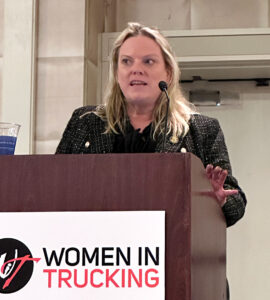
Rebecca Pettit, chief counsel for the Federal Motor Carrier Safety Administration (FMCSA), moderated the discussion, emphasizing the importance of cooperation between regulators and the trucking industry.
“We want to be proactive on all these things,” Pettit said, explaining that FMCSA wants to identify problems before they contribute to serious crashes. She encouraged carriers and drivers to share information about regulatory challenges, inadequate training and other safety concerns.
“We make the rules in DC, but we don’t get to see them how they play out on the roadways,” she said.
Moving from reaction to prevention
Several panelists described efforts to identify potentially unsafe driving behaviors before they result in collisions.
Jason Ahten, group director of fleet safety for Walmart Transportation, said the company is moving away from responding primarily to individual safety events and toward a more proactive, data-driven approach.
The company uses a process called Safe Path to evaluate information about driver performance and operating conditions, allowing safety personnel to provide more individualized coaching. Instead of applying the same intervention to every driver, the program helps identify specific risks and opportunities for improvement.
Ahten reported that Walmart’s preventable collision metrics have declined significantly year over year, while collision severity metrics are down by double digits compared with the previous year. Although multiple factors contribute to those improvements, he said the company’s more individualized approach to safety is playing an important role.
Jim Smith, vice president of safety and compliance for TransForce, described a similar effort built around the company’s accident data. TransForce provides professional drivers to approximately 3,000 client companies annually, creating challenges because drivers may operate in different environments with varying levels of safety technology.
An analysis of the company’s accident history found that approximately two-thirds of its accidents were preventable. Of those accidents, about 53% involved drivers who had been with the company for approximately 90 days or less. In response, TransForce developed an intensive 90-day safety protocol that includes increased communication and earlier intervention.
Smith said the company’s accident rate is now at its lowest level since 2011.
Turning technology into useful information
Cameras, advanced driver assistance systems (ADAS) and data analytics were recurring topics throughout the discussion.
Alicia Echols, director of safety and compliance for Bennett Heavy & Specialized, said the company uses information from cameras, roadside inspections, claims and driver tenure to build a more complete picture of potential risks.
That information helps safety personnel identify drivers who may benefit from additional coaching.
“We’re coaching on facts, not opinions,” Echols said.
When concerns arise, the company may establish an individualized professional development plan addressing issues such as speeding or following distance. Echols reported that drivers who completed these plans had experienced no subsequent claims or unsafe driving events during the period evaluated.
The technology also creates opportunities to recognize drivers who respond appropriately to dangerous situations or avoid potential collisions.
At Old Dominion Freight Line, Amber Kidwell, manager of environmental health and safety, said forward-facing cameras provide another important benefit: helping establish what actually happened when a crash occurs.
The company shares video examples with drivers to demonstrate how cameras can help protect them from being incorrectly blamed for collisions. Kidwell said the footage also provides opportunities to discuss following distances, blind spots, adverse weather and other factors that can contribute to crashes.
However, the panelists emphasized that technology cannot replace good judgment or effective driver training.
“All the investments in the technologies, the processes — they’re only as good as the people that are operating that truck,” Ahten said.
Training doesn’t end with a CDL
Driver qualifications and entry-level driver training were also among the FMCSA priorities discussed. Pettit said the agency is working to strengthen training requirements and address concerns about schools that fail to adequately prepare new commercial drivers.
Lisa Gonnerman, vice president of safety and compliance for SFI International, said the responsibility for preparing new drivers doesn’t end when they graduate from a CDL school.
“They’re not ready to go in a truck solo yet. We have to do more training,” she said, emphasizing the importance of qualified trainers providing hands-on instruction.
Echols pointed to the additional training needs of specialized transportation operations.
While CDL schools provide basic instruction, she said drivers moving from conventional freight hauling to heavy-haul and superload operations need opportunities to develop more advanced skills.
For carriers, the challenge is ensuring that drivers are not only properly licensed but also prepared for the particular equipment and loads they will handle.
Building safety through trust and communication
Beyond technology and training, panelists repeatedly returned to the importance of relationships between drivers and the people responsible for safety.
Gonnerman said individualized coaching is most effective when drivers trust the people providing it.
“Nothing matters more than a relationship,” she said, adding that safety cannot be the responsibility of a single department. Operations personnel and company leadership must reinforce expectations through everyday conversations with drivers.
At Bennett, Echols said drivers participate in safety planning through an advisory board that provides feedback on company policies and proposed changes. The company also holds regular safety meetings, discusses inspection results and provides financial incentives for certain safety achievements.
Explaining the reasons behind new policies is particularly important, she said.
“Safety is a culture of trust, and if drivers trust that you’re doing the right thing for them, then they’re gonna invest in safety for you.”
Kidwell described a similar approach at Old Dominion, where employee safety teams operate at service center, regional and national levels. Sharing companywide safety data helps employees understand how incidents at individual locations contribute to larger trends, she said. Just as important is listening to employees who have firsthand knowledge of the circumstances surrounding an incident.
Safety extends beyond the truck
The discussion also touched on the importance of educating passenger vehicle drivers about sharing the road with large commercial trucks.
Smith recalled helping develop a program that brought tractor-trailers to high schools, giving teenage drivers an opportunity to sit behind the wheel and understand the visibility limitations of a large truck. The initiative eventually reached 17 high schools, he said.
Ahten agreed that public education remains important, particularly as distracted driving continues to create hazards for commercial drivers and other motorists.
Pettit closed the session by encouraging carriers to continue sharing safety data, successful practices and suggestions for improving regulations.
She emphasized that meaningful rulemaking depends on understanding what happens in real-world trucking operations.
For the panelists, the message was consistent: Effective safety programs require more than regulatory compliance. They depend on identifying risks early, using available information wisely and giving drivers the training, communication and support they need to operate safely.

Linda Garner-Bunch has been with The Trucker since 2020, picking up the reins as managing editor in 2022. Linda has nearly 40 years of experience in the publishing industry, covering topics from the trucking and automotive industry to employment, real estate, home decor, crafts, cooking, weddings, high school sports — you name it, she’s written about it. She is also an experienced photographer, designer and copy editor who has a heartfelt love for the trucking industry, from the driver’s seat to the C-suite.