




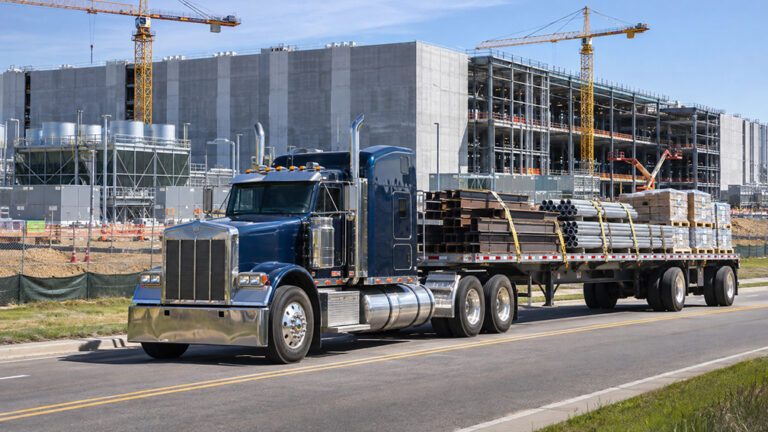
Data center construction and improving manufacturing activity support freight demand, but fuel costs and cash flow pressure could limit relief for smaller carriers.
DALLAS — Higher freight rates are giving trucking companies something to look forward to, but the recovery could bring an uneven payoff as fuel bills and other expenses eat into the gains.
That was a central takeaway from Eric Starks’ economic outlook Wednesday, Oct. 28, during the Women In Trucking Association’s Accelerate! Conference & Expo. The FTR Transportation Intelligence chairman described a market supported by data center construction and improving manufacturing activity, with tight hauling capacity putting upward pressure on rates.
For carriers, however, higher revenue does not necessarily translate into stronger finances. Smaller fleets and owner-operators could face particular challenges paying for fuel while waiting to collect from customers.
“Even if you know that you’re going to recoup it from your customer, you have to pay for it today,” Starks said.
Data centers help drive demand
One of the biggest influences on freight demand is the construction of data centers, according to Starks. The facilities require materials and equipment, creating transportation demand that reaches beyond the trucks that deliver material directly to construction sites.
Starks said FTR started digging into the connection after flatbed rates and capacity tightened more quickly than other trucking segments. Conversations with industry participants repeatedly pointed to data centers, either as a direct source of freight or as a competing demand for available equipment.
The effects can spread across the market. Equipment committed to one project is unavailable to haul another customer’s freight, even if that customer has no connection to data center construction. Starks expects the construction activity to provide support at least into the middle of 2027. Beyond that, he said, the outlook is less certain, with a potential correction if construction gets ahead of demand.
Manufacturing also offers encouraging signs. Starks pointed to improving industrial production outside the high-tech sector and an upward trend in inflation-adjusted capital goods orders.
Those orders can signal future freight movements as businesses manufacture and deliver the equipment customers have requested. Housing, by comparison, has provided little momentum.
Available trucks need available drivers
Understanding capacity requires more than counting trucks, Starks explained.
FTR’s active truck utilization measure compares the trucks needed to move freight with the trucks that have drivers and are available to haul cargo. A truck parked without a driver does not provide the same usable capacity as one ready for dispatch.
The utilization chart in Starks’ presentation puts the 10-year average at 92%. Starks said preliminary analysis suggested utilization could be near 100%, an unusually tight level, and that revised data could show it reaching that mark.
He attributed the squeeze to a combination of freight demand and constraints on the available driver pool, including changes affecting non-domiciled commercial driver’s licenses and training providers.
His outlook calls for utilization to remain elevated before easing during 2027, with a risk that tight conditions persist longer than expected.
In response to an audience question about repossessed equipment, Starks said a broader measure of the truck population still shows vehicles sitting outside active service. The distinction matters: Having equipment available for purchase does not mean it is ready to move a shipper’s load.
Rate gains come with higher expenses

Charts using Truckstop.com data showed weekly broker-posted spot rates through week 41 of 2026. The latest labeled year-over-year comparisons were increases of 46.7% for dry van, 44.1% for refrigerated and 43% for flatbed. Those are all-in rates, including fuel, so the increases should not be read as equivalent gains in carriers’ revenue after fuel expenses, Stark said.
Contract rates have also strengthened, according to Stark, as shippers seek agreements that ensure their freight will move. FTR’s contract-rate forecast, which excludes fuel surcharges, shows year-over-year increases approaching 20% during 2027 before slowing later in the year. The forecast shows the rate index itself continuing to climb before leveling off, meaning the slower growth would leave shippers paying rates above earlier levels.
For shippers, that changes the purchasing decision. Securing a lower rate offers little benefit if a missed shipment interrupts production or shuts down a facility.
“Am I trying to lock in capacity, or am I trying to lock in rates?” Starks asked. “And right now, capacity is the winner. You’re trying to lock down capacity to make sure that you can get your stuff moved when you want it moved”
He also emphasized that slower percentage increases would not necessarily bring a return to earlier rate levels. Rates can remain elevated even as year-over-year comparisons become less dramatic.
On the cost side, Starks warned that diesel would remain a pressure point through winter. His presentation cited an Energy Information Administration national on-highway diesel average of $6.276 per gallon for Oct. 19.
He pointed to low distillate inventories, exports and seasonal heating demand as factors supporting prices. Distillate fuels include diesel and heating oil, so winter heating demand can add pressure to the same fuel supply.
Tariffs and uncertainty surrounding equipment-related regulations add further complications for fleets making purchasing and replacement decisions, he said.
Cash flow could shape who benefits
During a question and answer session with the audience, Starks drew a distinction between a carrier’s ability to earn money on a load and its ability to finance the work until payment arrives.
Larger fleets generally have more access to capital and more sophisticated fuel surcharge arrangements, he said. Smaller operations may have less room to absorb the timing gap between buying diesel and collecting freight revenue.
The longer fuel prices remain high, the more pressure that creates.
Starks said one possibility is that some owner-operators and small-fleet operators leave their businesses and move into larger fleets. He described that as a hypothesis rather than an established trend. Such a shift could move capacity into larger operations without removing every affected driver or truck from the industry.
For carriers planning for 2027, his outlook offers reasons for optimism about freight demand and pricing. But the gains will depend on more than the rate on a load: Fuel recovery, payment timing and access to working capital could help determine how much of that recovery reaches the bottom line.

Linda Garner-Bunch has been with The Trucker since 2020, picking up the reins as managing editor in 2022. Linda has nearly 40 years of experience in the publishing industry, covering topics from the trucking and automotive industry to employment, real estate, home decor, crafts, cooking, weddings, high school sports — you name it, she’s written about it. She is also an experienced photographer, designer and copy editor who has a heartfelt love for the trucking industry, from the driver’s seat to the C-suite.