



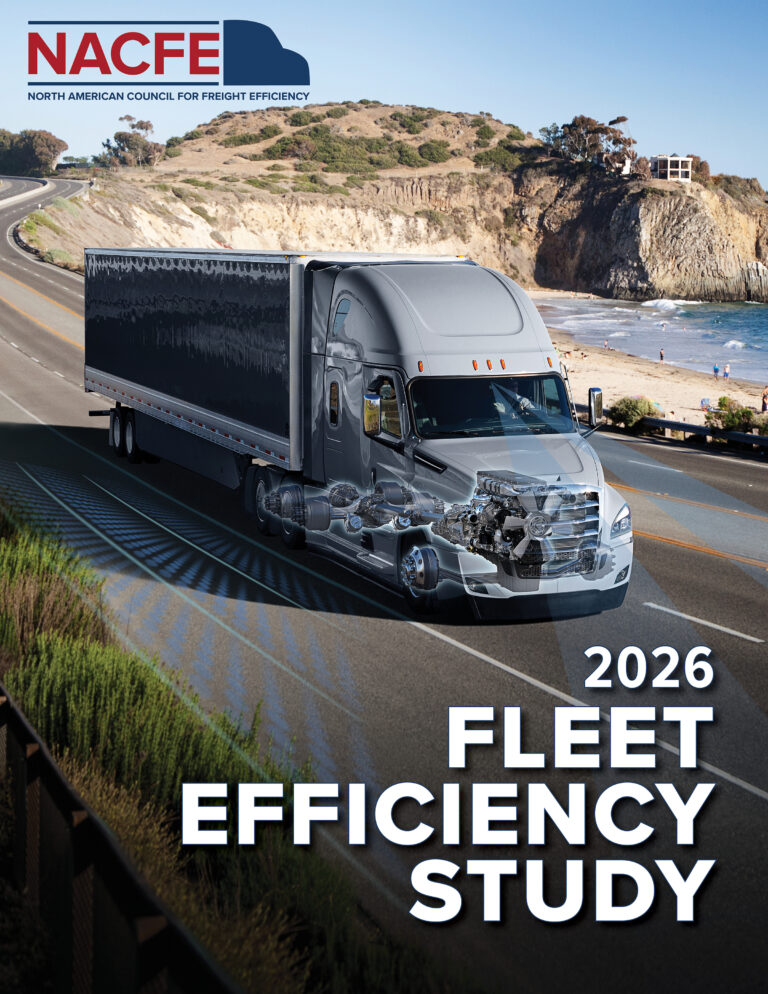
FORT WAYNE, Ind. — The North American Council for Freight Efficiency (NACFE) is releasing the 11th update of the Fleet Efficiency Study (FES), formerly known as the Fleet Fuel Study.
“For more than 20 years, the fleets in this study have shown that steady, deliberate investment in proven technologies pays off,” said Mike Roeth, NACFE executive director. “In 2025, our linehaul fleets reached an all-time high of 7.96 MPG, and regional fleets reached 7.29 MPG. Those gains are the result of fleets choosing efficiency truck after truck, year after year, and our analysis shows that this is also happening across the industry. We should be proud of that.”
Fleet Efficiency Study
The primary goal of the report is to study the fleets’ levels of adoption of 86 technologies and practices, and the savings those drove in each organization.
The report contains the results of a deep-dive investigation into the adoption of various products and practices for improving freight efficiency among 29 major North American fleets. Fleets share with NACFE their purchase and use of 80+ technologies going back to 2003.
Updating Technology
For this year’s report, NACFE updated the technologies covered in the survey. If there are no production systems available of a particular technology or if the technology has become standard at all of the truck OEMs, it was removed from the survey. In total, six technologies or practices were removed while two new ones were added bringing the total of technologies studied to 82.
Higher adoption rates of these studied technologies correlate to higher MPG throughout the 14 years for which NACFE has collected data. Fleets with the highest adoption rates consistently achieve the highest MPGs. Since 2016, more than half of the FES participating fleets have had an average adoption rate above 40%.
Impact of Fuel Costs
In 2024, at an average 7.4 MPG versus 7.1 MPG (the latest comparable year for Federal Highway Administration (FHWA) data), the studied fleets were more profitable on every truck by $2,373 ($0.024/mile) because of reduced fuel cost versus the average combination truck in the US assuming 100,000 miles per year and the average cost of fuel in 2024. At the current 2026 fuel prices, the savings were $3,520 per truck. For the fleets that contributed data to the FES this year, across their respective fleets, this amounts to a savings of more than $200 million.
New Interactive Tool
For the first time in the history of the report, NACFE is offering the FES Technology Adoption Explorer, an interactive online tool that lets readers investigate the data on their own terms. Users can filter by technology category and switch between line-haul and regional-haul fleets to see how adoption patterns differ by duty cycle.
“We’ve always shared what the data shows,” said Yunsu Park, NACFE’s director of engineering. “Now we’re sharing the data itself. Through the new interactive data explorer, or by downloading the dataset, anyone can explore 23 years of fleet technology adoption and draw their own conclusions.”
Recommendations
Based on the findings from the FES, NACFE offers these recommendations for fleets that are evaluating fuel-efficiency technologies.
- Collect and monitor fuel consumption by vehicle.
- Commit to and budget for an ongoing plan of MPG improvement.
- If possible, develop a test route and test driver with which to test new technologies.
- If purchasing used equipment, purchase equipment from fleets known for having good fuel economy.
- Allow for failure.
Click here to download the report.

Dana Guthrie is an award-winning journalist who has been featured in multiple newspapers, books and magazines across the globe.