



The Commercial Vehicle Safety Alliance (CVSA) released its Brake Safety Week results on Friday.
The CVSA stated in its release that out of the 15,528 commercial motor vehicle brake inspections conducted in Canada, Mexico and the U.S. for this year’s Brake Safety Week, 84.7% (13,159 vehicles) did not have any brake-related out-of-service (OOS) violations.
On the other hand, 2,369 vehicles were placed out of service for brake-related violations, which is a 15.3% out-of-service rate out of the total number of vehicles inspected.
CVSA reported that 51 jurisdictions participated in this year’s Brake Safey Week, which was Aug. 23-29.
Brake Safety Week is the CVSA seven-day inspection and compliance assessment program focused on identifying brake-system violations and educating commercial motor vehicle drivers, motor carriers and other industry stakeholders about the importance of properly functioning brake systems.
Most of the inspections completed on Brake Safety Week were North American Standard Level I Inspections, accounting for 91% (14,150 inspections) of all inspections conducted during the seven-day campaign.
CVSA defined a Level I Inspection as a thorough 37-step procedure that examines the driver’s operating requirements and assesses the vehicle’s mechanical fitness.
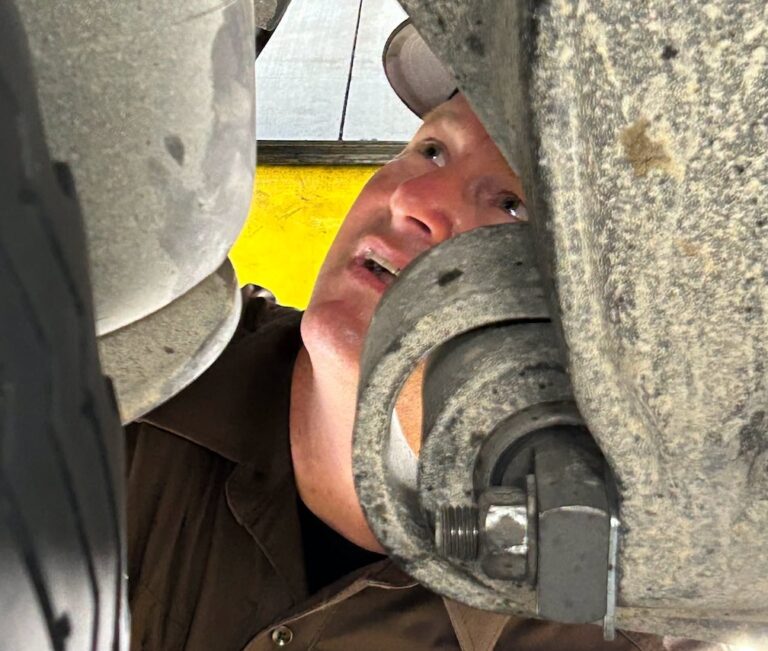
During the brake portion of a Level I Inspection, inspectors checked air brake mechanical components, such as: brake adjustment, slack adjusters, linings, pads, return springs, brake chambers and cam shafts. This includes steering axle components. They also checked air pressure and air loss, the tractor protection system, air tanks, tubing, hoses and fittings, breakaway and parking/emergency braking, and the anti-lock braking system.
This year, inspectors provided violation data for drums and rotors, the focus for this year’s brake safety initiative. There were 141 drum and rotor violations, resulting in 64 vehicles being placed out of service. Note: There may be more than one violation on a vehicle or vehicle combination.
CVSA said its inspectors placed 1,176 (49.6%) vehicles out of service that met the 20% defective brake criterion of the North American Inspection Out-of-Service Criteria. This means that 20% or more of the vehicle’s, or combination of vehicles’, service brakes had an out-of-service condition.
In addition, there were 92 out-of-service violations for steering axle linings and 119 for other steering axle conditions, 145 out-of-service violations for air loss rate, and 600 out-of-service violations for brake hoses/tubes. Inspectors cited 759 other out-of-service brake violations, which may include tractor protection system, air tanks, parking/emergency/breakaway brake, low-air warning device, hydraulic brake or electric brake violations, etc.
CVSA also reported that 12 U.S. jurisdictions with performance-based brake testers (PBBT) conducted 657 inspections utilizing the PBBT. Twenty-nine (4.41%) vehicles failed to meet the required 43.5% minimum braking efficiency rate and were placed out of service. U.S. Federal Motor Carrier Safety Regulations and CVSA’s North American Standard Out-of-Service Criteria require a minimum braking efficiency of 43.5%.
“While Brake Safety Week is a focused weeklong effort to identify brake-system violations and raise awareness, brake safety is a year-round priority and responsibility,” CVSA’s release stated. “CVSA encourages drivers and motor carriers to conduct regular inspections and proactive vehicle maintenance, promptly address identified issues, and ensure commercial motor vehicles are safely operating with properly functioning brake systems.”
Next year’s Brake Safety Week is scheduled for April 18-24, 2027.

Bruce Guthrie is an award-winning journalist who has lived in three states including Arkansas, Missouri and Georgia. During his nearly 20-year career, Bruce has served as managing editor and sports editor for numerous publications. He and his wife, Dana, who is also a journalist, are based in Carrollton, Georgia.