



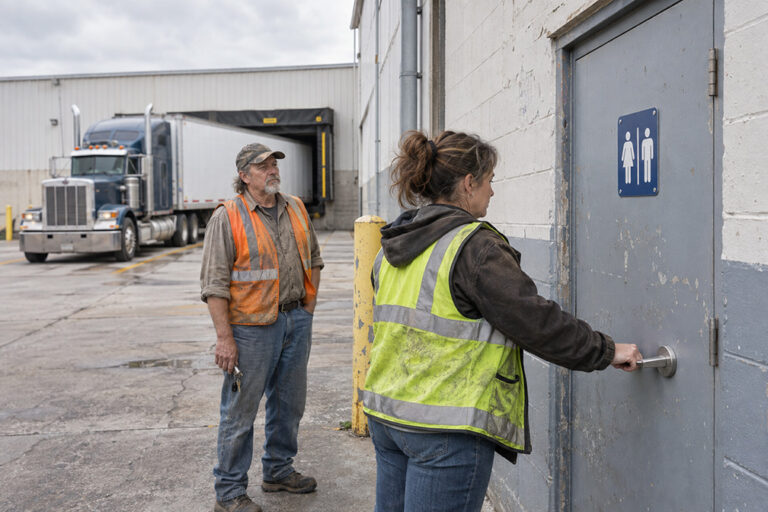
Does the right of truck drivers to have access to restroom facilities really need to be a law? Apparently, as many drivers will attest, it does.
Many drivers can recount an experience of arriving at a shipper or receiver only to find signs prohibiting them from entering buildings or areas of buildings where restrooms are located. Some have found signs stating the rooms are reserved for the use of employees, or more rudely, “no truckers allowed.” Others say they’ve asked to use facilities, only to be denied.
Drivers often plan for such policies, sometimes carrying portable toilets in the sleeper berths of their trucks or, at least, for males, a bottle to urinate in. Others deal with the problem by finding a secluded area and leaving their business somewhere in the parking lot.
In truth, many shippers and receivers understand that every truck comes with at least one human being that can be expected to have very human needs.
As a former OTR driver, I learned to appreciate places that provided bathroom facilities as well as water and vending options. Unfortunately, I also experienced the ones that viewed truck drivers as a necessary inconvenience, simply a part of the truck hauling their freight, assigning them about the same value as a lug nut.
To be sure, opening shipper and receiver restrooms to truckers adds traffic to those facilities and increases the services required to keep them clean and functional. And there will be the occasional person who leaves an unnecessary mess.
But so what? These facilities wouldn’t deny restroom access to their own employees based on those arguments — and shouldn’t exclude the people who haul their freight in or out.
Congress takes up restroom access again
Congress has tried before to ensure truck drivers can use restrooms at shippers and receivers.
On March 31, 2025, H.R. 2514 was introduced into the 119th Congress by Reps. Troy E. Nehls (R-TX) and Chrissy Houlahan (D-PA.) As soon as it was introduced, the bill was referred to the House Committee on Transportation and Infrastructure and then to the House Subcommittee on Highways and Transit. H.R. 2514 was eventually incorporated into the BUILD America 250 Act, which is still waiting for approval.
More recently, Senate bill 5718, the Trucker Bathroom Access Act, was introduced by Sens. Lisa Blunt Rochester (D-DE) and Deb Fischer (R-NE) on Nov. 12 and was referred to the Senate Commerce, Science and Transportation Committee. The bill cleared the committee Nov. 18 and could soon be scheduled for a vote by the full Senate.
The bipartisan nature of S. 5718 and its sponsors could be important, considering the Democrat victories in this year’s mid-term elections. On Jan. 3, 2027, the balance of power will shift from the Republicans to the Democrats.
Fortunately, both parties require restroom facilities from time to time and are sympathetic to the issue.
Who gets access and when it can be denied
There is room for improvement in S. 5718. One such area is in the definitions. Shippers and receivers would be required to provide facilities to “covered” drivers, defined as “any commercial motor vehicle operator with respect to whom the Secretary (of Transportation) has power to establish qualifications and maximum hours….”
In short, this means passengers and possibly some trainees could be excluded from the provisions of the bill.
In addition, fuel stations and restaurants with a square footage of 800 square feet or less and that have restrooms for employees only are exempt from the provisions.
While the bill, in its current form, requires an establishment that already has restrooms intended for use by employees or customers to allow drivers to use them, too, it would allow drivers to be excluded if allowing access poses “an obvious health or safety risk” to the driver or “an obvious security risk” to the establishment.
Those statements leave a lot of room for interpretation, especially in facilities where OSHA rules require strict traffic and access controls.
No establishment would be required to expand current restroom facilities or construct new ones, despite the additional traffic that would be generated by allowing drivers to use the facilities.
A part of the bill specifically targets intermodal terminals such as ports, requiring them to add restrooms where necessary. The term, “restroom,” however, doesn’t always mean indoor plumbing, soap and hand towels. Chemical toilets, known as “porta-potties,” are acceptable as long as they are placed in areas where safety and security aren’t compromised.
Trucking groups back the bill
Despite the shortcomings, the trucking industry is supportive of efforts to codify restroom access for truckers. The American Trucking Associations, Women In Trucking Association (WIT) and Owner Operator Independent Drivers Association have issued statements in support of the bill.
When introducing S. 5718, Blunt Rochester emphasized the importance of the measure to women drivers.
“Increasingly, more women are filling these critical jobs, and they should feel confident their basic needs will be met,” she said. “I’m proud to partner with Sen. Fischer to break down barriers for men and women in the trucking community and continue efforts to sustain and support our economy.”
Lana Nichols, WIT’s interim president and CEO, echoed that concern, pointing to what a lack of restroom access means for drivers already on the job.
“When drivers cannot access a restroom during their workday, it can affect their safety, health, dignity and overall experience on the job,” Nichols said.
“As the industry works to attract and retain more women, we need infrastructure and facilities that support the workforce,” she continued. “Ensuring drivers have access to these basic necessities is a practical step toward creating a safer, more welcoming and sustainable profession for everyone.”
What’s next for the bill?
Where the Truckers Bathroom Access Act goes from here is questionable, as majority rule in both the House and Senate is slated to change hands in a matter of weeks. If the bill doesn’t pass before this Congress ends, lawmakers will have to reintroduce it in the next Congress.
Democrats have announced an agenda of making changes to policies enacted while the Republicans held power, with President Donald Trump reminding everyone of his power to veto legislation that isn’t to his liking.
Hopefully, the bathroom bill won’t be lost amid the party squabbling. Perhaps its bipartisan nature, including cosponsors from both parties in both the House and Senate, will help keep the bill out of any political fallout.
After all, members of all parties need access to restrooms. Neither side benefits by allowing the current lack of policy to continue.

Cliff Abbott is an experienced commercial vehicle driver and owner-operator who still holds a CDL in his home state of Alabama. In nearly 40 years in trucking, he’s been an instructor and trainer and has managed safety and recruiting operations for several carriers. Having never lost his love of the road, Cliff has written a book and hundreds of songs and has been writing for The Trucker for more than a decade.