



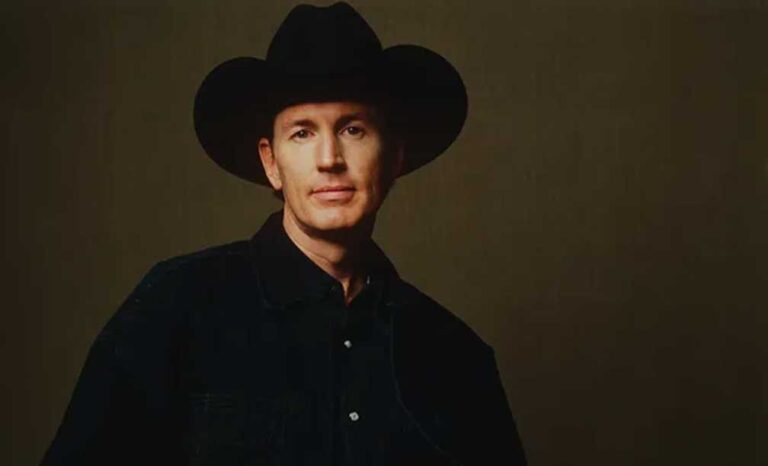
David Ball didn’t break through on the country music scene until he was 41 years old, but he had been working since childhood for the chance to entertain audiences as a solo artist.
Ball was born in 1953 in Rock Hill, South Carolina, but his family moved to Spartanburg when he was a child. It was there that he saw music take shape as his life’s calling.
He was born into a musical family; his father was a Baptist minister and his mother was a pianist. He eventually talked his parents into buying him a guitar and became a self-taught musician.
Ball’s first musical gig was with a band called The Strangers, a group he formed in seventh grade that performed in talent shows. He also learned to play upright bass in while in school, performing with both the school orchestra and at bluegrass and country festivals across the Carolinas.
After high school, his first real job was playing bass in Uncle Walt’s Band. Led by fellow Spartanburg native Walter Hyatt, the trio traveled to Nashville in 1972 with their sights set on making it in country music.
Hyatt, Ball and Champ Hood, who played the fiddle, made up Uncle Walt’s Band, when the group met Willis Alan Ramsey, who was by then popular in Texas-based music. Ramsey encouraged the trio to move to Austin. There, the band performed alternative country music for several years, breaking up only to get back together on more than one occasion.
In the meantime, Ball worked on his solo career.
Signed by RCA Records in the late 1980s, he released three singles, none of which gained any traction on the charts. A planned debut album was shelved, and for the next five years he was all but silent in mainstream music.
In 1994, recording for Warner Bros., Ball finally released his first album, “Thinkin’ Problem.” It topped out at No. 6 on the U.S. Country Charts.
The title song from “Thinkin’ Problem” is a play on words to which many can relate. The singer’s problem is manifested in a lost love who is “always on my mind. Her memory goes round and round. I’ve tried to quit a thousand times.”
With the change of one word — from “thinking” to “drinking” — Ball’s debut song could easily become a song about an alcoholic, as the rest of the lyrics can be taken however the listener wants to interpret them.
“Thinkin’ Problem” turned into a debut hit for Ball, charting at No. 2. The album sold 1 million copies and was certified as platinum.
Other releases from the album, including “When the Thought of You Catches Up with Me” (which reached No. 7 on the charts) and “Look What Followed Me Home” (No. 11), capitalized on the same theme as “Thinkin’ Problem” — a lost love who the singer just can’t shake.
“What Do You Want with His Love” (No. 48); and “Honky Tonk Healin’” (No. 64) rounded out the singles from the album. Ball either wrote or co-wrote all of the songs on “Thinkin’ Problem,” a rarity for a debut album.
Following his success with “Thinkin’ Problem,” Ball’s next two album releases, “Starlite Lounge” and “Play” produced no hit singles. The first, another of Ball’s albums in which he wrote all the songs, only reached No.44 on the charts, while “Play” fared even worse, topping out at No. 60. (“Play,” it should be noted, was Ball’s first album that featured songs he didn’t personally write.)
Things were looking grim for David Ball seven years after his success with “Thinkin’ Problem,” but hope was on the horizon.
In October of 2001, he released the album “Amigo” for Dualtone Records.
Unlike his previous two efforts, “Amigo” raced up the charts, eventually reaching No. 11. Dubbed by music critic Thom Jurek as Ball’s finest album — but the one least likely to get him anywhere outside of “Nash Vegas” as far as radio airplay was concerned — the compilation brought Ball only one single of commercial success, “Riding with Private Malone.”
Bolstered by a music video that helped tell the story of a lost military veteran, “Riding with Private Malone” reached No. 2 on the charts. Released prior to its album on August 13, 2001, the song undoubtedly benefited from the patriotism in the wake of 9/11.
At its root, though, “Private Malone” is a testimony to the unheralded veterans of the Vietnam War era, nearly 60,000 of whom went to fight in a faraway land — never to see their homes across America again. The line, “I’ll always be riding with Private Malone” is a ghostly reminder of all U.S. veterans, another point in its favor as the song was receiving substantial radio airplay over the Veteran’s Day holiday of 2001.
Because of the external forces impacting its airplay, “Private Malone,” while equal in popularity to “Thinkin’ Problem,” will likely always fall into second place as Ball’s signature song.
Since “Amigo,” David Ball’s albums have been unsuccessful. He has released five albums over the last 20 years and none of them have charted in the Top 100. But once a country star, always a country star. Ball continues to play music at the age of 72, focusing heavily on veteran events and fundraisers. He has also re-released a 25th anniversary album of “Thinkin’ Problem,” complete with Ball’s commentary, in an effort to capitalize on his early career.
Most telling of the Grand Ole Opry member’s music, David Ball was associated with country music royalty with commentary from the “Austin Chronicle”: “He glides between swing, honky-tonk, blues and even a touch of Tex-Mex with the ease of George Strait, the difference being Ball composes his own material.” (No slight intended to King George.)
Until next time, I must admit that a few pieces of truly classic country music slide beyond my self-proclaimed cutoff date of 1992. David Ball is a testament to that fact. After all, we all probably have a little “Thinkin’ Problem” from time to time.
Since retiring from a career as an outdoor recreation professional from the State of Arkansas, Kris Rutherford has worked as a freelance writer and, with his wife, owns and publishes a small Northeast Texas newspaper, The Roxton Progress. Kris has worked as a ghostwriter and editor and has authored seven books of his own. He became interested in the trucking industry as a child in the 1970s when his family traveled the interstates twice a year between their home in Maine and their native Texas. He has been a classic country music enthusiast since the age of nine when he developed a special interest in trucking songs.