






Billed as a “three day commercial motor vehicle inspection snapshot,” the annual International Roadcheck event conducted by the Commercial Vehicle Safety Alliance (CVSA) has resulted in over 1.8 million roadside inspections since its inception in 1988. As it does every year, the 2025 event revealed some shortcomings in equipment maintenance and inspection as well as driver qualifications.
It’s important to clarify that the “snapshot” provided by the inspection results applies to the group of trucks and drivers inspected and can not be credibly used for conclusions about all trucks on the highway. For example, in the 2025 event, 30,060 units received Level 1 inspections. 7,289 vehicles were place Out of Service (OOS), while 1,706 drivers were placed out of service. Some quick math shows that 24.2% of vehicles failed along with 5.7% of drivers. But a vehicle, or a driver, can have more than one OOS condition and many do, making those percentages inaccurate.
Another mistake would be to apply OOS rates to ALL commercial motor vehicles, as some media outlets do every year. For example, out of 44,435 vehicles inspected, 3,304 were placed OOS for brake system violations, a rate of about 7.4%. Does that mean that 7.4% of trucks on the road have brakes bad enough to be placed OOS? It does not. The reason is that inspections aren’t always random.
Results Don’t Represent an Entire Fleet
The sample of inspected trucks is not truly representative of the entire fleet. Jurisdictions are allowed to use their own criteria for selecting trucks for inspection. Some might inspect every 10th truck while others pick only older trucks that look like they aren’t well maintained. Still others might concentrate on truck types that are perceived as a problem in that jurisdiction, like inspecting all the logging trucks or focusing on trash haulers.
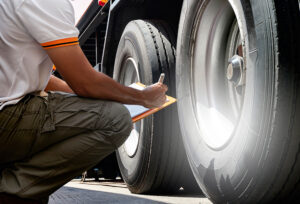
What the OOS numbers DO show is that some disturbing trends continue to occur, year after year. 2,899 OOS orders were given for tires that were bad enough to prohibit further operation of the vehicle. With several months of notice of the Roadcheck including notification that tires would be a focus item of inspectors, 21.4% of vehicles placed OOS failed because of an item that’s easy to inspect before hitting the highway – bad tires.
Brake System Violations
Drivers might have a better excuse for brake system violations, which were responsible for 24.4% of OOS orders. Some parts of braking systems, like proper operation of gauges and protection valves, air lines to the trailer and gladhands are relatively easy to inspect, other braking components are under the truck and difficult to get to. Still, brakes were number one on the OOS list, again.
Lighting Up Problems
12.8% of OOS orders were for lights, another easy pre-trip inspection item. Interestingly, 13.9% of OOS orders for inspections conducted in the U.S. were for lights. For Canadian inspections, it was less than half the U.S. rate, just 6.3%. In Mexico, 8.8% of OOS orders were for lights.
Credential Conundrums
Then there were the driver credential inspections. 1,076 OOS orders were issued for Hours of Service violations, representing 32.4% of driver OOS orders. That number doesn’t include log falsification, which alone accounted for 332 OOS orders or 10% of the total. If you though electronic logging devices (ELDs) were supposed to fix that problem, you aren’t alone.
24.4% of OOS orders, 810 in number, were given for no Commercial Drivers License. The breakdown provided by CVSA doesn’t supply the number of trucks that were tractor-trailer vs. straight trucks, and we know that buses were included in the inspections, so there’s no data to tell us where the largest numbers of violations occurred. Potentially, straight trucks driven by non-CDL holders who exceeded the 26,001 lb. threshold for CDL requirement or were hauling hazardous materials could be responsible for many of the OOS orders, but that information isn’t provided.
493 drivers were placed out of service for not having a medical card, 14.9% of the total. That’s something the FMCSA has been working on for decades with the intention of eliminating the driver requirement to carry a card once state computer systems were updated, but the issue still exists.
It’s not surprising that 5.1% of OOS orders, 170 in all, were issued for a suspended CDL. While there are certainly drivers without CDLs who choose to drive anyway, others are caught unawares. With suspensions often occurring for failure to stay current on child support payments and other non-driving issues, it’s not unusual for a driver to be out on the road when a suspension notice hits the mailbox back home.
Hazardous Materials Violations
The most common Hazardous Materials OOS violation in this year’s Roadcheck was for loading in a manner that secures cargo from moving in any manner that could cause damage, leaking, spilling, etc. 51 OOS orders comprised 28.8% of haz-mat OOS. Another 20.3% or 36 OOS violations involved shipping papers, with the violation types not specified. 32 OOS orders were issued for placards. 30 violations were for the driver not having a Training Certification for handling haz-mat, which is a requirement in Canada where all 30 violations were assessed.
Seatbelt Violations
Although not an OOS violation, 726 drivers were cited for not wearing seat belts. The FMCSA estimates that 14% of commercial drivers don’t wear their seat belts, despite statistics showing that accident fatality rates are much higher for unbelted drivers and passengers.
Overall Roadcheck Results
The positive news from Roadcheck is that 11,411 tractors and 5,043 trailers qualified for CVSA inspection decals, indicating no critical inspection item violations. That’s only about 81.6% of vehicles inspected, however, indicating that much more can be done to improve commercial vehicle safety. Also, the inspection numbers don’t take into account the number of trucks and drivers who shut down to avoid Roadcheck inspections or took alternate routes to avoid sites where inspections were occurring.
Drivers must decide for themselves what the numbers from Roadcheck 2025 mean. Is the event an annoyance that should be avoided or an opportunity to assess the overall roadworthiness of the North American commercial vehicle fleet? Taking unsafe drivers and equipment off the road is important, but improving the safety of motorists everywhere is a loftier goal

Cliff Abbott is an experienced commercial vehicle driver and owner-operator who still holds a CDL in his home state of Alabama. In nearly 40 years in trucking, he’s been an instructor and trainer and has managed safety and recruiting operations for several carriers. Having never lost his love of the road, Cliff has written a book and hundreds of songs and has been writing for The Trucker for more than a decade.




it was interesting
it was informative okay