





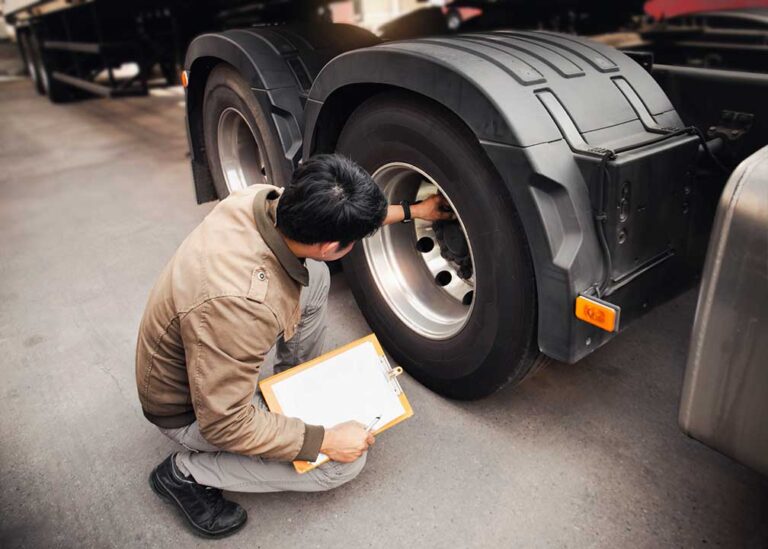
Pop quiz: What’s the legal requirement for tread depth on commercial motor vehicle (CMV) tires in the U.S.?
If you ask this question of just about experienced truck driver, they’ll quickly tell you it’s a minimum of 4/32 of an inch (3.2 millimeters) on steer tires and 2/32 of an inch (1.6mm) on all other tires.
Most of these drivers will also know that tires have built-in tread wear indicators that are visible as the tire wears. Some can even tell you which tire grooves to use for an acceptable reading, and they know that depth measurements are to be taken in two adjacent tread grooves.
But who decides these things?
If you ask that same person WHERE those measurements came from or who set the standards, and you’ll likely get a variety of answers. A few guesses might include the government, the tire/truck manufacturers, the Society of Automotive Engineers (SAE), maybe the United Nations (OK, so probably not the last one).
When drivers watch an official vehicle inspection in progress, they know the inspector is carrying a detailed checklist — and that getting too many checkmarks on that form can mean a citation and a possible out-of-service (OOS) order.
What you may NOT know is that every inspection item comes with a detailed description of what conditions are acceptable and which are in violation.
Before a law enforcement officer can determine whether the condition of a part or component on a truck renders it unsafe to operate, someone has to determine the parameters of that decision: How much slack in a slack adjuster is unsafe? How thick do brake pads and shoes need to be? How chafed should an air hose be before the driver gets a warning, and how chafed before they’re placed OOS?
Then, how do we make sure that inspections in Washington, D.C., are conducted the same way in as they are in Washington, Texas; Washington, Oregon; or Washington, Wisconsin?
That’s where the CVSA comes in.
The answer, in so many situations, is the Commercial Vehicle Safety Alliance (CVSA). It’s a common assumption that CVSA is a government oversight agency — but that assumption is wrong.
Under the “About” tab on the CVSA website, you’ll discover that the organization is nonprofit and is “comprised of local, state, provincial, territorial and federal commercial motor vehicle safety officials and industry representatives.” Some members are government officials and some are in law enforcement, while others represent the trucking industry or manufacturers of products used by the trucking industry, such as tires. Some represent the insurance industry, some train industry members.
All are working together to obtain the safest possible result for the motoring public.
Before an enforcement officer can decide if a part is too worn for safe operation, the engineers who designed/tested the part, technicians who have replaced the part, and others get together to determine how much wear is too much.
From how much play in the steering wheel to how many bugs on the windshield, each definition has been discussed and dissected to arrive at the safest conclusion.
Who trains the inspectors?
After defining inspection parameters, who trains the inspectors? And who trains the trainers? Again, that would be the CVSA.
At several intervals each year, inspectors and trainers have the opportunity to sharpen their skills and, in some cases, compete against one another.
This year, two three-day events are scheduled concurrently March 10-12 in Savannah, Georgia — one is a training session, and the other is a meeting where state and federal partners work out problems reporting inspection and crash reports to the Federal Motor Carrier Safety Administration (FMCSA).
In August, CVSA will conduct the North American Inspectors Championship in Pittsburgh, Pennsylvania. Just as CMV drivers earn bragging rights in driver rodeos, inspectors earn bragging rights of their own in a competition that covers a continent.
What does all this mean for truck drivers?
CVSA organizes annual inspection events — most drivers refer to them as “blitzes” — to help direct the transportation industry’s attention to the many factors that impact safety on North American highways.
CVSA’s International Roadcheck is scheduled for May 12-14 this year.
For 72 hours, thousands of CMVs will be checked in what CVSA calls the “largest targeted enforcement program for commercial vehicles in the world.” Each annual event centers around two “focus areas” that change each year, which are generally not announced until 30 days or so prior to the event.
International Safe Driver Week runs July 12-18 this year.
While drivers of both CMVs and passenger vehicles are ticketed during this initiative, others are educated before a safety issue becomes costly. The event helps teach the public about driving around commercial vehicles by targeting unsafe behaviors, such as following too closely.
Brake Safety Week is scheduled this year for August 23-29.
Brake safety inspections will be conducted all over North America. This event usually results in thousands of OOS orders. In addition to Brake Safety Week, CVSA also conducts an unannounced Brake Safety Day.
There’s also a Hazardous Materials/Dangerous Goods (HM/DG) Road Blitz — another unannounced event — that lasts five days and focusing, as the name implies, on hazardous materials loads.
Each year, drivers complain about these CVSA events. Inspections take time, and when problems are found, it’s more time and money. Even drivers who don’t own the trucks they drive still suffer from lost time and pay.
Some drivers — and even some carriers — shut down completely during the events they know about. Statistics show that spot freight rates actually go up during the International Roadcheck and the Brake Safety Week events. So many drivers shut down that shippers must compete for space on the trucks that DO run, and they’re willing to pay premium prices to move their products.
Some drivers and carriers, however, use the potential of failed inspection to up their game, getting their equipment inspected and repaired to make sure it’s in tip-top shape. Ultimately, this is what CVSA hopes to accomplish. Whether the organization motivates drivers and carriers to improve the safety of the vehicles they drive or improves the overall safety of the motoring public by removing the most unsafe equipment, the mission is accomplished.
Some shut down, some earn extra money by running hard. Some come away with dreaded citations and repair to-do list, and others sport their shiny new inspection stickers.
You can either blame or thank the CVSA for doing their part to ensure the safe transportation of cargo and passengers.

Cliff Abbott is an experienced commercial vehicle driver and owner-operator who still holds a CDL in his home state of Alabama. In nearly 40 years in trucking, he’s been an instructor and trainer and has managed safety and recruiting operations for several carriers. Having never lost his love of the road, Cliff has written a book and hundreds of songs and has been writing for The Trucker for more than a decade.



the cvsa is nothing but a group of discriminatory clowns that are lazy incompetent a**holes. They blatantly discriminate against truckers and who they inspect. They try to put discriminatory regulations in place and most of the regulations they put in place are s direct violation of the constitution, which make them unenforceable.
The inspectors go thru all of these inspections and details on exactly what is acceptable and then totally ignore the fact that the driver can’t even speak English? Credibility – 0.