




TCA and its members work to ensure truckload priorities are included in bill
September 30, the end of the U.S. government’s fiscal year 2026, looms large for the next Surface Transportation Reauthorization bill.
The Truckload Carriers Association (TCA) has several priorities for inclusion in the legislation. Missy Edwards, of Missy Edwards Strategies, and Richard Sullivan, with State Federal Strategies, are working diligently to keep legislators fully informed of the issues that impact the truckload industry and TCA membership.
Infrastructure on a Diet
As noted, the current Highway Bill, known as both the Infrastructure Investment and Jobs Act (IIJA) and the Bipartisan Infrastructure Law, expires September 30. Government shutdowns and political wrangling have harmed efforts to craft a new bill, and the upcoming mid-term election is expected to draw legislators to the campaign trail.
The clock is ticking to get the next highway bill signed. The burning question is this: What will be in it?
“The one thing we keep hearing is, it’s going to be a ‘skinny’ bill,” said David Heller, senior vice president of safety and government affairs for TCA.
“The chairman (of the House Committee on Transportation and Infrastructure) has said he wants to ‘pour concrete and lay asphalt’ — and that’s a skinny bill,” he continued. “I don’t think it’s going to be as all-encompassing as the IIJA was previously. I think this is going to be roads and bridges.”
Edwards believes Congress is very focused on reauthorizing the surface transportation bill.
“They’re going to keep pushing for that until it just gets to a point where they probably can’t get something done — which would mean in the lead-up to the election (this fall),” she said.
However, Sullivan points out that the potential upcoming change in leadership of one or both houses of Congress provides an incentive to get things done.
“Republicans will want to pass their own bill,” he said. “They would rather not have to deal with a Democratic bill coming out of a potential democratic house or Senate. That always carries a lot of weight when a party knows that this might be their chance to pass something with majority support.”
Gallons-Based User Fee
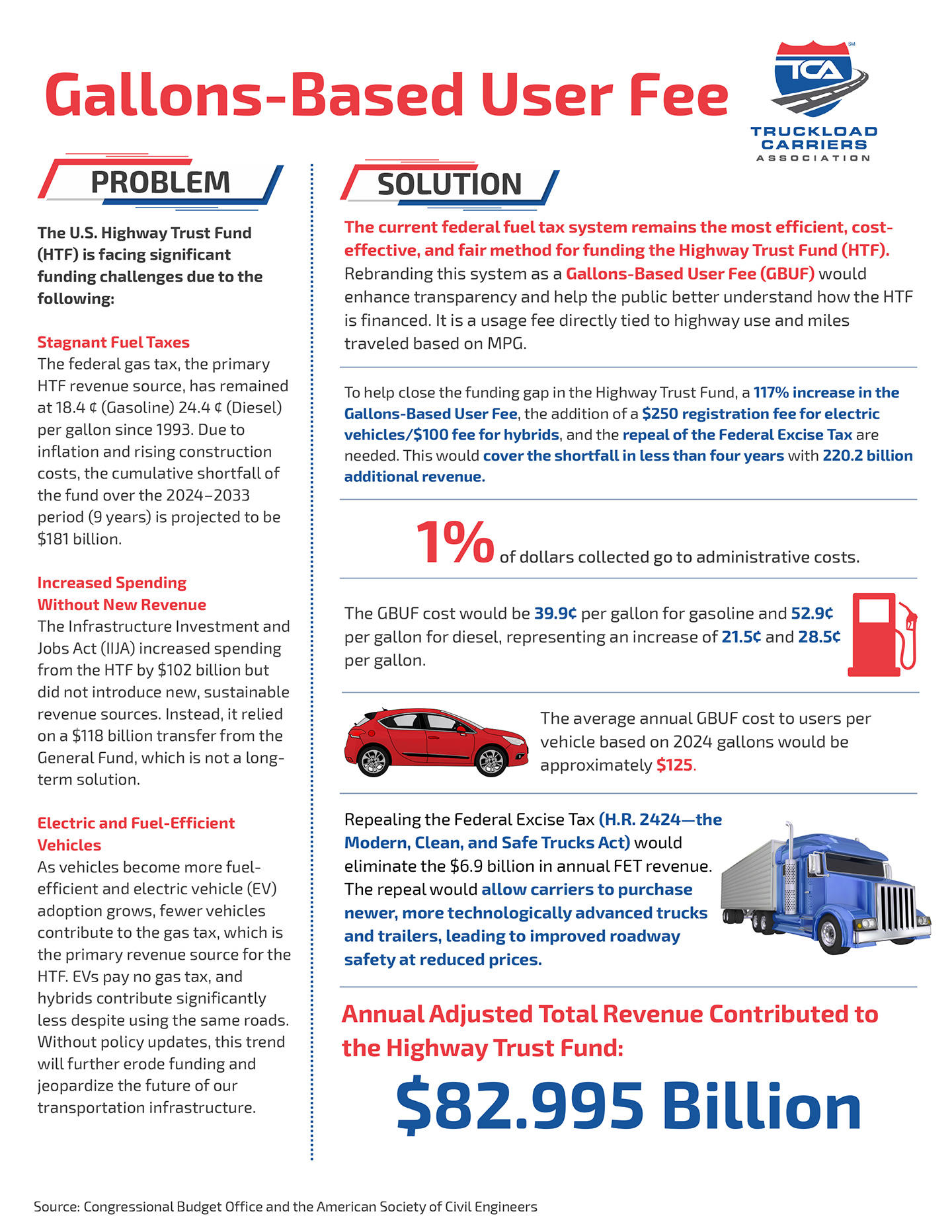
One TCA priority is a modification to the current fuel tax, transitioning to a Gallons-Based User Fee (GBUF) to fund the Highway Trust Fund.
“This model has proven itself time and time again,” Heller said. “The only thing it’s guilty of is being left unattended — meaning it hasn’t been raised since 1993. Effectively, we’re collecting 1993 dollars … but paying 2026 pricing.”
The TCA proposal recommends increasing the amount paid per gallon as well as increased registration fees for electric and hybrid vehicles. (See the infographic at the end of this story for more information about the GBUF.)
While it may seem unusual for an organization like TCA to demand the right to pay more in taxes, the timing isn’t ideal for a funding increase.
“The optics of raising taxes when the majority of Republicans have signed a pledge … saying they won’t increase taxes aren’t good,” Edwards said, noting that low gas prices are a cornerstone to the Trump administration’s plan for the economy. “That’s a big, big, big hurdle,” she said.
Hair Follicle Testing
Another TCA priority is the inclusion of hair follicle testing for controlled substances in protocols regulated by the U.S. Department of Transportation (DOT).
Studies have proven it to be more reliable and to identify drug use over a longer period than conventional urinalysis; however, hair testing is currently not authorized for DOT qualification purposes.
Carriers that incorporate hair testing must also conduct urine or saliva testing, incurring greater expense. Drivers who fail hair testing can be subject to the carrier’s disciplinary program, but results aren’t reported in Federal Motor Carrier Safety Administration’s Drug & Alcohol Clearinghouse.
“The longer we go without (the inclusion of hair follicle testing), the worse off we are, especially when we know the benefits of getting the results put into the Clearinghouse,” Heller said.
Sullivan pointed out that hair testing isn’t currently an administrative issue.
“The guidelines rest under the purview of the Department of Health and Human Services,” he said. “Members of Congress are supportive, but the action really lies at the Department of Health and Human Services.”
Still, Congress often decides to force an issue by law, as they have done recently on English language proficiency regulations.
Increased Truck Parking
One TCA priority that’s seen recent success is federal funding for increased truck parking.
“There was $200 million set aside in the appropriations bill for truck parking, which is a great win for the industry,” Heller said. “But it’s got to cross the finish line, so we’re still pushing for parking.”
Edwards agrees.
“I feel positive that truck parking will be included in the next bill,” she said. “The Republicans and the Democrats have both been supportive. It’s a significant priority that should be highlighted.”
The IC Business Model
Preserving the independent contractor (IC) model is also top of mind for Heller.
“This is ‘the great American story’ — a lot of large truckload carriers started because somebody went out, bought one truck and grew it to what it is today,” he said. “That strategy still works. We can’t give up on it.”
Call to Action
It’s vital that TCA members make their voices heard on Capitol Hill through calls, emails and personal visits, such as the association’s annual Call on Washington.
“Members (of Congress) want to hear from constituents, especially leaders of important industries like trucking,” Sullivan said. “They know how important trucking is to the economy.
“They want to hear their constituent’s viewpoints, but they want to hear directly from the companies themselves,” he continued. “It makes all the difference in the world.”
Edwards stressed the importance of member engagement in TCA’s advocacy.
“Anything they can do to support TCA’s advocacy efforts is helpful,” she said. “Engage anytime they’re contacted, and let TCA know their willingness to come into town.
“It’s very important when we do meetings with the (White House) administration that they hear from CEOs directly versus those of us in Washington,” she continued.
Whether the next Surface Transportation Reauthorization Bill is passed by the current Congress or delayed until the next one, TCA will continue to promote issues important to the industry.
As Heller points out: “There are no ‘Republican roads’ or ‘Democrat roads.’ They’re all American.”

Cliff Abbott is an experienced commercial vehicle driver and owner-operator who still holds a CDL in his home state of Alabama. In nearly 40 years in trucking, he’s been an instructor and trainer and has managed safety and recruiting operations for several carriers. Having never lost his love of the road, Cliff has written a book and hundreds of songs and has been writing for The Trucker for more than a decade.