




Trucking forecasters mostly agree that freight rates improved in January and are on an upward trajectory. There is still caution, however, that rate improvements will come slowly and carrier fiscal responsibility will remain a guiding principle for some time.
A January 26 update to ACT Research’s “Trucking Industry 2026 Outlook” pointed out that trucking is at an important inflection point, “transitioning from a prolonged downcycle toward early-stage rebalancing — but not yet recovery.” The story points out that freight demand remains “below historical norms” while costs for credit and tariff-driven inflation remain high.
Capacity Contraction Continues
Perhaps the biggest factor for the trucking industry is the ongoing capacity contraction. The pool of available trucks is shrinking as carriers (at least the ones who haven’t shut their doors) cut back their fleets.
Manufacturers have slowed truck production to match buyer demand.
In January, OEMs reported selling 12,287 new, Class 8 trucks on the U.S. market, according to Omdia. That’s the lowest January total since 2011, when the world was coming out of the Great Recession.
Freight Outlook ‘Promising’
Cass Information Systems
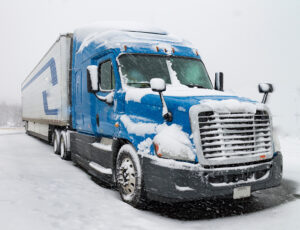
The Cass Linehaul Index rose 1.7% in January, following a 1% increase in December. The Cass Index for Shipment fell by 2% on a seasonally adjusted basis, but severe winter weather impacted the number of available trucks, pushing rates higher. The Cass release calls for “moderate truckload rate increases” for the remainder of 2026.
FTR Transportation Intelligence
FTR Transportation Intelligence has its own Trucking Conditions Index, which rose to 4.85 in December. While the number isn’t meaningful outside of the context, it DOES reflect what FTR calls “the most favorable operating environment for U.S. carriers since February 2022.”
“FTR is not forecasting anything like the 2021 market, but something close to it no longer seems inconceivable,” said Avery Vise, vice president of trucking at FTR.
The FTR release credits spot freight rates with driving the market upwards.
DAT Freight and Analytics
Data from DAT Freight and Analytics supports that assertion. Their “Trendlines” report shows an increase of 5% in January spot load posts over December and a 27.4% increase over January 2025.
At the same time, trucks posted as “available” declined 1.5% from December and by 4.9% compared with January a year ago. The end result was that national average dry van rates increased to $2.32 in January, up from December’s $2.29. Refrigerated rates rose to $2.58 from $2.53, and flatbed rates rose to $2.81 from $2.70.
All three categories have risen further in February. Some of the increases were undoubtedly spurred by severe winter storms in January, but the weather isn’t responsible for all of them. The market is clearly shifting.
DAT’s weekly linehaul rate average for refrigerated trucking, for example, reached $2.57 for the last week of December 2025 — and did it again for the first week of February 2026. A year ago, those rates were $2.22 and $1.99, respectively. The last time the weekly average topped the $2.50 per mile mark was in April 2022.
American Trucking Associations
The American Trucking Associations (ATA) reported a modest 0.4% increase in tonnage reported by its membership for January. The ATA Index is comprised of mostly contract freight.
“Tonnage has lifted off the recent bottom in October, with modest gains in November and January,” said Bob Costello, ATA’s chief economist. “However, truck freight tonnage in January was down 1.3% from the 2025 high point in August.”
Costello further noted that “the trucking recovery story is more of a supply-side one with those motor carriers remaining benefiting from reduced overall capacity.”
Signs of an improving economy
The ISM (Institute for Supply Management) Manufacturing Index for January reached its strongest reading in more than three years, jumping to 52.6%. New orders surged to 57.1% and production rose to 55.9%.
Additionally, the U.S. economy added 130,000 new jobs in January — more than double the prediction by economists. It was the first time since April of last year that more than 100,000 jobs were added, and it happened while total federal government jobs fell by 34,000.
While an unexpected increase in employment numbers is a good sign, one month does not make a trend. Still, any growth in the economy can benefit trucking.
Fuel Prices
Diesel fuel costs have been on the rise lately, but those increases are primarily weather-based, too.
Demand for fuel oil used for home heating increases during colder winter periods, placing higher demand on petroleum refining.
Fuel prices are still well below where they were a year ago and are expected to stabilize as the weather improves.
Tariff Threats Continue
What happens in the next few months will very likely be impacted by the recent Supreme Court ruling that the International Emergency Economic Powers Act (IEEPA) does NOT grant the president power to impose tariffs.
The court ruled that President Donald Trump was not authorized to impose tariffs that have raised nearly $179 billion in fiscal year 2025 and another $82 billion in the first quarter (October-December) of fiscal year 2026.
It’s important to note that the SCOTUS ruling does not prohibit the president from levying tariffs; it merely denies the use of IEEPA as the authority to do so. Other laws DO provide such authority, and Trump has used them for tariffs on steel, aluminum and copper, among other things.
Trump can reimpose tariffs under different laws that he believes will provide a stronger legal basis for his actions, and those new tariffs would need to be challenged in court all over again.
The Court did not rule on reimbursement of tariffs collected to date. That’s for the Court of International Trade to decide, and more than 1,000 lawsuits for recovery of tariffs paid have already been launched.
In the meantime, however, trucking could benefit in two ways from the Court’s action:
- Tariff refunds will inject cash into the economy, potentially resulting in more freight.
- Importers will look for ways to increase imports before new tariffs can be imposed, providing more freight once those products reach American shores.
While economists discuss how far rates will rise and how fast it will happen, truckers are beginning to see revenue improvement and are looking forward to more favorable months to come.

Cliff Abbott is an experienced commercial vehicle driver and owner-operator who still holds a CDL in his home state of Alabama. In nearly 40 years in trucking, he’s been an instructor and trainer and has managed safety and recruiting operations for several carriers. Having never lost his love of the road, Cliff has written a book and hundreds of songs and has been writing for The Trucker for more than a decade.