





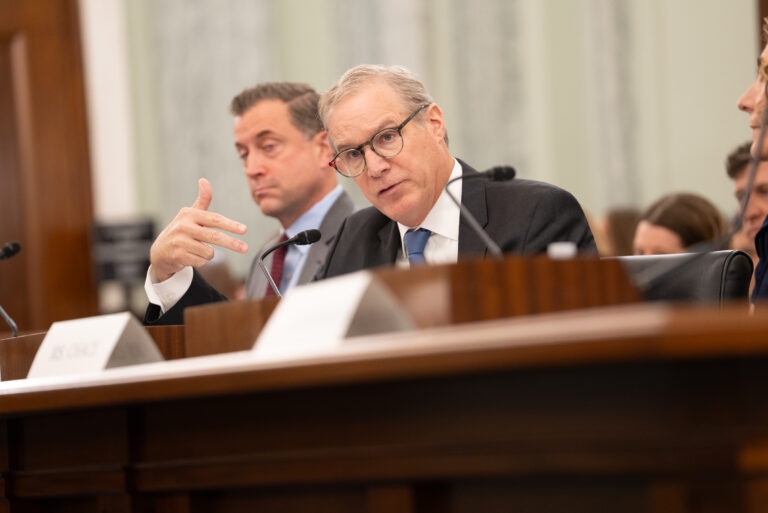
WASHINGTON — American Trucking Associations president and CEO Chris Spear testified before the Senate Commerce Subcommittee on Surface Transportation, Freight, Pipelines and Safety, urging Congress to support policies that accelerate the deployment of proven technologies, strengthen America’s supply chain and ensure the United States remains the global leader in transportation innovation.
“Trucking moves the vast majority of our nation’s freight, connects manufacturers to markets, keeps store shelves stocked and delivers essential goods to communities in every state,” Spear said. “Our industry is already investing billions in technology to create a safer, more modern freight network. Innovation-driven solutions not only improve outcomes but also help lower the prices paid by consumers and businesses alike.”
The Need for Speed: How Technological Advances are Driving Transportation Innovation
The hearing, titled “The Need for Speed: How Technological Advances are Driving Transportation Innovation,” was convened by Subcommittee Chairman Todd Young (R-IN), who has emphasized the importance of ensuring America continues to lead in the development and deployment of technologies critical to the nation’s transportation network.
Spear outlined six policy priorities Congress should advance to help build a safer, more efficient and more resilient freight network.
- Repeal the 12% federal excise tax on heavy-duty trucks, trailers and tractors: According to Spear, the century-old tax adds tens of thousands of dollars to the cost of new equipment, discouraging fleet turnover and slowing adoption of the latest technologies. Spear urged lawmakers to support Chairman Young’s Modern, Clean and Safe Trucks Act, which would remove this outdated barrier and accelerate the deployment of newer, cleaner, and safer equipment nationwide.
- Preserve a clear national framework for motor vehicle safety standards by reaffirming the National Highway Traffic Safety Administration’s role as the primary authority over vehicle safety: According to Spear, a fragmented patchwork of state or court-imposed equipment standards would create uncertainty for manufacturers, motor carriers and the broader supply chain. “Trucking is a national industry, and vehicle standards must remain national as well,” Spear said. “That clarity is essential if companies are going to invest confidently in new technologies and deploy them at scale.”
- Establish a federal framework for autonomous commercial vehicles: According to Spear, Autonomous systems hold real promise to enhance safety, improve productivity and strengthen America’s economic competitiveness, but only if deployment is governed by a clear national strategy. The BUILD America 250 Act would provide needed guidance and help prevent a patchwork of conflicting state rules from stifling innovation.
- Technology upgrades and operational improvements at federal agencies to combat the rise of cargo theft and supply chain fraud: According to Spear, driminal networks are exploiting outdated systems, weak identity controls and fragmented reporting structures to steal freight, impersonate legitimate carriers, and undermine trust in the supply chain. He highlighted Chairman Young’s SAFER Transport Act and the Combating Organized Retail Crime Act as important steps toward strengthening federal tools to detect, deter, and respond to these crimes.
- Congress and regulators should distinguish between technologies that are ready for broad deployment and those that still require additional testing, refinement and real-world validation: According to Spear, policymakers should promote proven safety technologies while avoiding mandates for systems that have not yet matured or demonstrated effectiveness in trucking operations.
- Spear also warned against proposals that could disrupt existing positioning, navigation and timing technologies relied on by the freight network. He specifically urged policymakers to reject NextNav’s petition to repurpose the Lower 900 MHz band in a manner that could risk harmful interference with incumbent devices and systems used across logistics, transportation, and critical infrastructure.
Sending a Clear Signal
“Together, these six steps would send a clear signal,” Spear said. “Congress is ready to embrace the technologies of today and tomorrow and help the trucking industry deliver even greater safety, resilience and economic strength for the American people.”
Spear’s testimony comes as Congress prepares to consider the next surface transportation reauthorization and as the trucking industry continues making major private-sector investments in technologies that improve safety, efficiency, environmental performance, and supply chain reliability.
Click here to read the full testimony.

Dana Guthrie is an award-winning journalist who has been featured in multiple newspapers, books and magazines across the globe.




It would be a great initiative to try to help small struggling trucking companies instead of only caring about the large trucking companies. I own a trucking company with only 6 trucks and am struggling due to the high fuel prices and repairs on older equipment, I cannot afford the new trucks with all the new updated equipment. Seems like there could be some kind of financial assistance to the small guys. I am very determined to keep my small company going after 50+ years in business. I worry about the people I have employed that depend on me to support their families. I am not a quitter and being a woman at the age of 79; I am not ready to give up. But help from the government would be appreciated.
Thank you for reading my message.
Nancy Mathias