



Advanced Driver Assistance Systems (ADAS) have changed trucking forever. Features like adaptive cruise control, automatic braking, lane centering and blind-spot detection have made the driver’s job easier and safer.
What those devices have NOT done, however, is replace good, old fashioned driving skills. While cameras and proximity sensors help the driver stay aware of what’s going on all around the vehicle, they don’t replace eye scans and diligence.
Therein lies a pitfall.
By assisting drivers in critical tasks, ADAS can actually make drivers a little too complacent:
- If the system warns the driver every time there’s a vehicle in a blind spot, does the driver really need to monitor those areas visually?
- If the brakes automatically apply when too close to the vehicle in front, why not let the system determine following distance?
Autonomous trucks do those things automatically. Powered by artificial intelligence (AI), they gather needed information and make decisions.
But they can’t beat human intelligence — at least not yet.
A human knows where the road is, even when it’s covered in snow and the lines aren’t visible. A human knows that a ball bouncing across the lane ahead might be followed by a child, or that a pedestrian might open a door and exit a car right into a truck’s path.
However, humans still need reliable information to make sound, safe decisions.
While some of that information can be provided by ADAS, drivers who depend on ADAS to do it all will eventually be surprised, and not in a good way.
Electronic sensors fail for various reasons. Human senses and the ability to reason — including anticipation of the actions of other motorists — are still important.
Keep those eyes scanning.
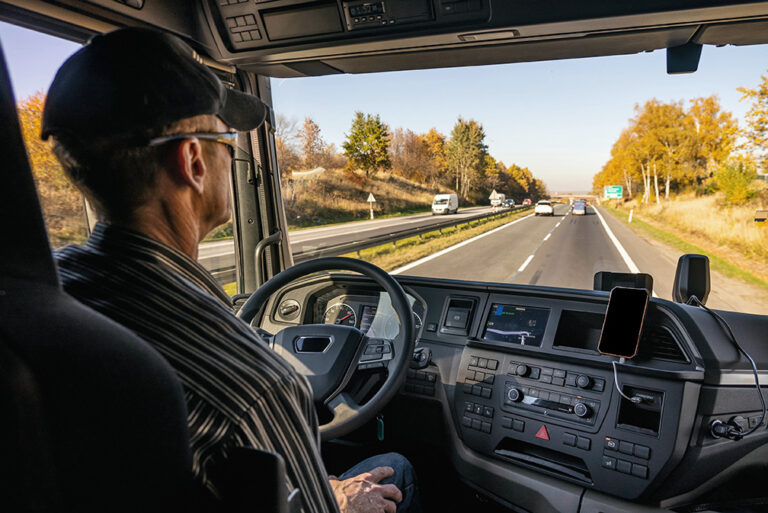
Drivers are taught early in their careers to maintain an eye scan around the vehicle. Windows, mirrors, windshield, gauges — it’s all a part of keeping your head on a swivel, constantly monitoring what’s going on all around. Visually checking blind spots (not just noticing the alert lights installed in the mirror) is still vitally important before changing lanes. Monitoring the distance to the vehicle ahead is still critical.
Often, drivers are taught to repeat their eye scan every so many seconds. A Smith System “key” to safe driving is to Keep Your Eyes Moving.
If you’re concerned about how often to check your mirrors, however, the correct answer is this: “As often as necessary.” There is no set formula.
When traffic is heavy all around, you’ll want to repeat the mirror scan frequently while also scanning ahead for hazards. In the middle of the night on a rural stretch of highway when traffic is light, you’ll want to pay more attention to the road ahead, watching for animals, pedestrians or disabled vehicles. If there are no headlights showing in your mirrors, you can adjust your scan to spend more time looking ahead.
Adjust the timing of your gauge checks, too.
Methodically checking a fuel gauge every 30 seconds is likely to be a waste of time, but a temperature gauge running warmer than normal might warrant some extra attention. Don’t ignore gauges, but keep priorities in order.
One way to maximize eye scans is to minimize distractions. Many GPS units display a turn-by-turn map from the perspective of looking ahead of the vehicle. An occasional glance may be necessary, but focusing on the screen for more than a few seconds takes your eyes off the road ahead long enough to cover a lot of ground.
Be aware of how much ground you’re covering per second.
How can you know how much ground you’re covering? Multiply your speed in miles per hour by 1.46667 to convert it to feet per second. I suggest using 1.5 instead; it’ll be off by a tiny bit, but the math is a whole lot easier to do in your head. So, 60 mph times 1.5 = 90 fps.
This is more than just an interesting way to look at speed. It means that for every second your eyes are somewhere besides the road ahead, you’ve covered that distance driving blind:
- Five seconds to look at a billboard at 60 mph = 450 feet.
- Eight seconds to read a text message 60 mph = 720 feet.
- 10 seconds to check every gauge on the dash 60 mph = 900 feet.
If your speed is 70 mph, that last example jumps to more than 100 fps, and at 80 mph it leaps to 120 fps.
It’s not an exaggeration to say that you literally have to make a decision about how long it’s safe to drive without looking. That’s why you keep your eyes moving and don’t allow distractions to take away your eyes.
Don’t let your cellphone be a distraction.
It’s no secret that using a smart phone while driving is a dangerous distraction. That’s because these devices are far more than phones. They’re hand-held computers, capable of surfing the internet and performing many of the functions of a laptop.
Some of those functions are designed to make the truck driving job easier and more efficient. No function, however, is worth a highway crash and, potentially, your life or the lives of others.
Professional drivers learn quickly to anticipate the actions of others.
A motorist that is weaving in and out of traffic is likely to continue that behavior alongside and ahead of your truck. A vehicle full of children is likely to be a distraction to its driver.
One trick pro drivers use it the knowledge that motorists often telegraph their intentions with the direction of their line of sight. If they’re looking left, there’s a good chance they’re drifting left too, and will soon be making a lane change in that direction. If you pay attention to the vehicles around you, you’ll be able to predict what many of them will do and be prepared for it.
Tailgaters, or other motorists following too closely to your vehicle, can attract your attention to the degree that they become distractions. Don’t let them draw your attention from the road ahead. If you fail to identify a hazard and become involved in a crash, the tailgater isn’t likely to accept responsibility.
It’s an unfortunate truth that actions that you take in an attempt to be safer, like monitoring a tailgater, can distract you if you let them, making you less safe in the long run.
You can’t control the distractions you’ll encounter on the highway, but you CAN control your reaction to them. Make sure you know what’s going on all around your vehicle, but especially the road ahead. It’s your future.

Cliff Abbott is an experienced commercial vehicle driver and owner-operator who still holds a CDL in his home state of Alabama. In nearly 40 years in trucking, he’s been an instructor and trainer and has managed safety and recruiting operations for several carriers. Having never lost his love of the road, Cliff has written a book and hundreds of songs and has been writing for The Trucker for more than a decade.