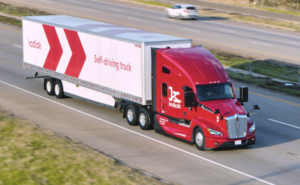




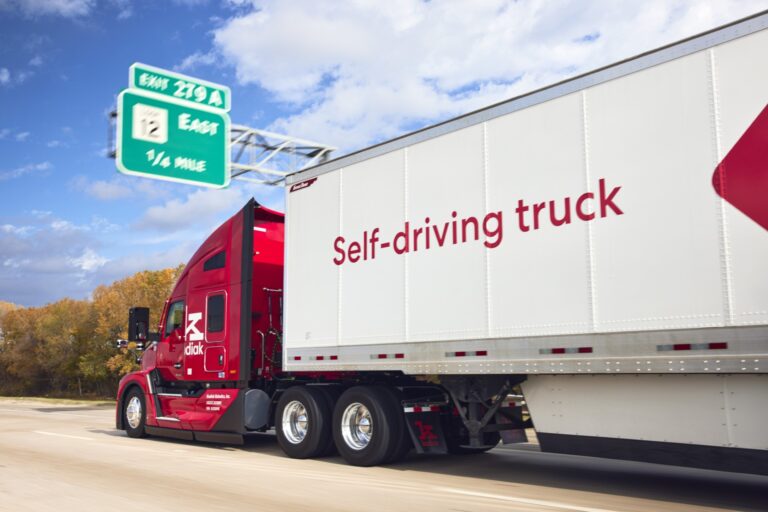
MOUNTAIN VIEW, Calif. — Kodiak AI Inc. is collaborating with AMD to implement its AMD EPYC Series processors to power Kodiak’s seventh-generation autonomous truck platform.
According to a company press release, Kodiak is the first company to deploy the advanced AMD EPYC processors into their hardware platform for driverless trucking. High-performance AMD EPYC Series CPUs provide the compute performance needed to quickly and reliably aggregate and preprocess the massive volume of sensor data required to safely operate the Kodiak Driver, Kodiak’s autonomous driving system.
“Physical AI is pushing computing into some of the most complex and data-intensive environments in the world,” said Wayne Lyons, senior director, automotive market, AMD. “Kodiak is demonstrating what’s possible when advanced autonomous driving software is paired with high-performance AMD compute. Together with Kodiak, AMD is providing the processing capabilities needed to move driverless trucking from innovation to significant scale.”
Navigating Complex Environments
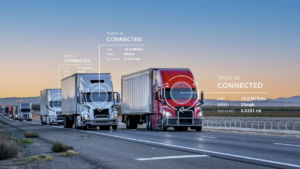
According to the release, driverless trucks demand exceptional central processing unit (CPU) performance. Within the seventh-generation Kodiak Driver, AMD EPYC CPUs aggregate sensor data, preprocess information collected by LiDARs, cameras and radars, and support the path-planning processes that determine how the vehicle safely and efficiently navigates complex environments.
“Physical AI requires compute capabilities that can rapidly handle enormous amounts of sensor data while supporting increasingly sophisticated AI workloads,” said Don Burnette, founder, CEO, Kodiak. “AMD delivers best-in-class CPU technology with the performance, scalability and efficiency required for advanced autonomous driving applications. AMD EPYC CPUs give us the compute capabilities we need to advance the Kodiak Driver and continue commercializing autonomous trucking.”
Demanding Compute Requirements
“AMD EPYC is designed to support the demanding compute requirements of autonomous driving,” the release said. “Key CPU workloads in autonomous driving, including sensor processing, localization, and path planning, are latency-sensitive and cannot easily be parallelized. These capabilities help the Kodiak Driver efficiently process critical data and support increasingly sophisticated AI workloads. The AMD EPYC CPU provides a meaningful performance upgrade, including a significantly higher clock speeds than the previous generation device. Faster clock speeds at lower power consumption enable the Kodiak Driver to process critical data more quickly and support increasingly sophisticated AI workloads.”
According to the release, using leading, commercially available hardware from AMD allows Kodiak to focus its resources on quickly building scalable, production-ready autonomous trucks. This approach is increasingly important as Kodiak grows its driverless fleet in the Permian Basin that already operates with no humans in the cab today. Kodiak is working toward launching driverless trucks on public highways later this year.

Dana Guthrie is an award-winning journalist who has been featured in multiple newspapers, books and magazines across the globe. She is currently based in the Atlanta, Georgia, area.