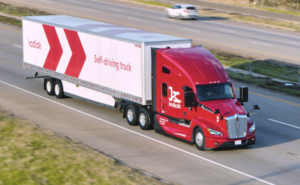





Autonomous trucking companies welcome five-year exemption; OOIDA questions safety of alternative warning system
The Federal Motor Carrier Safety Administration (FMCSA) has cleared the way for autonomous trucks to replace traditional roadside warning triangles with flashing warning beacons mounted on the truck itself.
The agency granted a five-year exemption Oct. 7, allowing qualifying motor carriers operating Level 4 automated driving systems (ADS) to use cab-mounted flashing amber beacons instead of the reflective warning devices required under federal regulations.
The exemption, originally requested by Aurora Operations, takes effect Oct. 7, 2026, and expires Oct. 7, 2031. It also extends to other qualifying autonomous trucking operators that notify FMCSA of their intent to operate under the exemption and comply with its conditions.
The decision addresses a practical problem facing developers of driverless trucks: Federal regulations require drivers to place warning devices around commercial vehicles stopped along a highway, but an autonomous truck operating without a human driver has no one available to set out the devices.
Under the exemption, qualifying trucks can use flashing amber beacons mounted high on the cab to alert approaching motorists when the vehicle is stopped.
FMCSA says it determined that the alternative warning system is likely to achieve a level of safety equivalent to or greater than the protection provided by existing regulations, provided operators comply with the exemption’s conditions.
Specific requirements apply
The exemption does not eliminate the requirement for stopped trucks to warn approaching motorists.
Qualifying vehicles must be equipped with flashing amber beacons that are visible from the front and rear. The beacons must activate as soon as possible, but no later than five minutes after a qualifying stop. The trucks’ regular hazard warning lights must also remain in operation.
The exemption includes restrictions on eligible vehicles and operations, along with reporting requirements intended to help FMCSA monitor the safety of the alternative warning system.
Motor carriers operating under the exemption must report crashes involving required beacon use within five calendar days and submit annual reports on their operations.
The exemption applies only to qualifying Level 4 autonomous trucks operating within the conditions for which their automated driving systems are designed and validated. It does not change the warning-device requirements for conventional, human-operated commercial vehicles.
Autonomous trucking industry welcomes decision
Although Aurora originally sought the exemption, other autonomous trucking companies are preparing to take advantage of the decision.
Kodiak AI announced that it intends to notify FMCSA of its plans to operate under the exemption.
“This exemption further empowers Kodiak and other innovators to usher in an autonomous era of freight movement on U.S. roads, one that can save lives and improve the efficiency of goods delivery,” said Daniel Goff, vice president of external affairs at Kodiak AI.
Goff also praised the agency’s decision to modernize transportation regulations while prioritizing safety and providing regulatory clarity.
The approval follows earlier efforts by autonomous trucking developers to obtain relief from roadside warning-device requirements.
In December 2024, FMCSA denied a broader exemption request submitted by Aurora and Waymo, citing insufficient information to determine whether the proposed alternative would provide an equivalent level of safety.
Aurora subsequently operated under temporary waivers while gathering additional information about the performance of its warning beacons.
In its latest decision, FMCSA cited operating experience and additional safeguards in concluding that the alternative system could provide an equivalent or greater level of safety.
OOIDA challenges FMCSA’s safety determination
The Owner-Operator Independent Drivers Association (OOIDA) strongly criticized the exemption, arguing that cab-mounted beacons cannot adequately replace traditional roadside warning devices under all driving conditions.
The association submitted formal comments opposing the exemption May 15, raising concerns about the effectiveness of the warning system in real-world operating environments.
“Beacons are not an adequate replacement for warning devices across the range of curves, hills, weather, trailer types, failure modes and emergency conditions that trucks encounter every day,” said Todd Spencer, OOIDA president and CEO.
Spencer contends that FMCSA’s decision compromises highway safety.
“In today’s disappointing decision, FMCSA has chosen a less safe system over a proven and reliable solution,” he said.
OOIDA also expressed concern that the exemption could establish a precedent for relaxing existing safety requirements to accommodate autonomous vehicle technology.
“This corporate carve-out sets a troubling precedent,” Spencer said. “Relaxing safety standards for the AV industry, which fights tooth and nail against even minimal transparency and accountability, should alarm all highway users.”
The association urged FMCSA to take a different approach when considering future exemption requests.
Could conventional trucks eventually use beacons?
Although the exemption applies only to qualifying autonomous trucks, FMCSA noted that cab-mounted warning beacons could also offer benefits for trucks operated by human drivers.
In its decision, the agency noted that a beacon-based warning system could eliminate the need for drivers to exit their vehicles and walk along highway shoulders to place reflective triangles — an activity that can expose drivers to the dangers of passing traffic.
FMCSA suggested that broader changes to warning-device regulations, potentially extending similar technology to conventional commercial vehicles, could warrant consideration through future rulemaking.
For now, however, FMCSA’s decision applies only to qualifying autonomous trucking operations, leaving existing roadside warning-device requirements in place for the rest of the trucking industry.

Linda Garner-Bunch has been with The Trucker since 2020, picking up the reins as managing editor in 2022. Linda has nearly 40 years of experience in the publishing industry, covering topics from the trucking and automotive industry to employment, real estate, home decor, crafts, cooking, weddings, high school sports — you name it, she’s written about it. She is also an experienced photographer, designer and copy editor who has a heartfelt love for the trucking industry, from the driver’s seat to the C-suite.