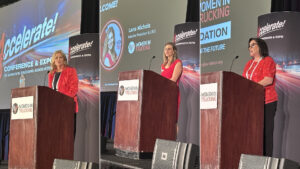




DALLAS — When Federal Motor Carrier Safety Administration (FMCSA) Administrator Derek Barrs asked everyone attending the Women In Trucking Association’s (WIT) Accelerate! Conference & Expo to stand, it wasn’t for his own recognition.
It was to recognize the people who keep America’s freight moving.
After thanking everyone in the room for their contributions to the trucking industry, Barrs asked those who hold a commercial driver’s license (CDL) to remain standing while everyone else sat down.
Then he turned the tables, asking the drivers to be seated while the rest of the audience stood in their honor.
“This right here is the backbone of America,” Barrs said, emphasizing the importance of professional drivers and the need to support them.
“We need to make sure that we continue to do everything that we can to strengthen what they do every single day,” he said.
It was one of several moments during Barrs’ opening keynote that offered attendees a glimpse of the man behind the federal agency responsible for overseeing commercial motor vehicle safety.
Although his presentation included a discussion of FMCSA’s priorities, enforcement efforts and regulatory initiatives, Barrs also spoke candidly about his Christian faith, his family, his upbringing and the experiences that continue to influence his approach to roadway safety.
And rather than spending the entire session delivering prepared remarks, he devoted considerable time to answering questions from the audience — including some for which he acknowledged he didn’t have all the answers.
Finding His ‘Why’
Barrs began his presentation by departing from his prepared remarks, inspired by an earlier discussion of the personal values and priorities that motivate people in their professional and personal lives.
He said the conversation had him thinking about his own “why.”
“The first one is surely my faith in God. And my faith in Jesus Christ. That is the number one thing in my life,” he told attendees. “I’m not afraid of it. I’m glad to talk about it, and I’m thankful for the raising that I had.”
Family comes next, he said, followed by the community where he grew up and the people who have helped shape his life.
Barrs reflected on how relationships evolve over time and the role others play in helping people find their way.
“The good Lord kind of puts people in your life at a certain time,” he said.
Some relationships last a lifetime, he noted, while others serve a purpose during a particular season.
He also spoke about the influence of growing up in a small town, where people knew their neighbors and a family’s reputation meant something.
“If you hadn’t heard a rumor (by) about 9 o’clock, somebody had to start one,” he joked.
Behind the humor was a lesson about accountability, character and the importance of service. Barrs said his upbringing taught him that a person’s actions matter, not only to their family and community but also to the people whose lives they touch through their work.
That message carried over to the trucking professionals gathered in Dallas.
“Everybody that’s in this room, you mean something,” he said, thanking attendees for the work they do to support the nation’s economy and provide goods and services that many Americans take for granted.
A Memory that Never Faded
Later in his presentation, Barrs again asked audience members to stand. This time, however, the mood was more somber. He asked anyone who had witnessed the aftermath of a fatal traffic crash to rise.
“When you stood up, you should have thought about somebody that you saw,” he told them. “This is the reason why we have to do everything that we can.”
Barrs recalled the first traffic fatality he encountered — a 19-year-old woman who was killed when her vehicle crashed into a logging truck.
He had taken the 911 call reporting the crash and, after finishing his shift, went to the scene, where the victim had not yet been removed from the wreckage.
The experience left an impression that has stayed with him throughout his career.
“I will never forget that as long as I live,” he said.
He asked those standing to remember the people whose deaths they had witnessed — and to recognize those lives as part of the reason roadway safety matters.
For Barrs, the work of FMCSA goes beyond regulations, inspections and compliance. At its heart is the responsibility to prevent tragedies and protect the people who share America’s highways.
That includes professional drivers, he emphasized, as well as the families and communities whose lives can be changed in an instant by a crash.
Supporting the people who keep America moving
Throughout his presentation, Barrs repeatedly returned to the importance of professional drivers and the challenges they face.
Whether male or female, he said, drivers deserve the tools, training and support necessary to perform their jobs safely.
Finding safe places to park, having access to clean and secure restroom facilities, spending extended periods away from family, and dealing with harassment or discrimination are all issues that can affect a driver’s quality of life.
They can also influence whether someone chooses to remain in the profession.
“These are not just general issues that we’re talking about,” Barrs said. “They affect your personal security, your quality of life, and decisions that you make, whether you continue to stay in this profession or not.”
He acknowledged the contributions women are making throughout the transportation industry, from behind the wheel to leadership positions.
Barrs also took time to recognize women serving in key roles at FMCSA, praising their work and commitment to improving transportation safety.
He noted that career opportunities in transportation extend far beyond driving, and that developing the next generation of workers requires introducing young people to the industry’s possibilities.
Drawing on his own experience as a former school board member, he stressed the importance of workforce development beginning at an early age.
“This is a great profession,” he said, adding that industry stakeholders should work together to promote the positive aspects of trucking while addressing the problems that undermine safety and professionalism.
A Willingness to Listen
While Barrs had prepared remarks addressing FMCSA’s initiatives, a significant portion of the session was devoted to questions from attendees.
The discussion covered a wide range of issues, including driver training, enforcement, electronic logging devices, truck parking and efforts to improve safety across the industry.
Some questions were pointed. Others raised concerns about existing regulations, shortcomings in driver education or the challenges facing women who want to enter and remain in trucking.
Barrs responded directly, sometimes explaining actions already underway and other times acknowledging that FMCSA needs to take a closer look at an issue.
Asked what could be done to better support women working in trucking, he emphasized the importance of partnerships and continued communication between the agency and the industry.
“I don’t know everything about the industry,” he acknowledged.
He said hearing directly from the people affected by FMCSA’s regulations helps the agency identify problems and develop better solutions.
That approach was evident when an attendee raised concerns about the quality and consistency of training drivers receive after earning their CDLs and going to work for a motor carrier.
Barrs acknowledged the complexity of the issue, particularly when considering the differences between large fleets, small carriers and owner-operators.
Rather than offering an easy solution, he said the matter deserved further examination.
“I actually don’t have an answer for you, to be honest with you,” he said. “But it is something that we need to be looking at.”
“I don’t want to just kick the can, because that’s not my style,” he continued.
On another question concerning delays in removing noncompliant driver training schools, Barrs said he wasn’t familiar with the specific cases cited but would look into the matter.
His willingness to acknowledge what he didn’t know was a recurring part of the exchanges.
Barrs also urged industry professionals to submit comments on proposed federal regulations, emphasizing that individual input is important and that comments from drivers and other stakeholders can help shape the rules that ultimately affect their work.
Working Together for a Safer Industry
Barrs acknowledged that FMCSA faces challenges of its own, including limited resources and the need to address longstanding problems within the commercial transportation system.
Nevertheless, he expressed confidence that progress is possible when regulators and industry professionals work toward the same goals.
His message was one of shared responsibility — that improving trucking safety requires cooperation among drivers, carriers, educators, regulators and enforcement personnel.
He also returned to the lessons of his upbringing, recalling his father’s advice that anything worth having requires hard work.
As a young man, Barrs said, he learned valuable lessons through jobs he ultimately decided weren’t for him, including working in tobacco, plumbing and painting.
Those experiences, he said, helped teach him perseverance and the importance of picking himself up after setbacks.
He encouraged attendees to learn from their mistakes, recognize the value of people working in all areas of transportation and continue finding ways to make the industry better.
“We have to level the playing field,” he said. “We have to root out the bad so the cream can rise to the top.”
The Conversation Continues
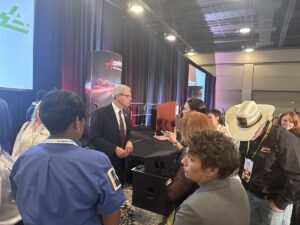
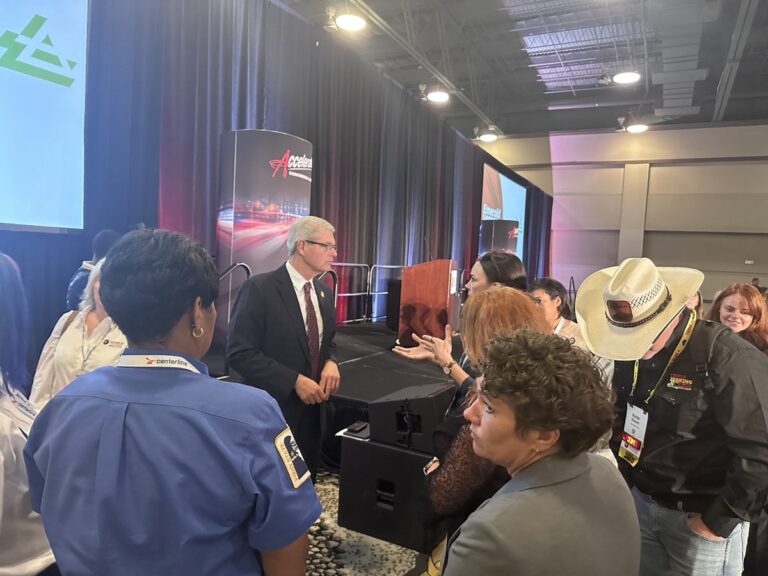
When the formal question-and-answer session ended, Barrs’ conversations with trucking professionals didn’t.
Rather than leaving immediately after the keynote, he remained near the stage, visiting with attendees who gathered around him.
Professional drivers, industry representatives and others took advantage of the opportunity to speak with the administrator face to face.
The exchanges reflected much of the message Barrs had delivered from the podium: Improving trucking safety requires listening to the people who know the industry firsthand.
Throughout the session, Barrs had emphasized that FMCSA’s mission is about more than enforcing regulations. It’s about protecting lives, supporting professional drivers and strengthening an industry on which the nation depends.
And the values he described at the beginning of his presentation — faith, family, community and service — provided a personal perspective on the responsibilities he carries as the agency’s administrator.
As he told attendees during his opening remarks, the work they do matters, even when the people who benefit from it never see what goes into moving America’s freight.
“We need to make sure that we don’t forget you,” Barrs said. “And so at this agency, we are not going to forget who you are and what you’re doing.”

Linda Garner-Bunch has been with The Trucker since 2020, picking up the reins as managing editor in 2022. Linda has nearly 40 years of experience in the publishing industry, covering topics from the trucking and automotive industry to employment, real estate, home decor, crafts, cooking, weddings, high school sports — you name it, she’s written about it. She is also an experienced photographer, designer and copy editor who has a heartfelt love for the trucking industry, from the driver’s seat to the C-suite.