




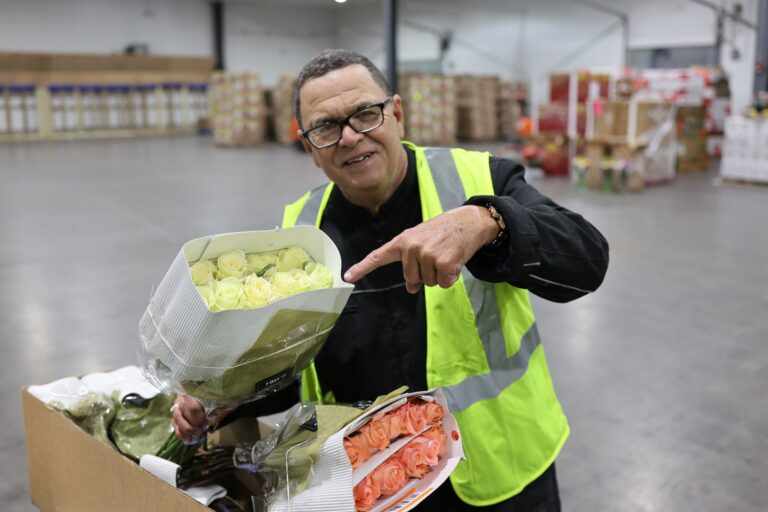
EDEN PRAIRIE, Minn. — Valentine’s Day marks the beginning of floral peak season and C.H Robinson is giving an inside look into how the company moves so many petals.
“What you might not realize when you receive that perfect bouquet, is what a complex, sophisticated logistics operation it took to bring it to you,” said Jose Rossignoli, president of Robinson Fresh, the company’s fresh supply chain solutions division. “When you’re handling a perishable product that starts losing shelf life the moment it is cut, you need to have the ability to orchestrate operations across a full ecosystem of growers, air, temperature-controlled carrier capacity, warehouses, and the retailers we work with to ensure that the product is on display at the exact right time, at thousands of points of sale. Every single part must run like clockwork.”
The company will move up to 10 million boxes of flowers—representing one out of every four fresh floral units sold in retail—helping to bring joy to lovers, sweethearts and secret flames all over.
A Closer Look at the Numbers and Timeframes Illustrates the Complexity of the Operation
- The great floral migration: About 70% of all flowers sold in the U.S. every year move North from Latin America during the three-month peak season from Valentine’s Day (Feb. 14) to Mother’s Day (May 10). 95% of these come from Colombia and Ecuador. 80% move through Miami’s International Airport within 24 hours of being cut, before being distributed to thousands of retailers across the U.S.
- Business is blooming: U.S. retail flower sales reached approximately $9.8 billion last year, growing nearly 50% over five years. Globally, the floral market exceeds $72 billion. In Colombia and Ecuador, florals account for up to 15% of total exports. In the U.S., all that product drives a 2,500% surge in floral volumes for Valentine’s Day alone.
- No room for error: Flowers need to be moved at a steady temperature of 35-38º F, and 90-95% humidity. Any fluctuation in those values and every delay means loss of freshness. That means minimizing dwell time on the tarmac, smooth handoffs, and flawless last-mile execution are crucial. For every minute that is lost, shelf life dwindles and profits fall.
End-to-End Coordination and Adaptability
According to a company press release, during the 2024 floral season, C.H. Robinson delivered 98% on-time. The company can do that because it combines product sourcing, supply chain solutions and tailored customer service under one umbrella. As a result, it can track, analyze and optimize every box of flowers’ journey across the length of the supply chain, and adapt to disruptions such as extreme weather, flight cancelations or labor shortages in real time.
“What makes C.H. Robinson, so uniquely fit for this job is our scale, end-to-end coordination and adaptability” said Jim Mancini, vice president of customer success. “Moving so many millions of flowers between continents in such a short timeframe requires a fully integrated approach that aligns planning, sourcing and execution, as well as the ability to pivot quickly when the unexpected happens—and to do it better every single year.”

Dana Guthrie is an award-winning journalist who has been featured in multiple newspapers, books and magazines across the globe. She is currently based in the Atlanta, Georgia, area.