



WASHINGTON — The U.S. Department of Labor (DOL) announced a final rule Nov. 19 that changes how it determines whether workers — including truck drivers — are employees or independent contractors under federal wage and hour law.
The rule replaces the department’s 2024 standard and takes effect 60 days after publication in the Federal Register. It does NOT automatically reclassify drivers or change separate state classification laws.
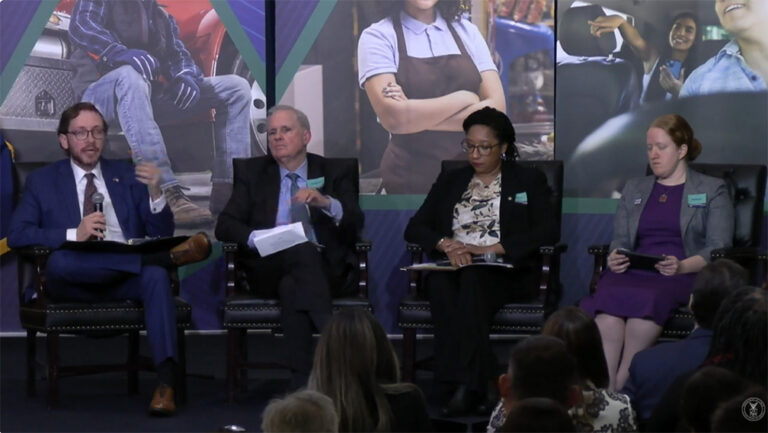
Watch the DOL’s announcement and panel discussion at the end of this story or view it on YouTube.
What changes under the new rule
The basic question under the Fair Labor Standards Act remains whether workers are in business for themselves or depend on an employer for work. The 2024 rule listed six factors without assigning any of them a set weight. Under the new rule, two factors generally carry more weight than the others:
- Who controls the work? Can the worker make meaningful decisions about scheduling, which jobs to take and whether to work for others?
- What drives profit or loss? Can the worker improve the bottom line through business decisions or by managing an investment, beyond simply working more hours?
Other considerations include the skill required, how permanent the working relationship is and how the work fits into the company’s operations. The same analysis also applies under the Family and Medical Leave Act and the Migrant and Seasonal Agricultural Worker Protection Act.
What a truck lease can tell you
In examples accompanying the rule, the department describes two drivers who lease trucks from the carriers they haul for.
In the first case, the carrier sets nonnegotiable rates, the driver must commit to a shipment before learning what it pays, and the lease offers no realistic path to ownership. Those facts point toward employee status under the profit-or-loss factor.
In the second, the driver can negotiate rates before accepting a load, sometimes line up a paying backhaul, and realistically work toward owning the truck. Those facts point toward independent contractor status under that same factor. The distinction is what the driver can actually do under the arrangement, not simply whether there’s a lease.
In a separate example, DOL says requiring federally mandated drug and alcohol testing and enforcing agreed-upon delivery deadlines do not, by themselves, count as employer control. That distinction addresses an issue the Truckload Carriers Association raised during the comment period.
Trucking industry reaction
The American Trucking Associations, which opposed the 2024 standard, welcomed the final rule. ATA said members of its Women In Motion Council met with Labor Department officials last year to explain why the independent contractor model matters to them.
“Being an independent contractor gives me the power to choose my own routes and control my own schedule to ensure I can be home for weddings, graduations, and other special moments,” independent truck driver Emily Plummer said in ATA’s statement.
The Owner-Operator Independent Drivers Association (OOIDA) welcomed several revisions but said it would take time to assess the rule’s full impact on its members.
“While the rule does not address all of our concerns, it also does not create new barriers for an owner-operator to work as an independent contractor,” OOIDA President and CEO Todd Spencer said in a statement.
Spencer welcomed DOL’s acknowledgment that speed limiters are not federally required and its clarification that carriers can’t justify micromanaging drivers simply by labeling equipment a safety requirement. He also pointed to provisions that could help drivers in predatory lease-purchase arrangements.
“With that said, the effectiveness of this regulation will be determined by how its details are interpreted and enforced,” Spencer said.

Linda Garner-Bunch has been with The Trucker since 2020, picking up the reins as managing editor in 2022. Linda has nearly 40 years of experience in the publishing industry, covering topics from the trucking and automotive industry to employment, real estate, home decor, crafts, cooking, weddings, high school sports — you name it, she’s written about it. She is also an experienced photographer, designer and copy editor who has a heartfelt love for the trucking industry, from the driver’s seat to the C-suite.