The trucking industry received some positive news in December, helping generate optimism about an improving freight market.
• On Dec. 10, 2025, the Federal Reserve cut its key overnight lending rate by another quarter percent, bringing its current range to 3.5% to 3.75%. The stock market responded with new pricing records.
• The national average price per gallon for diesel fuel has fallen every week since mid-November. According to the U.S. Energy Information Administration (EIA), prices should remain steady well into the new year.
• Two days before Christmas, the U.S. Commerce Department announced that the U.S. economy outpaced expectations in the third quarter, growing at 4.3%.
• Tariffs certainly had an impact on economic growth. The value of imports is generally subtracted from a country’s Gross Domestic Product. During the first quarter of the year, imports increased as retailers and manufacturers sought to get ahead of tariffs, resulting in a lowered GDP. In the second and third quarters, imports declined, pushing GDP numbers upward.
• Perhaps the best news for truckers is that freight rates rose in November, at least in part due to tightening capacity. The market has been oversupplied with available trucks for years, keeping rates at or below survival level for many carriers. U.S. sales of new, Class 8 trucks nosedived to near 12,500 units in November, the worst November since 2010 and the Great Recession. That’s about 7,200 fewer trucks than were sold in November 2024, a decline of 36.5%.
Capacity tightening but rates sluggish
DAT Freight and Analytics, in their “Trendlines” report, showed an 20.6% increase in spot load posts in November 2025 compared with November 2024. For the same period, spot truck posts fell by 21.7%.
More available loads with fewer available trucks to haul them is the formula the industry needs to move freight rates into higher territory. The DAT report shows this happening.
Dry van spot rates were 0.5% higher in November 2025 than in the same month of 2024. Likewise, refrigerated spot rates showed an increase of 0.9%. Flatbed rates fell 1.2% year over year, but a robust economy and lowered interest rates may show an impact in spring when the homebuilding season kicks off for 2026.
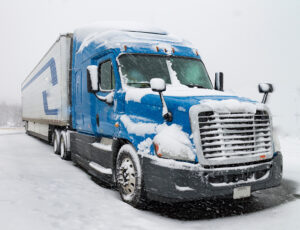
Rates for all three trucking categories rose again in December, but the final numbers aren’t in yet. During the last week of 2025, severe winter storms in the Midwest and Northeast, as well as torrential rains and flooding in Southern California, should hold capacity down and push rates higher.
“After three winter storms in the first half of December, TL (truckload) spot rates are 10% above year-ago levels in late-December, rising about 8% in seasonally adjusted terms over the past month,” explained Tim Denoyer, vice president and senior analyst at ACT Research.
Denoyer cautioned that weather-related increases are temporary.
“However, these past few weeks have done more to swing the pendulum of pricing from shippers back towards fleets than anything we’ve seen in a few years,” he noted.
As the capacity contraction accelerates, this swing will continue in 2026.
According to ACT’s For-Hire Indexes, freight pricing has been positive for five consecutive months while freight volumes were up in November 2025.
The American Trucking Associations (ATA), dealing with predominantly contract freight, announced a 0.2% increase in its Truck Tonnage Index for the same month.
“In addition to challenging volumes, more capacity appears to be leaving the industry after a prolonged freight downturn and increased government enforcement measures targeting unqualified drivers and noncompliant carriers,” explained Bob Costello, ATA’s chief economist.
The Cass Freight Index for November 2025 showed a month-over-month increase in shipments of 0.7%, which is 2.7% when adjusted for seasonality. For the same month, the firm’s Expenditures Index rose 2.1% on a seasonally adjusted basis.
“Though not necessarily sustainable, as weather effects are typically brief, the stormy winter combines with tightening capacity and contributes to the eventual cycle turn,” said ACT’s Denoyer, who also writes for the Cass report.
DAT Principal Analyst Dean Croke, in a recent interview with The Trucker, said “I think going the next year, the domestic manufacturing side of it should start to pick up, barring any cataclysmic events.
“We’re not going to see a blockbuster,” he said, offering a prediction for 2026. “Instead of too much capacity chasing not enough demand, I think we’ll see just enough capacity chasing stable demand.”
The freight market may be turning, but how fast the changes occur can be influenced by other events. Weather has already played a part and the season only officially started on December 21. President Donald Trump has ordered the seizure of multiple Venezuelan oil tankers. Sabre-rattling between that country and the U.S. could escalate, and any action to curtail oil exports from Venezuela could push crude prices higher, impacting not only diesel fuel prices but manufacture of petroleum-based products, too.
Fewer trucking jobs further tightens capacity
Another indicator that capacity in the trucking market is shrinking comes from payroll employment figures released by the U.S. Bureau of Labor Statistics. In a report that was delayed by the 43-day government shutdown this fall, the bureau reported the largest decline in truck transportation jobs since May 2024.
In September 2025, trucking employment fell by 8,000 jobs, declining an additional 1,300 in October and another 4,400 in November. That’s 13,700 jobs in three months.
“The upshot is that we suddenly have a weaker picture of employment, which almost certainly translates into tighter capacity as drivers make up the majority of payroll jobs and clearly are the most subject to major population shifts in short periods of time,” said Avery Vise, vice president of trucking at FTR Transportation Intelligence.
Some of those job losses are undoubtedly from large carriers that have downsized their fleets. With fewer trucks, carriers can tighten hiring standards and reduce recruiting efforts.
However, a portion of the jobs decline is attributable to drivers leaving the trucking industry. Facing higher road expenses, reduced miles and closing carriers, some drivers have chosen other professions.
The freight market recovery can be expected to have ups and downs, and economists are cautioning that rate increases will be gradual, but signs are there for improvement in 2026.

Cliff Abbott is an experienced commercial vehicle driver and owner-operator who still holds a CDL in his home state of Alabama. In nearly 40 years in trucking, he’s been an instructor and trainer and has managed safety and recruiting operations for several carriers. Having never lost his love of the road, Cliff has written a book and hundreds of songs and has been writing for The Trucker for more than a decade.