






WASHINGTON — Trucking groups are rallying behind “Dalilah’s Law” a proposed legislation aimed at prohibiting states from issuing commercial driver’s licenses (CDLs) to undocumented immigrants.
Introduced by Senator Jim Banks, the law would enforce restrictions by threatening to revoke U.S. Department of Transportation (USDOT) funding for non-compliant states.
“Too many people have been hurt,” Banks said. “Too many have been killed. Americans are paying the price because illegal drivers are being handed commercial driver’s licenses like candy and put behind the wheel of 80,000-pound trucks. That stops now. The Dalilah Law makes it clear: if you are here illegally, you do not get a CDL. We need to act and we need to act now.”
The law, aimed at enhancing road safety, mandates English-only testing and restricts CDLs to citizens, permanent residents and specific visa holders.
“For years, unscrupulous carriers have exploited the ‘non-domiciled’ CDL program to recruit the cheapest labor possible, often at the expense of highway safety,” the Owner-Operator Independent Drivers Association said. “Dalilah’s Law reinforces recent USDOT and FMCSA actions to crack down on states issuing licenses to unvetted applicants and ensures that commonsense English language standards remain “on the books.”
Dalilah’s Law
In June 2024, five-year-old Dalilah Coleman suffered catastrophic, life-altering injuries when an illegal immigrant driving an eighteen-wheeler caused a six-car pileup. She endured a traumatic brain injury, skull fractures, a broken femur and weeks in a coma. While Coleman survived her injuries, she lives with permanent neurological damage and requires lifelong care.
According to the Department of Homeland Security (DHS), an Indian national, Partap Singh crossed into the United States illegally through the Mexico border in 2022, was arrested after allegedly causing the crash.
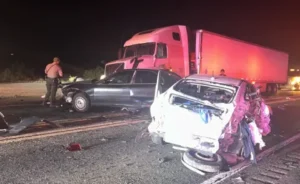
Dalilah and her father were recognized during President Trump’s State of the Union address, during which he called for a federal ban on states issuing CDLs to individuals who lack legal status, with strict English Language Proficiency (ELP) requirements so drivers can read road signs and communicate with law enforcement.
The bill is named in her honor.
OOIDA
“This legislation closes loopholes that have allowed unqualified individuals to obtain a commercial driver’s license (CDL) through the ‘non-domiciled’ CDL program and ensures full enforcement of English Language Proficiency standards for professional truck drivers, among other improvements,” said Todd Spencer, OOIDA president. “As the largest national organization representing small-business truckers and professional drivers, this legislation would help improve highway safety for our members making their living behind the wheel of a truck.”
According to Spencer, the legislation reinforces DOT/FMCSA’s authority to issue its recent regulations on non-domiciled CDLs and ensures that these important improvements are not reversed in the future. The legislation would also require states to review and revoke any improperly issued non-domiciled CDLs while ensuring that traditional CDL holders are not subject to an unnecessary recertification process.
English Language Proficiency Standards
“This legislation also makes critical improvements to English Language Proficiency standards. As we saw in 2016, DOT weakened enforcement by no longer placing drivers out-of service if they were unable to communicate to law enforcement in English or read road signs,” Spencer said. “In 2025, DOT and FMCSA reversed this dangerous decision, and Dalilah’s law would ensure that these requirements stay on the books. This legislation also requires that CDL testing is administered only in English and drivers must demonstrate proficiency before they can obtain their license. And just as importantly, this legislation also gives the Secretary the authority to crack down on carriers when they hire drivers lacking English proficiency. While drivers who lack English proficiency are certainly at fault and must be disqualified from driving, it is just as imperative to remove bad actors who knowingly put unqualified truckers out on the road.”
FMCSA’s Training Provider Registry
“Finally, the bill rightfully strengthens the certification process for entry-level driver training providers,” Spencer said. “OOIDA raised concerns with FMCSA’s Training Provider Registry (TPR) as it became clear that proper oversight was not being conducted during the initial years of implementation. The Entry-Level Driver Training Advisory Committee met more than a decade ago, and the industry has now seen how weak certification standards allowed fraud to take hold. Thankfully, FMCSA’s recent enforcement actions have removed thousands of inadequate and fraudulent entities from the TPR. Dalilah’s Law will build on these efforts by bolstering the training provider certification process. We appreciate Highways and Transit Subcommittee Chairman Rouzer’s leadership on these issues and are thankful that President Trump and Secretary Duffy have highlighted the serious safety shortcomings in existing law that have made our roads less safe. We look forward to continue working with the Committee and ultimately enact Dalilah’s Law.”
American Trucking Associations (ATA)
“We thank President Trump, Secretary Duffy, Administrator Barrs, and the House Transportation & Infrastructure Committee for their leadership and commitment to enforcing the laws that keep our highways safe,” ATA said. “Strengthening the integrity of the commercial driver’s license system is essential to restoring accountability, removing bad actors from the road, and protecting the overwhelming majority of professional truck drivers who follow the rules and uphold high standards.”
According to the ATA, the motoring public deserves confidence in who is operating heavy commercial vehicles. This legislation reinforces that trust by ensuring drivers are properly trained, tested, and qualified. By holding states accountable for how CDLs are issued, the bill establishes a consistent, lawful framework for employment in this safety‑critical industry—setting uniform testing standards and improving employer notification systems so agencies and industry can better share information. Together, these reforms increase transparency, support responsible carriers and drivers and strengthen the safety and reliability of the nation’s freight network.
“ATA will remain engaged throughout the legislative process to ensure the final product delivers real accountability, consistent enforcement and the high safety standards that benefit everyone on the road,” ATA said.

Dana Guthrie is an award-winning journalist who has been featured in multiple newspapers, books and magazines across the globe. She is currently based in the Atlanta, Georgia, area.



it’s about time they do something like this
Nothing more dangerous than another driver no able to understand the rules or having common sense to be behind a 40ton truck