



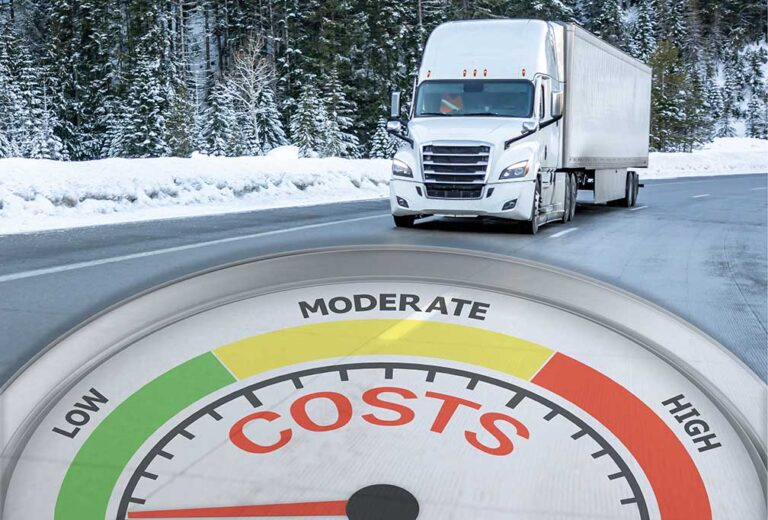
Making a living in the trucking industry is currently a tough go. Costs are high, rates are low and predicting what comes next is a roll of the dice. It takes careful cost control and judicious decision-making to keep your business afloat until profitability returns to the freight market.
If you don’t know your operational cost per mile, you’ve already failed.
It’s kind of like the old joke about the person who thought their checking account couldn’t possibly be empty because they still had checks: Too many truck owners assume that as long as they’re finding loads to haul everything will pan out eventually.
For these drivers, sooner or later a bill comes along that they just can’t pay. Maybe it’s an insurance premium increase, a traffic fine, a tax levy or a major repair. Often, these drivers will borrow from carriers they lease to or from friends and relatives — or they use the plastic in their pocketbook and add to their credit debt.
These solutions only delay the inevitable.
Revocations of operating authority averaged nearly 5,000 per month in 2025, according to the Federal Motor Carrier Safety Administration (FMCSA).
The vast majority of registered carriers are of the one-truck variety, so that’s a lot of owner-operators who shut down their businesses last year! And that’s not even counting the many thousands of truck owners who run under someone else’s authority by leasing to another carrier.
Face it: You’re a business owner, and you’ve got to manage that business.
Profit in the trucking industry begins with the understanding that buying a truck doesn’t make you a truck driver with a truck; it makes you the owner and manager of a trucking business.
Your thinking has to evolve to another level: That settlement check you’ll receive periodically is NOT a paycheck; it’s business revenue.
This is why knowing your cost per mile is vital.
If you don’t know your operational cost per mile, you increase the difficulty of deciding which loads to accept, when to shut down — and even how much to pay yourself. You can’t make good decisions about borrowing or spending if you don’t know how to calculate (or even read) a profit and loss statement.
Calculate both fixed and variable expenses.
Your fixed expenses — such as truck and insurance payments, costs for tags and permits, etc. — cost less per mile the more miles you run. On the other hand, your variable costs — like fuel and maintenance — increase when you run more miles.
If you have a plan for how many miles you’ll run this year, you can estimate your costs fairly accurately.
Fuel is, of course, a huge component of your cost per mile. It’s comparatively inexpensive right now, at least compared with last year. According to the U.S. Energy Information Administration, the U.S. national average price for a gallon of diesel fuel was $3.46 per gallon as of Jan. 19, 2025. That’s down more than 14 cents per gallon from a year ago (you can check weekly pricing averages at eia.gov/petroleum/gasdiesel).
If you keep track of your fuel mileage — and you should! — you’ll be able to calculate how much you’ll save per mile when diesel prices drop. For example, if your truck averages 6 miles per gallon, you’re saving 2.3 cents per mile on fuel at the average price noted on Jan. 19.
Risk has a cost, too.
Managing risk is a part of running a business. Things that you may have done as a driver — like running over the speed limit or hauling an overweight load without the proper permits — now could have a cost that comes out of your pocket if things go wrong.
When things go really wrong, accidents are costly.
Even if you aren’t at fault in an accident and litigation doesn’t occur, you still have the expenses of repairing your truck — and you won’t be earning revenue while it’s in the shop. Even with insurance coverage, you’ll have a deductible, along with costs for whatever insurance doesn’t cover.
Running safely and legally isn’t just an ethical thing to do; it actually saves your business money.
Your cost per mile is an important factor when choosing loads.
When you’re booking loads, your operational cost per mile figures prominently in your decision.
Many drivers have preferences about the areas they like to run, the weather, the scenery, the availability of parking or services and so on. When you OWN the business however, there are other considerations.
Freight rates differ from region to region, and higher rates can be tempting — but your operating costs can change, too.
Fuel cost is a great example: According to the latest EIA report, diesel fuel averaged $4.01 per gallon in New England, while the average cost was $3.16 along the Gulf Coast. That’s a difference of 85 cents per gallon — or more than 14 cents every mile you drive.
You may also experience tolls on your way to New England and paying for parking is a possibility, too.
Another consideration is your next load.
Before you accept what seems to be a good rate to a destination, use any available tools to check on rates for freight leaving that destination. It won’t do you any good to earn $3 per mile on the trip out if you’ll only make $1 per mile on the return trip.
You may even choose a load knowing that you’ll receive a lower return rate, if it sets you up for another good-paying load or helps you meet a scheduled activity such as time at home.
Look for regional opportunities as well.
Harvest times for agricultural products vary — but when perishable crops head to market trucks are tied up. Refrigerated trailers that sometimes haul dry van loads are busy with vegetables, leaving fewer trucks for the rest of the freight. California and Texas can be good places to haul from at harvest time.
If you’re not good at calculating all of these costs, ask for help.
A good accountant can help you track expenses and keep you apprised of where your business stands financially.
While many owner-ops think of accountants as necessary inconveniences in their businesses, they should be business partners that help you achieve your goals. Often, it’s easier for these finance professionals to see the “big picture” of your business. They deal with annual budgets and taxes, while you as driver have a more day-to-day perspective. An added bonus is that enlisting the aid of an accountant may save you enough on taxes to more than cover their fees.
Making good business decisions and ultimately realizing a profit depends on your knowing your operational cost per mile.
For more resources and news impacting small trucking businesses, visit The Trucker’s Owner-Operator Survival Guide.

Cliff Abbott is an experienced commercial vehicle driver and owner-operator who still holds a CDL in his home state of Alabama. In nearly 40 years in trucking, he’s been an instructor and trainer and has managed safety and recruiting operations for several carriers. Having never lost his love of the road, Cliff has written a book and hundreds of songs and has been writing for The Trucker for more than a decade.