



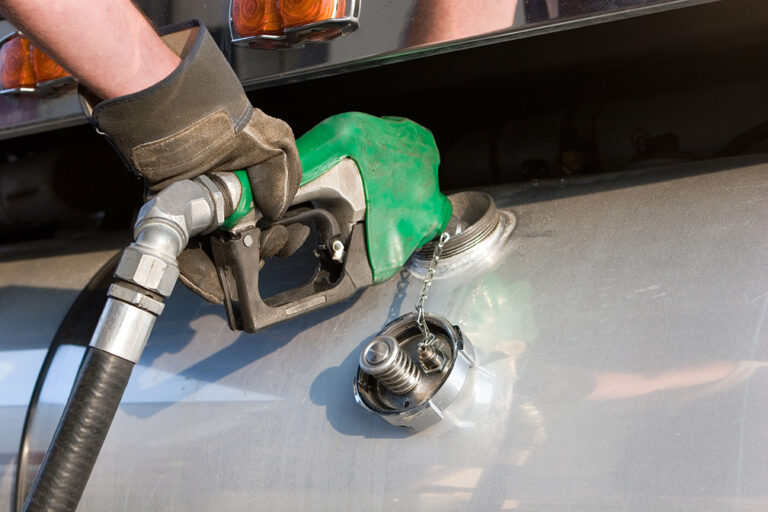
Do you feel like you’re paying too much at the gas pump? Fuel prices have been relatively stable lately, but there’s no denying that the cost of gasoline and diesel fuel has steadily increased since the Gulf War in the early 1990s.
In recent years, it’s been all too common for customers to shell out $5 or more per gallon for regular gasoline in some parts of the U.S. The other day, I heard a radio commercial claiming that the average driver spends $5,000 a year on gasoline.
Multiply that by 16 or 17 and you’ll see what many truck drivers pay for gasoline: The average U.S. truck driver spends upward of $60,000 on fuel each year.
That’s not surprising.
Truck drivers travel many more miles in a year than the average motorist, often averaging 10,000 miles per month or more. In addition, they’re also buying diesel fuel as opposed to gasoline — and diesel costs more than refined fuel.
Then, on top of all that, drivers running diesel must pay a higher fuel tax as opposed to those who burn gasoline, boosting costs even higher.
So, what’s the story behind fuel taxes?
When and why did the U.S. start taxing motor vehicle fuels, and how have those taxes changed over the decades?
Progress seldom comes without cost.
Modern motorists can trace fuel taxes over 100 years back in the U.S. Before motorized vehicles took to the roadways, the primary method of paying for the upkeep of those routes was user tolls, a relatively progressive model of taxation where maintenance for roadways was funded by people who actually used them.
But tolls could only raise so much revenue.
Even before the advent of motorized vehicles, many travelers became tired of paying for roads that were often kept in poor condition. The popularity of toll roads has suffered ever since.
Once motorized vehicles became the norm, the idea of taxing fuel seemed to be as fair as tolls. After all, only those who bought fuel would be traveling on the roadways, and the revenue could be used for maintenance.
Let’s talk about taxes.
In the U.S., the idea of taxes in general in the grew in favor in 1913, when the 16th Amendment was ratified, authorizing Congress to impose an income tax.
However, Congress was not quick to implement the income tax. For the most part, government in the early 20th century was funded through tariffs and various “sin taxes,” like those on alcohol and tobacco.
It really wasn’t until World War I that Congress saw the need to tax income to fund the war effort — and the tax was supposed to be temporary. Once the income tax arrived, however, it never left. Income taxes have grown into one of the most prolific and complicated methods of funding today’s government.
But what about fuel taxes?
Congress has always favored a “user pays” method of funding highway improvements, but the idea didn’t really start with Congress at all.
In 1919, the state of Oregon levied the first fuel tax in 1919 that levied the first fuel tax, charging a penny per gallon. The funds raised were dedicated to upkeep of roadways in the state.
The idea caught on quickly and spread to other states.
By 1929, all 48 existing states and the District of Columbia were levying taxes on fuel purchases, typically one or two cents per gallon.
At the time, the cost of a gallon of gas was about 21 cents, and the percentage of the rate (5% to 10%) was reasonable. Without federal taxation, gas taxes were bearable. Plus, the federal government largely saw highway maintenance and development as a responsibility of the state’s and did not involve itself in that sort of taxation.
That stance would change.
By 1932, with the Great Depression bearing down on the nation, the federal budget needed stabilization.
In the 1932 Revenue Act, which was designed to fund national interests (including defense), Congress recommended imposing a 1 cent per gallon tax on fuel
Although it wasn’t meant to pay for highways, Congress recommended imposing a 1 cent per gallon tax on fuel for a period of one year. President Herbert Hoover signed the bill into law, noting that he did not expect Americans to balk too heavily at the rather small — and temporary — tax.
Nine years later, that “temporary” tax still clung to the books, and President Franklin Roosevelt signed a 1.5 cent per gallon PERMANENT fuel tax into existence. While efforts have been made to repeal Roosevelt’s tax in the decades since, none have gained enough support.
Quite the opposite, in fact: The fuel tax slowly increased. By 1959, it stood at four cents per gallon. Then the increases suddenly halted, and the fuel tax remained stable for another twenty years.
Then changes began to hit, one after the other.
In the 1970s, economic conditions and the Arab Oil Embargo sent gasoline prices soaring. By 1981, gas prices topped out at well over $1.25 per gallon after only costing about 40 cents a gallon during the previous decade.
Regardless, Congress was motivated to act because of what it deemed as “the crumbling infrastructure” of America. The federal government got in on the act of repairing and maintaining highways with fuel tax dollars.
In 1982, Congress increased the fuel tax to 9 cents per gallon; a penny of that tax was intended to fund mass transit projects. By the early 1990s, Congress increased the tax again, leveling it at 18.4 cents per gallon in 1993.
Diesel, always levied at a higher tax rate, settled at 24.4 cents per gallon in the 1990s — and it’s at these prices that the tax remains today, over three decades later.
But is that a good thing for our highways?
A leveled fuel tax obviously does not keep up with inflation, and the spending power of the 1993 taxes has dropped 45% over the past 30-plus years. In the meantime, highway maintenance costs have soared, as have those for new construction.
Without the federal fuel taxes leading the way, the challenge has fallen to individual states to fund America’s highways. Every state has followed suit with higher fuel taxes of their own.
Likewise, Congress and various presidential administrations have come up with gimmicks to continue funding highways, including several infrastructure bills — which are also considered economic incentives — over the years.
In the past 30 years, there’s been little talk of repealing the fuel tax.
In fact, for consumers, it’s probably best that talk about the fuel tax remain quiet, as Congress is more likely to raise it than take any other stance on it at this point. On occasion over the years, administrations have considered reducing the tax temporarily to lower fuel prices, but no permanent reduction has ever taken effect.
Like income tax, this “temporary” levy that was initiated during the first half of the 20th century has become something Americans have learned to live with. In reality — with diesel fuel hovering in the neighborhood of $3.50 to $5 a gallon depending on the region — from an inflationary standpoint, the 1 24.4 cent diesel tax is not actually any higher than it was in 1932.
From the fuel tax standpoint, travel is still rather cheap. Think about that the next time you fill up your 18-wheeler.

Since retiring from a career as an outdoor recreation professional from the State of Arkansas, Kris Rutherford has worked as a freelance writer and, with his wife, owns and publishes a small Northeast Texas newspaper, The Roxton Progress. Kris has worked as a ghostwriter and editor and has authored seven books of his own. He became interested in the trucking industry as a child in the 1970s when his family traveled the interstates twice a year between their home in Maine and their native Texas. He has been a classic country music enthusiast since the age of nine when he developed a special interest in trucking songs.