





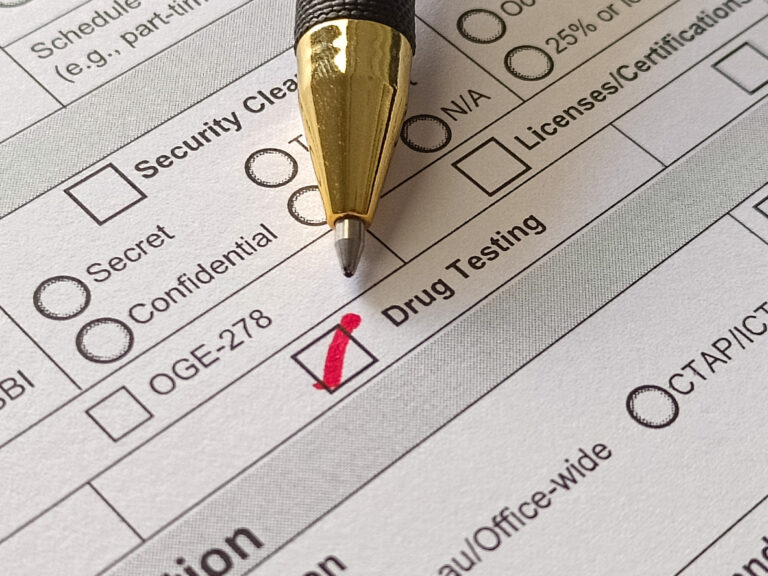
WASHINGTON — A proposed rule from the Federal Drug Administration (FDA) could open the door to oral fluid, hair follicle and other advanced drug testing for commercial vehicle operators.
“For decades, that program has been constrained by a regulatory barrier that prevented modern, less invasive testing methodologies from being used in federally mandated programs,” the National Drug & Alcohol Screening Association (NDASA) said. “That barrier is now coming down.”
The Food and Drug Administration is proposing to eliminate the 510(k) premarket notification requirement that blocked oral fluid, hair, and other advanced testing methodologies from programs governed by the Department of Transportation, the FAA, the NRC, SAMHSA, and the U.S. military.
“This is not just a regulatory update,” NDASA said. “It is a long-overdue modernization of a public safety program that millions of Americans depend on without knowing it. A determined group of industry leaders came together independently, united by a shared belief that the [people] in safety-sensitive jobs across this country deserved a drug testing program built for the modern era. They brought their expertise, their relationships, and their resolve, and found in NDASA an organization with the credibility, membership, and reach to carry their fight to the highest levels of government. Together, they built something Washington could not ignore.”
Advanced Methodologies Should Not Be Excluded
According to NDASA, fror years, testing methodologies and reagents proven effective in private sector employment testing were explicitly excluded from federally mandated programs by a 510(k) carve-out that had outlived any reasonable justification. That exclusion did not just block modern collection methods like oral fluid and hair testing. It strangled innovation across the board.
“Manufacturers faced costly regulatory hurdles every time they sought to add new drugs of abuse to federal testing panels or bring updated reagents to market,” NDASA said. “Fentanyl surged. Synthetic cannabinoids spread. New threats emerged. And the program designed to protect the most safety-sensitive workers in the country could not keep pace. The science was there. The barrier was not about safety. It was about bureaucracy. That coalition came together to change it, and NDASA led the charge.”
Putting Safety First
“The industry has been waiting and wanting a federal drug testing program that puts public safety first and keeps pace with science for decades,” said Scott Taillie, vice chairman, NDASA. “Our nation relies on the [people] governed by DOT, FAA, NRC, and other federal programs to keep our roadways, skies, and communities safe. They deserve a program built on the best science available, not one held back by outdated regulatory barriers. Oral fluid and hair testing are less invasive, harder to cheat, and long overdue in federal programs. What this coalition accomplished by going directly to Congress and HHS and refusing to back down is something I am extraordinarily proud of. This is the first step. We are not done.”
The proposed rule, published in the Federal Register on May 1, under Docket No. FDA-2026-N-4268 covers fourteen categories of clinical toxicology test systems, including amphetamines, cocaine, opiates, cannabinoids, benzodiazepines and methamphetamine, among others. This proposal opens the door to a broader modernization of federal drug testing policy, including the expansion of oral fluid and hair testing and the ability to respond rapidly to emerging drug threats like fentanyl and synthetic cannabinoids. A 60-day public comment period is now open and NDASA will be submitting comments.
American Trucking Associations (ATA)
“Trucking relies on a strong federal drug testing program to protect public safety and ensure that impaired individuals are not operating commercial motor vehicles,” said Chris Spear, ATA president, CEO. “Following years of advocacy focused on cutting red tape, ATA is pleased that FDA has finally created a pathway to implement oral fluid testing. This major development also lays the groundwork for the eventual adoption of hair testing. Empowering employers with these tools will make drug testing more accurate, more cheat-resistant, and less invasive. The end result will be a stronger trucking workforce and safer roads for everyone.”
According to ATA, for well over a decade, ATA has warned that the federal government’s over-reliance on urine testing has created dangerous gaps in the system—including widespread drug test “cheating.” According to an analysis of Quest Diagnostics data, substituted and invalid urine specimens increased by more than 370% and 36%, respectively, between 2022 and 2023 among federally regulated, safety-sensitive employees—a troubling trend that underscores how vulnerable the current system has become.
Decreasing Tampering of Samples
“Directly observed methods, oral fluid and hair testing are less susceptible to substitutions or tampering,” ATA said. “Additionally, hair testing offers a longer detection window, providing a more complete picture of past drug use. Access to these testing methods ensures motor carriers have the most effective, robust toolboxes when it comes to understanding potential patterns of drug and alcohol use and safety hazards, yet for years, their adoption has been stalled by needless bureaucratic delays.”
Oral fluid testing was approved for regulated use in 2023, yet no U.S. laboratory has been able to obtain certification due to the 510(k) clearance process. The 510(k) requirement also risked further delaying the adoption of hair testing once HHS issues its guidance.
The comment window for FDA’s proposed rule is open for the next 60 days. ATA plans to submit comments in support of removing the 510(k) requirement and is encouraging other safety stakeholders to do the same via regulations.gov.
Truckload Carriers Association (TCA)
The TCA supports permitting hair testing as an alternative to urine or oral fluid testing for the following reasons:
- Hair testing is the most effective method of drug testing for preemployment screenings.
- This method of testing is less invasive and harder to cheat compared to urine testing.
- Concerns over racial bias in hair testing results have been disproven by studies showing any differences are not significantly different.
According to TCA, in a study conducted by the Trucking Alliance and the University of Central Arkansas (UCA), 88,021 licensed truck drivers who applied for jobs at seven trucking companies took both a urinalysis and a hair drug test. It was found that:
-
- 403 tested positive with urinalysis.
- 4,362 tested positive using hair testing.
UCA found that of the 936,872 preemployment urine and hair drug screens, hair testing uncovered:
- 25 times more opioid users.
- 23 times more cocaine users.
- 13 times more amphetamine users.
- 5 times more marijuana users.

Dana Guthrie is an award-winning journalist who has been featured in multiple newspapers, books and magazines across the globe. She is currently based in the Atlanta, Georgia, area.


Truck drivers do not make the mistake and allow them to do that They’re putting artificial intelligence cameras in mega carrier’s trucks, and those cameras are gonna be used to replace you 1 day. Those cameras are recording more than ypu driving your facial recognition. And when you switch from urine to other, they’re taking your DNA, and they’re gonna store your DNA. For the mass data surveillance of Americans, Sean Duffy has not said one thing, nor all these race-baiting youtubers about real problems in the trucking industry, which are brokers, mega carriers and the high fuel prices because they cant because they’re only good at race, baiting problems in the trucking. Industry are more than race baiting what Sean Duffy’s trying to do? He’s trying to input on artificial intelligence and mass surveillance of truck drivers in the trucking industry do not fall for it.Use your brain
They’re trying to find any reason to have less and less truck drivers so that they can scream about the driver shortage and usher in autonomous trucks.
we need the oral fluid testing laboratories certified by October 2026 this is ridiculous already something so simple as getting laboratories certified , Newsflash , the same laboratories that are currently trying to get certified for DOT oral fluid already do nonDOT oral fluid so what’s the big discrepancy. I think it’s more about laziness and dragging their asses like everything else with the government instead of just getting the job done. the entire department of transportation companies across America want a faster less invasive testing for their drivers and want to eliminate the cheating that goes on with outdated urine tests