



In the commercial motor vehicle (CMV) industry, technical competency is only half the equation. We can train a student to master double-clutching, memorize a flawless 90-step pre-trip inspection and back a 53-foot trailer into a tight dock with absolute precision.
However, if that same student enters the industry without an uncompromising, bone-deep culture of safety, all that technical skill means nothing.
According to federal data, large trucks are disproportionately involved in catastrophic accidents when driver focus wavers. As instructors at truck driving schools, private academies and high school career and technical education (CTE) pathways, our highest burden is to cultivate authentic behavioral change.
Classroom lectures and textbook warnings on the dangers of phone use or driving under the influence (DUI) often bounce off young adults and seasoned students alike. They view themselves as highly skilled or invincible.
To break through that wall of overconfidence, you need a high-impact, kinesthetic learning experience.
Building a physical distracted driving and impairment simulator using a modified golf cart is one of the most effective ways to dramatize these real-world dangers.
This comprehensive guide covers everything your driving school needs to plan the event structure, engineer a safe course, modify the vehicle and — most importantly — transform a high-energy activity into an unforgettable lesson that saves lives.
Phase 1: Structuring the event
Before laying a single cone on your training yard, you must determine the educational scope of your event. While a pure DUI course using impairment goggles is a classic approach, combining it with a distracted driving component creates a significantly deeper pedagogical impact.
If you decide to run a dual-focus event, sequence is vital. Always run the distracted driving simulation first, followed by the impairment simulation. This specific progression prevents students from treating the experience merely as a game and grounds it in a sobering reality.
Run 1: Distracted driving simulation
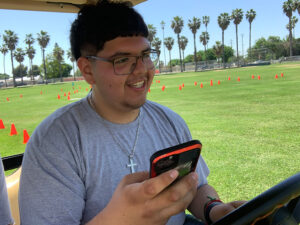
During the first run, students drive the course while attempting to manage secondary cognitive, manual and visual loads. To execute this seamlessly, you will need a pair of two-way walkie-talkies.
An instructor or designated safety handler remains on the sideline with one radio, while the driver keeps the other in the golf cart’s cup holder or dashboard cubby. As the student navigates the course, the handler calls them over the radio to ask rapid-fire questions — such as basic math problems, CDL general knowledge trivia or spelling words — and instructs the student to text the answers back using their personal cell phone.
This forces a stark demonstration of total distraction. Students quickly realize that even at 5 mph, taking their eyes off the path to read or send a text results in an immediate loss of situational awareness.
Run 2: Impairment simulation
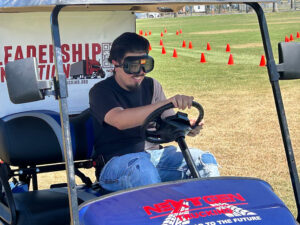
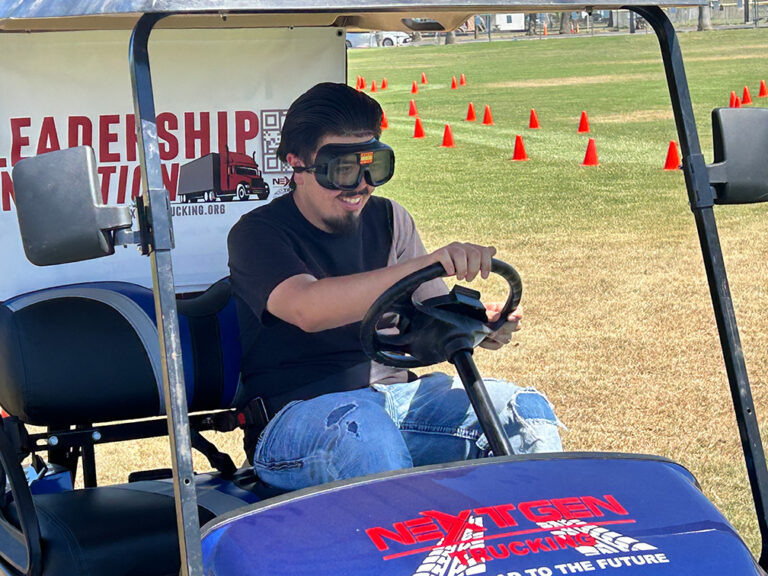
Once the student completes the distraction run, have them complete the exact same course a second time — this time wearing “drunk goggles” (Fatal Vision impairment goggles).
Because they just drove the course while texting, they will have a baseline spatial memory of the layout. Operating the vehicle with altered depth perception, double vision and delayed spatial awareness immediately highlights the physical differences between cognitive distraction and sensory impairment.
Phase 2: Turn an activity into a lesson
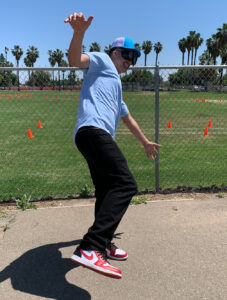
Here is where you, as the instructor, must step in and willingly be the “buzzkill.”
Students will naturally approach this event with high energy. They will laugh, cheer when their classmates swerve, and view the golf cart maneuvering as a novel, video-game-like activity.
Let them have their fun while they are behind the wheel — but the moment they step out of the cart, the tone must pivot immediately from entertainment to raw, authentic reflection.
The goal of this course is not amusement. It is a permanent shift in how these future professional drivers view their responsibility on the road. Do not be surprised if this transition catches them off guard. Instructors frequently watch big, confident students completely break down in tears on the field when the reality of their actions finally sinks in.
The debrief protocol
The second a participant completes their runs and exits the vehicle, pull them physically off to the side, away from the noise and laughter of the waiting crowd. Look them in the eye and deliver a quiet, sobering reality check.
Contrast the lightheartedness of what just happened with the brutal reality of traffic statistics:
• Distracted Driving: Inform them that cognitive and texting distractions claim roughly 3,500 lives every single year while injuring over 300,000.
• DUI/Impairment: Inform them that driving under the influence causes over 12,000 annual fatalities in addition to over 145,000 injuries.
• Comprehensive Societal Cost: Reveal that when factoring in broader societal impacts — such as the calculated value of lost quality of life, pain and long-term injury suffering—the total comprehensive cost rises to a staggering $518 billion each year.
Humanizing the cones: Put faces to the numbers.
Do not let those numbers remain abstract statistics. Turn around, point directly at the course and force the student to look at the trail of destruction they left behind.
Say to them: “Look back at the course. Look at those cones you just mowed down because you were looking at a text message or because your vision was blurred. In the real world, those aren’t pieces of orange vinyl. Those are innocent victims. Those are real people who didn’t make it home.”
To make this realization permanent, show them the actual faces of the people represented by those knocked-over cones and their stories. Organizations like EndDD.org (End Distracted Driving) document these exact tragedies.
By holding up these photos and sharing these names, you strip away the anonymity of traffic data. You force the driver to realize that their short text or “harmless” impairment leaves a permanent wake of grief for real families.
This immediate, localized accountability bridges the gap between a fun schoolyard activity and a memorable, emotional anchor that can actively prevent a future tragedy.
Phase 3: Course engineering and safety design
When students are actively distracted or visually impaired, they will drive off course. Therefore, spatial safety margin is the most critical variable during setup.
Location selection
Select a wide-open area entirely free of fixed obstacles, utility poles, perimeter fencing or pedestrian cross-traffic. An open dirt or grass expanse (like a wide field or an isolated section of your backing yard) is ideal. Surfaces with rolling resistance naturally help limit top speeds compared to smooth asphalt.
Cone selection
An effective layout requires approximately 250 cones. Do not cut corners on the equipment: Strictly purchase pliable, lightweight traffic cones that are designed to be run over. Avoid hard plastic injection-molded cones. Hard plastic can crack, create sharp shards that can puncture the golf cart’s tires or wedge beneath the chassis, causing the driver to lose steering control. Pliable vinyl or rubber cones simply flatten and pop back into shape.
Speed mitigation via geometry
The core engineering goal of the course design is speed suppression. Golf carts possess a short wheelbase and a relatively high center of gravity, making them remarkably easy to roll over if an impaired driver panics and cranks the steering wheel at full throttle.
To prevent participants from picking up speed, design a layout characterized by continuous twists, tight S-curves, acute slaloms and immediate pinwheel turns. The geometry should make it physically impossible to accelerate beyond a slow, walking-pace crawl (under 5 mph) to ensure the vehicle remains firmly on all four wheels.
Emergency communications
Even if you choose to skip the distracted driving portion and run a DUI-only training event, the walkie-talkies remain a mandatory safety requirement. The instructor on the sidelines must maintain an open audio line to the vehicle at all times. If a student becomes severely disoriented by the goggles, panics and floors the accelerator toward a boundary line, the instructor must be able to immediately command them to “Abort, abort, brake!” over the radio.
Phase 4: Optimizing and modifying the golf cart
While any standard electric or gas golf cart can serve as the platform for this course, standard factory fleets require specific modifications to optimize them for liability protection and dual-use commercial training.
1. Restraint systems (mandatory liability protection)
For insurance and risk-management approval, the golf cart must be equipped with functional seat belts for both the driver and the passenger seat. Distracted or impaired drivers frequently execute sudden, jerky steering maneuvers when they realize they are striking cones. Lap or three-point belts ensure that neither the student driver nor the accompanying in-vehicle safety proctor is thrown from the open sides of the vehicle during a sharp pivot.
2. Dual-purpose CDL enhancements
To maximize your school’s equipment budget, configure the golf cart so it pulls double duty as a micro-training vehicle for your standard curriculum. Equipping the cart with a standard trailer hitch allows you to hook up a small utility trailer, giving beginner students an affordable, low-stakes platform to learn the baseline physics of trailer articulation and backing dynamics before moving up to a full-size tractor-trailer.
Additionally, install a complete set of commercial-style side mirrors (such as west coast-style or wide-angle convex mirrors).
3. Visual sight-blocker (backing shield)
To strictly enforce proper commercial backing habits, mount an opaque plastic canvas, wooden shield or heavy vinyl cover directly behind the driver’s seat of the cart. This barrier must completely block the driver’s rear-window view. By completely obstructing the rearward line of sight, the barrier prevents students from looking over their shoulders when reversing. They are forced to rely entirely on their sideview mirrors to navigate — accurately mimicking the precise visibility constraints of a standard commercial semi-truck.
4. Branding and program marketing
An event of this scale naturally draws substantial attention from the student body, community members and local media. Turn the golf cart into a moving billboard for your training program. Apply clean, professional vinyl wraps or decals featuring your commercial driving school’s logo, website and phone number. It serves as an excellent recruitment and marketing tool when community members see the simulator in action.
Instructors’ Implementation Checklist
Before launching your simulator event, verify that you have checked off every logistical step:
• Liability Clearances: Risk management waivers signed by participants or parents explicitly detailing golf cart operation, distracted texting exercises and impairment goggle use.
• Vehicle Prep: Seat belts inspected, backing cover securely mounted and commercial mirrors adjusted.
• Site Clearance: Ground checked for holes, hidden debris, or active irrigation heads.
• Hardware Check: Walkie-talkies fully charged with fresh backup batteries on hand.
• Impairment Gear: Drunk Goggles: Fatal Vision Red Label (simulating a high impairment Blood Alcohol Concentration of 0.12-0.15).
By blending rigorous safety engineering with a targeted, serious post-drive intervention, your driving school can provide an unforgettable safety lesson that protects future commercial drivers while elevating the educational integrity of your training curriculum.

Dave Dein is co-founder of the Next Generation in Trucking Association and the former truck driving program coordinator and instructor at the Patterson High School Supply Chain and Logistics Training Center in Patterson, California.
With a career spanning over three decades in the trucking industry, Dave has worked as a driver and a manager. He is also the founder of Faith Logistics, a nonprofit truck driving school ministry dedicated to providing career opportunities through trucking.
For the past 27 years, he has been a dedicated educator within the Patterson, California, Joint Unified School District, holding both multiple and single-subject teaching credentials.
His commitment to shaping the next generation of trucking professionals has earned him significant recognition, including being named the 2025 California and Region V Teacher of the Year.