



On Dec. 11, 2025, we published a story about autonomous trucks: “Autonomous trucks are here and ready to work. Is the industry ready?”
The piece generated lots of reader feedback, as well as several questions, including these from reader Clyde Kerns. (Thanks for reaching out to us, Clyde!)
So, we went back to ACT Research autonomous vehicle (AV) experts Ann Rundle and Lydia Vieth for clarification. Rundle is vice president of electrification and autonomy at ACT, and Vieth is ACT’s research analyst for electrification and autonomy.
Without further ado, here’s what we learned.
How is this autonomous vehicle (AV) technology being received by the insurance industry?
Opinions abound, but in reality, it will take a few court cases to establish legal precedent. That’s because the question of who should be liable for damages is far from settled.
Traditionally, the carrier that owns the truck and hired and trained the driver ends up in the legal crosshairs — but how does that apply when the “driver” is a computer? Is the company that developed the autonomous system liable? What about the manufacturer that installed the self-driving system in the truck they built?
Determining risk and calculating insurance premiums will take time.
“It’s an actuarial science, so they build up data,” Rundle explained. “But for autonomous vehicles, it’s nowhere near the amount of data, that we have for regular trucks.”
Then, the reasons behind crashes will change.
“If you look at the propensity of accidents, it still comes down to a driver issue, distracted driver, drowsy driver. Human error, right?” she said. “And if you take that out, theoretically, you should have a safer driver because the computer isn’t looking at its phone. It’s not being distracted. It’s not having a bad day.”
What additional training will be required for our technicians to operate these trucks?
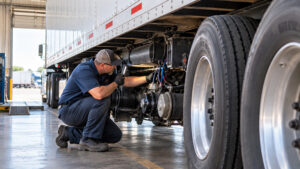
Unless and until electric trucks become more prevalent, the mechanical workings of trucks will be similar to what they are now. Oil will need to be changed, flat tires fixed, worn-out parts replaced and so on.
There will, however, be more of an Information Technology (IT) presence, as someone will need to evaluate how much the autonomous software contributes to the need for repairs.
It’s also likely that fleet managers and dispatchers will need additional training to master the differences presented by autonomous vehicles. For example, the vehicles aren’t currently able to operate under certain weather conditions or in construction areas where markings have not been painted on the pavement yet. Planning trip times without concern for rest periods will be another difference to adjust to.
What are the estimates as to initial purchase cost of a traditional unit versus an AV spec truck?
In some cases, there won’t be a “purchase” at all. In the “trucking as a service” scenario that some developers intend to offer, carriers will pay developers on a per-mile basis, just as they might pay drivers by the mile today.
For trucks that are sold, prices will likely be double the price of a traditional model (or higher). The payback, of course, will be the elimination of driver salaries, plus taxes and benefits that often increase an employer’s cost of hiring a driver by 35% or more. Then, there may be a competitive advantage in being able to offer longer trips without rest breaks or other delays.
There are other anticipated costs and issues:
- Would trailers need to be “smart?” If so, will they need to communicate flat tires or light issues to an autonomous tractor?
- Will “hubs” need to be developed where AVs drop and hook trailers and undergo pre-trip inspections by human employees?
- What about infrastructure — will special lanes be needed in congested areas?
Will maintenance intervals remain the same for these trucks as for non-AV-equipped units?
In some cases, it’s likely. If an engine manufacturer mandates oil changes at 50,000 miles, it really won’t matter whether those miles were driven by a human or a computer.
However, it’s important to note that the vast majority of testing for autonomous vehicles has taken place under controlled conditions. Even testing on public roads has been conducted in states where the climate is more temperate. Routes are often all interstate, with a human driver taking over on secondary roads or in local areas.
Once adopted for regular use, will parts last longer in trucks that are completely autonomous? The answer is maybe. We could see results like less tire damage or longer suspension parts longevity, but it’ll take millions of miles before trends are known.
How do we as an industry “sell” the technology investment to the general public?
Despite the occasional — and often spectacular — news report of an autonomous vehicle failure, AVs are already racking up millions of miles … with safety records as good as or better than human drivers.
“Right now, each AV developer has their own safety case,” Rundle said. “They’re saying, ‘Yes, we do think that our system meets this XYZ standard, and here’s why,’ but each developer is coming up with their own argument for why their vehicle is safer.”
What resonates with the public, however, will depend on actual AV performance in real-world conditions and the data that is built up over time.
The public will also look to our country’s leadership for guidance on the issue. Laws that are passed or regulations enacted by the U.S. Department of Transportation and the Federal Motor Carrier Safety Administration will be designed to ensure and enhance safety, and they’ll need to be amended as more is learned.
“The America DRIVES Act was introduced this summer, and that is specific to commercial vehicles,” Vieth said. “It seeks to define remote assistance and remote operation. Ann and I attended the SAE (Society of Automotive Engineers) symposium in Tempe, Arizona, where there was debate about what these terms mean.”
That’s a start.
“I think, on the whole, we’re much closer to the federal government creating some guidelines around this than we are to all 50 states individually adopting rules that actually allow AVs,” Vieth continued. “I think a lot of states will be dragging their feet for a while.”
It’s important to note that there won’t be a day when the switch is thrown and autonomous trucks suddenly rule the highways. It will happen one carrier, one shipper, and one route at a time.

Cliff Abbott is an experienced commercial vehicle driver and owner-operator who still holds a CDL in his home state of Alabama. In nearly 40 years in trucking, he’s been an instructor and trainer and has managed safety and recruiting operations for several carriers. Having never lost his love of the road, Cliff has written a book and hundreds of songs and has been writing for The Trucker for more than a decade.