




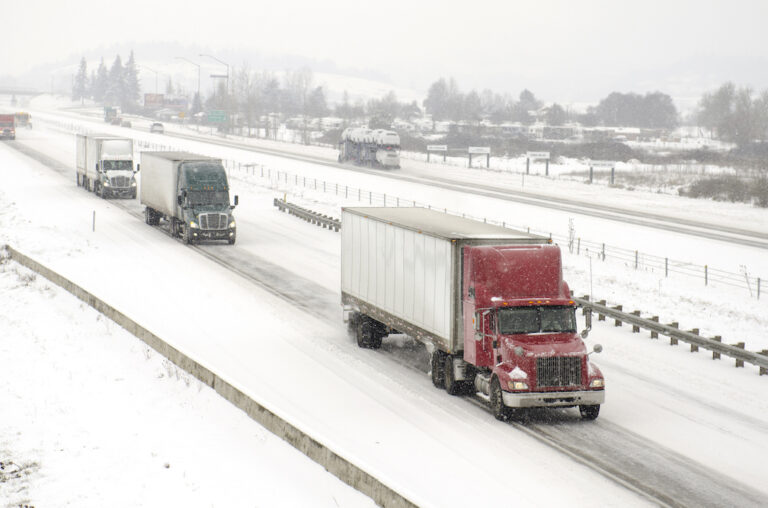
The Federal Motor Carrier Safety Administration (FMCSA) issued a declaration on Saturday for an Hours of Service (HOS) waiver for states hit hard by severe winter weather over the weekend.
FMCSA declared officially that “an emergency exists that warrants issuance of a Regional Emergency Declaration and provide emergency regulatory relief from certain requirements in Part 395 of the Federal Motor Carrier Safety Regulations (FMCSRs).”
The declaration was issued in response to severe winter storms and cold temperatures substantially below normal in the Affected States and the current and anticipated effects on people and property, a release from the Department of Trnasportation stated.
The factors that were included in the criteria were the immediate risk to public health, safety and welfare.
This declaration addresses the emergency conditions creating a need for immediate transportation relating to the restoration of essential services and essential supplies. The Affected States and jurisdictions (Affected States) in this Emergency Declaration are: Alabama, Arkansas, Colorado, Connecticut, Delaware, District of Columbia, Florida, Georgia, Illinois, Indiana, Iowa, Kansas, Kentucky, Louisiana, Maryland, Massachusetts, Michigan, Mississippi, Minnesota, Missouri, Montana, Nebraska, New Hampshire, New Jersey, New York, North Carolina, North Dakota, Ohio, Oklahoma, Pennsylvania, Rhode Island, South Carolina, South Dakota, Tennessee, Texas, Vermont, Virginia, West Virginia, Wisconsin, and Wyoming.
FMCSA said by execution of this Emergency Declaration, motor carriers and drivers providing direct assistance supporting emergency relief efforts involving transportation and other relief services incident to the immediate restoration of essential supplies or services in the affected states are granted emergency relief from 49 CFR § 395.3, maximum driving time for property-carrying vehicles, and 49 CFR § 395.5, maximum driving time for passenger-carrying vehicles, subject to the restrictions and conditions set forth herein. The regulatory relief under this Emergency Declaration applies regardless of the origin of the trip, so long as the carrier or driver is providing direct assistance to the emergency in the affected states. Direct assistance does not include transportation related to long-term rehabilitation of damaged physical infrastructure after the initial threat to life and property has passed, nor does it include routine commercial deliveries, including mixed loads with a nominal quantity of qualifying emergency relief added to obtain the benefits of the Declaration.
Emergency Declaration Restrictions & Conditions
FMCSA documents also say by execution of this Emergency Declaration, motor carriers and drivers providing direct assistance to the emergency in the Affected States as set forth herein are granted emergency relief from regulations in 49 CFR §§ 395.3, maximum driving time for property-carrying vehicles, and 395.5, maximum driving time for passenger-carrying vehicles, subject to the following restrictions and conditions:
1. Nothing in this Emergency Declaration shall be construed as a waiver of or exemption from any applicable requirements or any portion of the FMCSRs (49 CFR Parts 350–399) including the controlled substance and alcohol uses and testing requirements (49 CFR Part 382), the commercial driver’s license requirements (49 CFR Part 383), or the financial responsibility (insurance) requirements (49 CFR Part 387); Federal Hazardous Materials Safety Regulations (HMRs) (49 CFR Parts 100–180); vehicle size, and weight limitations, as well as route designations administered by the Federal Highway Administration (23 CFR Part 658; 23 U.S.C. § 127; 49 U.S.C. §§ 31111–31115); or any other regulations for which relief is not specifically granted herein.
2. Motor carriers or drivers currently subject to an out-of-service order are not eligible for the relief granted by this Emergency Declaration until they have met the applicable conditions for its rescission and the order has been rescinded in writing by the issuing jurisdiction.
3. This Emergency Declaration provides for regulatory relief from 49 CFR §§ 395.3 and395.5 for commercial motor vehicle operations while providing direct assistance supporting emergency relief efforts. Direct assistance terminates when a driver or commercial motor vehicle is used in interstate commerce to transport cargo or provide services that are not in support of emergency relief efforts related to the emergency as set forth in this Emergency Declaration, or when the motor carrier dispatches a driver or commercial motor vehicle to another location to begin operations in commerce. (49 CFR § 390.23(e)). Upon termination of direct assistance to emergency relief efforts related to the emergency as set forth in this Emergency Declaration, the motor carrier and driver are subject to the requirements of 49 CFR §§ 395.3 and 395.5 while operating commercial motor vehicles in interstate commerce, except that a driver may return empty to the motor carrier’s terminal or the driver’s normal work reporting location without complying with 49 CFR §§ 395.3 and 395.5, except as noted herein. When a driver is moving from emergency relief efforts to normal operations, (1) if a driver is transporting property, a 10-hour break is required when the total time a driver is engaged in emergency relief efforts, or in a combination of emergency relief and normal operations, equals or exceeds 14 hours; and (2) if a driver is transporting passengers, an 8-hour break is required when the total time a driver is engaged in emergency relief efforts, or a combination of emergency relief and normal operations, equals or exceeds 10 hours.
In accordance with 49 CFR § 390.23, this Emergency Declaration is effective immediately and shall remain in effect until the end of the emergency (as defined in 49 CFR § 390.5T) or until 11:59 P.M. (ET), February 6, 2026, whichever is earlier

Bruce Guthrie is an award-winning journalist who has lived in three states including Arkansas, Missouri and Georgia. During his nearly 20-year career, Bruce has served as managing editor and sports editor for numerous publications. He and his wife, Dana, who is also a journalist, are based in Carrollton, Georgia.