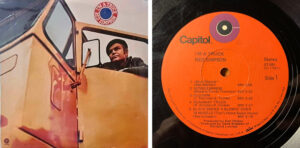




When one considers the career of Dave Dudley, the arguable “King of Trucker Country,” it might appear that the genre reached its stride in the 1960s.
While ’60s country music DID produce a montage of truck driving-related songs, it wasn’t until the 1970s that trucker country reached its peak. After all, the ’70s were the decade that brought country music’s trucking class to both the small screen in “Movin’ On” and the to big screen with “Smokey and the Bandit.”
These shows, along with the CB radio, turned truck driving into a cultural phenomenon —largely on the heels of the C.W. McCall’s No. 1 superhit, “Convoy.”
As the genre of “trucker country” gained steam, the charge was led, among others, by Red Sovine, an artist whose hits transcended the two decades.
Who was Red Sovine?
A native of Charleston, West Virginia, Woodrow Wilson Sovine was born in 1917, at the height of his namesake’s presidency. One of five children, Sovine was seldom called by his real name.
Early in life, he earned the nickname “Rusty” because of his rust-colored hair. Eventually, the nickname shifted to “Red” — a more popular name for a light-complected reddish-haired boy of the time — a name by which he is still known today.
The early days
Sovine got his start in music at an early age, when his mother taught him to play guitar. As a teenager, he and a childhood friend formed a band. They played on a Wheeling, West Virginia, radio station, but they had only a small following. Eventually, his friend believed he would see more success with his brothers and left Sovine on his own.
As for Sovine, he got married and took a job as a factory foreman. However, he continued to play music on various West Virginia radio stations in addition to his “real” job.
Chasing a dream
Then, at the age of 26, with a wife and young son, Sovine decided to give up “working life.” He uprooted his family and headed for Shreveport, Louisiana.
Why not Nashville, you ask? At the time, Shreveport was also a hotbed of country music, largely in part to the “Louisiana Hayride” radio show. The Hayride served as a stepping-off point for Nashville’s Grand Ole Opry, the pinnacle of country music success.
At first, it was slow going for Sovine. A former bandmate helped him land a morning radio show in Shreveport, but it met with little popularity.
The “Louisiana Hayride” proved to be Sovine’s ticket toward building his name. After appearing on the show in guest slots, he caught the attention of the Hayride’s top name, Hank Williams (ever heard of him?). When Williams decided to leave Shreveport for Nashville and the Grand Ole Opry, he recommended Sovine as his replacement.
On the road to success
Now a bona fide radio star, Sovine was convinced by Webb Pierce, a fellow Hayride performer, to lead his band. Pierce also helped Sovine get his first recording contract with Decca Records in 1954.
Two of Sovine’s first recordings turned out to be hits. The first, “Are You Mine?” was cut with Goldie Hill and reached No. 15 on the country charts. The second, “Why Baby Why?” — a duet with Pierce — turned out to be Sovine’s first No. 1 single in 1956. Not a bad start for a fellow barely off the bus from West Virginia!
Sovine followed these up with a second duet with Pierce, which hit No. 5, and a song of his own, “Hold Everything ’til I Get Home,” that did the same.
By 1959, Sovine had left Decca and signed with Starday, where he focused on a solo career. Over the next five years, Sovine released four albums, alternating between Starday and Decca. None met with commercial success, nor did they produce any singles of note.
His only charting song of the period, “Dream House for Sale,” managed to briefly reach the Top 30 on the U.S. Country charts. This 1964 tune wasn’t included on an album; it was merely a single released by Starday.
Even though it enjoyed limited popularity, “Dream House” spread Sovine’s name across the country, paving the way to his breakout album and single two years and two albums later.
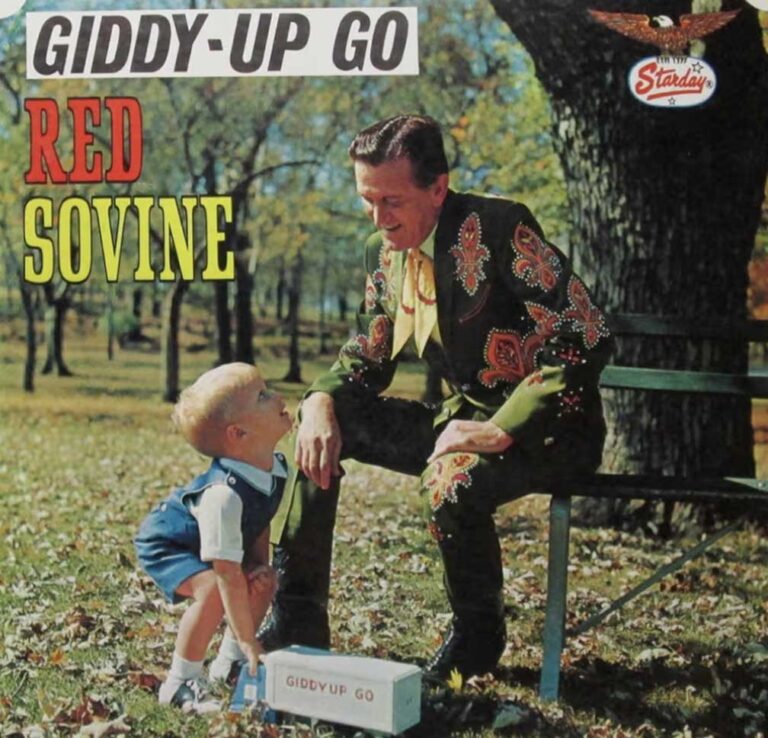
Revving up with Giddy Up Go’
In 1965, Starday Records released Red Sovine’s seventh album, “Giddy Up Go.” The compilation of 10 songs had a number of quality country songs, including “Lonesome Number One,” “Tender Years” and “Love Is All She Ever Asks of Me.” The album also sported an instrumental piece titled “Trucker’s Ramble.”
Little did Sovine realize that the trucking theme he introduced on “Giddy Up Go” would be the niche that would bring him his greatest success as a performer. The title song from the album, propelled Red Sovine’s career into the spotlight after a decade of near obscurity.
Among the best-known trucker country songs of the 1960s, “Giddy Up Go” tells the story of a lonely trucker who lost his wife and son to the rigors of his career. The driver’s life is consumed with following the white line of the highway; his only respite are truck stops along the way. The happy ending became a requisite of Sovine’s future songs, as did the style in which the recording was presented.
“Giddy Up Go” was not so much a song as it was a recitation. Backed by the piano, an occasional fiddle (or maybe, in this case, a violin) and orchestra instrumentals, Sovine didn’t sing a syllable of the tune. Instead, he stood in front of the microphone and seemingly read from a script … but the vocal inflections throughout the song clearly indicated that Sovine was not simply reading. He was performing.
Sovine knew how to turn a heartfelt phrase into one with a tear or two, and the tears dripped from the radio speakers. Followers cried along with him as “Giddy Up Go” raced to No. 1 on the U.S. Country charts. The song even reached the Top 100 in a lineup of all U.S. recordings played on the radio.
What’s more, Sovine’s style set the standard for trucking songs that presented the public with the view that truckers were not just figures of the highway: Each driver had a personal life and a personal story. Sovine would feature some of these stories in future recordings that proved him to be one of the genuine stars of the trucker country genre.
Until next time, when we’ll take a look at some of Red Sovine’s other trucker country tunes, don’t rest on your laurels. Keep the “giddy” in your “Giddy Up Go.”

Since retiring from a career as an outdoor recreation professional from the State of Arkansas, Kris Rutherford has worked as a freelance writer and, with his wife, owns and publishes a small Northeast Texas newspaper, The Roxton Progress. Kris has worked as a ghostwriter and editor and has authored seven books of his own. He became interested in the trucking industry as a child in the 1970s when his family traveled the interstates twice a year between their home in Maine and their native Texas. He has been a classic country music enthusiast since the age of nine when he developed a special interest in trucking songs.