This story is Part 2 of a series. To read Part 1, click here.
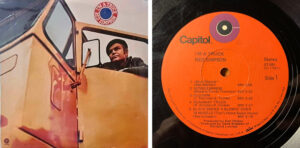
By the mid-1960s, with songs like Dave Dudley’s “Six Days on the Road,” Del Reeves’ “Girl on the Billboard,” and Red Sovine’s “Giddy Up Go,” “trucker country” had firmly established itself as a sub-genre of country music.
Performers from all corners of country music were getting in on the act.
Even Minnie Pearl, in the only single she ever recorded, responded to Sovine’s “Giddy Up Go” with “Giddy Up Go Answer.” In this tune, she retold the trucker’s story from “Giddy Up Go” — but from the wife’s point of view. While Pearl’s song wasn’t met with much fanfare, it DID give listeners the realization that the life of a truck driver is hard on all sides of the family and that the driver isn’t the only one to suffer from loneliness.
Pearl’s “Answer” also gave Red Sovine pause to realize he had struck a chord with his first hit trucking song and may have found his niche.
He excelled at telling tales of truckers on the open road.
While Sovine recorded a number of songs that could be considered trucker country between 1965 and1980, most were relegated to Side B of the .45 RPM singles that contained his hits.
And Sovine’s hits had one thing in common, aside from merely being trucking songs: They were not songs per se, they were recitations of stories told through a trucker’s voice — a voice that many began to equate with that of Red Sovine.
Other musical artists like Red Simpson (“I’m a Truck”) and even C.W. McCall (“Convoy”) adopted Sovine’s style for some of their songs, and the telling of stories set to background music became fairly popular in trucker country.
But nobody did it quite like Sovine.
Between the release of “Giddy Up Go” in 1965 and 1967, Sovine charted four singles, but none met with the success of his first hit song. “Long Night,” “Class of ’49,” “I Didn’t Jump the Fence” and “In Your Heart” all hit the charts — largely with the credit of Sovine’s increasing name recognition. But only one managed to break the Top 20.
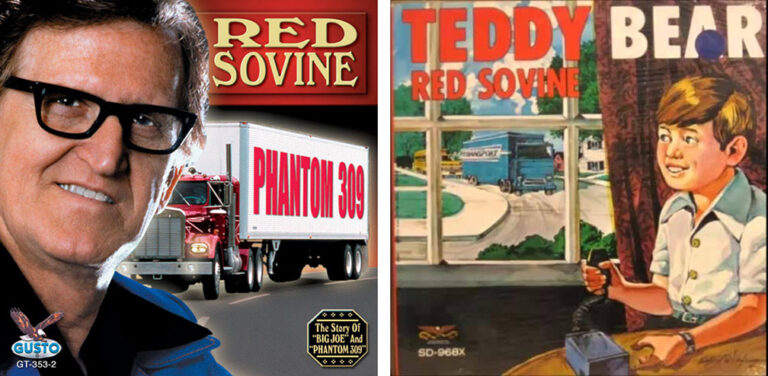
That changed with Sovine’s second single of 1967, “Phantom 309.”
Written by Tommy Faile and released on Starday Records, “Phantom 309” was likely pegged specifically for Sovine: It told a truck driver story similar to that of “Giddy Up Go” and was meant to be recited, not sung.
Like its predecessor, “Phantom 309” features lyrics set over light orchestral-like music, with just enough of an interlude to give listeners pause and allow them to soak in the lyrics and story.
Unlike “Giddy Up Go,” however, “Phantom 309” doesn’t have a happy ending — at least not in the same sense as the reunion celebrated in “Giddy Up Go.” In fact, “Phantom 309’s” haunting lyrics well could have made for a song released at Halloween, as they could be considered a ghost story set to music.
I’ll let you recall or listen to the song itself rather than summarize the story in this article (a quick internet search will bring up numerous recordings, along with the lyrics).
Some folks have said “Phantom 309” has at least a grain of truth to its story — although settling on exactly which story the song is based on is problematic. Several eerily similar accidents involving an 18-wheeler and a school bus happened during the 1950s and ’60s, including one in Vermont.
Other artists covered the tune.
Several singers recorded covers of “Phantom 309,” including Dave Dudley and Del Reeves. It was just that kind of a song — one that resonated with truckers and that sounded a little different, depending on whose voice one was listening to when it was performed.
The story itself became more than the song, as similar stories have been recorded in different languages that essentially are the same as that Sovine took to No. 9 on the country charts.
Some have claimed that Johnny Cash paid homage to Sovine’s song in his 1986 recording “Like the 309.” A brief look at the lyrics of Cash’s tune, however, prove the rumor to be untrue. “Phantom 309” was pure 1960s trucker country. While it may have been recorded by others, no one — not even Johnny Cash — did it like Red Sovine.
Then Sovine hit a proverbial “dry spell.”
Following “Phantom 309,” Red Sovine’s new songs were seldom heard on the airwaves for the next several years. He had a minor hit with “It’ll Come Back” (No. 16) in 1974; then a regional hit in New England with “Daddy’s Girl” the same year.
But it took the “trucker as cultural icon” craze of the mid-1970s to return Sovine to the top of the charts, and he did it with his signature song and No. 1 single, “Teddy Bear.”
“Teddy Bear” is once again classic Red Sovine.
Co-written with three others, Sovine struck America’s heart with “Teddy Bear” when he demonstrated — again through recitation set to music — that truck drivers were not necessarily outlaws and renegades as they were portrayed in many trucker country songs.
Like “Phantom 309,” I’ll take it for granted that most trucker country fans out there and most truckers on the road) are familiar with the lyrics of “Teddy Bear,” and I won’t bother to retell the story. If you haven’t heard it, look it up.
Suffice to say that the songwriters’ focus on a youngster “taken in” over the CB radio by a truck driver sets the stage for “Teddy Bear.” Some will claim (and I have been guilty myself) that “Teddy Bear” is a bit too sappy-sentimental for trucker country — but it’s certainly no more forlorn than Dolly Parton’s “Coat of Many Colors” or most any early 1970s Bobby Goldsboro song.
And “Teddy Bear” had staying power; it ranked No. 5 on the top country hits of 1976.
Sequel songs continued the story.
“Teddy Bear” was followed up by two sequels. The first, “Teddy Bear’s Last Ride,” was recorded by a singer named Diana Williams. The lyrics of Williams’ song suggested the little boy in “Teddy Bear” did not live to see adulthood.
Sovine was taken aback at the tragic ending to the story.
While he let it pass when Minnie Pearl recorded a response to “Giddy Up Go,” Sovine was moved to write his own far more satisfying sequel to “Teddy Bear.” In Sovine’s version, “Little Joe,” Teddy Bear miraculously recovered from the condition that afflicted him. The song never managed to reach the Top 40.
I suppose listeners wanted to form their own opinions about what happened to young Teddy Bear, and they didn’t need a performer, not even Sovine, to tell them. Records certified as Gold have a way of standing on their own.
Until next time, dig deep and search out some unheralded Red Sovine on the streaming service of your choice. You may hear a voice that speaks to your soul.

Since retiring from a career as an outdoor recreation professional from the State of Arkansas, Kris Rutherford has worked as a freelance writer and, with his wife, owns and publishes a small Northeast Texas newspaper, The Roxton Progress. Kris has worked as a ghostwriter and editor and has authored seven books of his own. He became interested in the trucking industry as a child in the 1970s when his family traveled the interstates twice a year between their home in Maine and their native Texas. He has been a classic country music enthusiast since the age of nine when he developed a special interest in trucking songs.