



Once in a great while, a country music performer comes along who’s an entire entertainment package.
These artists don’t just sing, although that’s certainly an important part of the package. These performers are also true instrumentalists, and they command a stage presence like few in the industry. This ability to captivate an audience translates into other entertainment professions like songwriting, comedy and even acting.
In the 1970s, few country performers provided the entire entertainment package like Jerry Reed.
Jerry Reed Hubbard was born in Atlanta in 1937. From an early age he had his eyes set on the music business. As a child, after obtaining his first guitar, he decided he was going to be a star.
As a youngster, Reed worked in the cotton mills, and he saw music as an escape. By the time he was a young teenager, he and his guitar appeared in clubs across the Atlanta area, where he played backup for cover bands.
At 16, based on the recommendation of a policeman who had seen Reed play and read some of the songs he had written, Reed signed a contract with Capitol Records. Although the singing contract produced no success, Capitol DID show an interest in his songwriting talents in the early 1960s.
Reed’s works were recorded by numerous artists, including Brenda Lee (“That’s All You Gotta Do”), Johnny Cash (“If the Good Lord’s Willing and the Creeks Don’t Rise”), Elvis Presley (“Guitar Man” and “U.S. Male”) and others.
After serving in the military from 1959-1961, Reed moved to Nashville, where his guitar playing skills brought him work as a studio musician. The amount of work he received was almost more than his schedule allowed, especially since he was in demand as a touring musician with some of pop and country music’s top acts.
Still, his goal of finding the spotlight as a solo artist remained out of reach.
Then, in 1965, guitar aficionado Chet Atkins signed Reed to RCA and gave him advice on his approach to music that changed the trajectory of his career. According to Reed, Atkins simply told him, “You’re doing it wrong. Let’s try it this way.” Later, Reed was quoted as saying of Atkins, “Damned if he wasn’t right!”
Exactly what “this way” meant is hard to pin down — but after receiving the advice, Reed’s music was on the charts for years to come.
Beginning in 1967, Reed released album after album. Both his visibility in Nashville and among country music fans grew. He soon became known as one of Nashville’s top writers, penning songs like “Misery Loves Company,” “Remembering,” “A Thing Called Love” and “US Male.” He also scored BMI awards for “That’s All You Gotta Do” and “Guitar Man.”
Then, in 1970, he finally had a major breakthrough.
Reed released one of his top selling songs, “Amos Moses,” in 1970. It was a No. 1 hit that also scored high on the crossover pop charts. He won a Grammy for Best Instrumental Performance and another nomination for Best Male Country Performance. On top of all that, the Country Music Association (CMA) named him Instrumentalist of the Year.
Television variety shows created another avenue for success.
One thing Reed’s songs are known for is that they’re all heavy on instrumentals. He alternates lyrics and guitar-picking with a skill like few others. This ability translated well to television where Reed became a regular on Glen Campbell’s CBS-TV endeavor, “The Glen Campbell Goodtime Hour,” from 1970-1972.
During this time, he also released the smash hit, “When You’re Hot, You’re Hot,” a song that won him another Grammy and led to six CMA nominations, including Entertainer of the Year. Through the mid-1970s, Reed continued recording hit songs and appearing on television shows featuring country artists.
Then, in 1974, Hollywood came a’calling.
A new career opened up for Reed when he was cast in the Burt Reynolds movie “W.W. and the Dixie Dance Kings.” Critics wrote favorably of Reed’s acting, and he appeared in another Reynolds’ film, “Gator,” two years later.
But the role that brought Jerry Reed the fame he sought as a toddler was still a year away.
By 1977, Citizens Band radio (better known as the CB) and truck driver in general had become cultural icons. C.W. McCall’s hit song “Convoy” paved the way for a breakout in the subgenre of Trucker Country music.
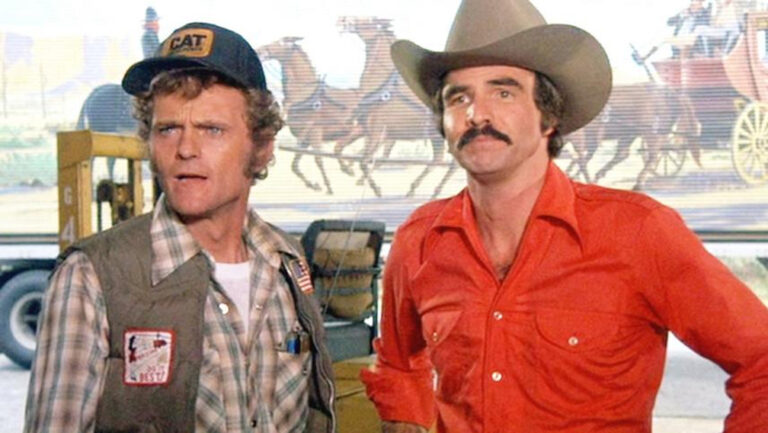
This time the influence was strong enough to carry its way to Hollywood. The most successful of the movies showcasing trucking was another Burt Reynolds film, that you may have heard of — “Smokey and the Bandit.”
Fresh out of prominent roles with Reynolds in other successful movies, Reed was cast as Reynolds’ co-star, a character who went by the CB handle “Snow Man.”
Snow Man’s job in the plot, of course, was to drive an 18-wheeler from Atlanta to Texarkana, Texas, load a truckload of bootleg Coors beer and haul it back to Atlanta — all over the course of 28 hours.
According to the movie plot, no such feat had ever been achieved. Burt Reynolds, as “The Bandit,” convinced Snow Man to go along with the plan “for the money, for the glory and for the fun” — but “mostly for the money.”
The result was a film also starring Jackie Gleason that turned out to be one of the surprise hit movies of 1977, finishing second to “Star Wars” as the highest grossing film of the year.
For Reed, “Smokey and the Bandit” was much more than an acting endeavor.
While it was indeed the high-water-mark of his acting career — and created an iconic role that he reprised in 1980’s “Smokey and the Bandit II” — it also served as a means to feature his musical ability before a much larger audience than those who listened to country music.
Reed, writing under his given name of Jerry Hubbard, along with Bill Justis, wrote the soundtrack for the movie, which included a dozen songs, some with lyrics and some strictly instrumental. Also heavily involved in the writing of the songs was Dick Feller (today known as Deena Kaye Rose).
In addition to popular songs like “The Bandit,” “Foxy Lady” and “Orange Blossom Special,” one hit song that came out of “Smokey and the Bandit” was “East Bound and Down.” This tune essentially presented the plot of the movie in lyrical and musical form. It rose to No. 2 on the country charts — and became Reed’s signature song.
“East Bound and Down” has become a Trucker Country anthem, its upbeat tempo and lyrics illustrating the image of professional drivers. “We’ve got a long way to go and a short time to get there,” sums up a long-haul truck driver’s task in just a dozen or so words.
After “East Bound and Down,” Reed continued to record successful hits throughout the 1980s. Songs like “Workin’ at the Carwash Blues,” “Texas Bound and Flying,” “She Got the Gold Mine (I Got the Shaft)” and “The Bird” kept his music on the charts.
By 1990, after some failed movie and television roles, Reed decided to lower his profile and cut back on his career pursuits. He continued touring and living off the success of hits like “Amos Moses” and “East Bound and Down.”
In 2005, he was inducted into the Nashville Songwriters Hall of Fame. Today, some 18 years after his death in 2008, those songs continue to receive airplay and place Reed among elite company in the entertainment world.
Until next time, here’s a challenge: Try to think of another trucking-themed movie that had the impact of “Smokey and the Bandit.”

Since retiring from a career as an outdoor recreation professional from the State of Arkansas, Kris Rutherford has worked as a freelance writer and, with his wife, owns and publishes a small Northeast Texas newspaper, The Roxton Progress. Kris has worked as a ghostwriter and editor and has authored seven books of his own. He became interested in the trucking industry as a child in the 1970s when his family traveled the interstates twice a year between their home in Maine and their native Texas. He has been a classic country music enthusiast since the age of nine when he developed a special interest in trucking songs.