



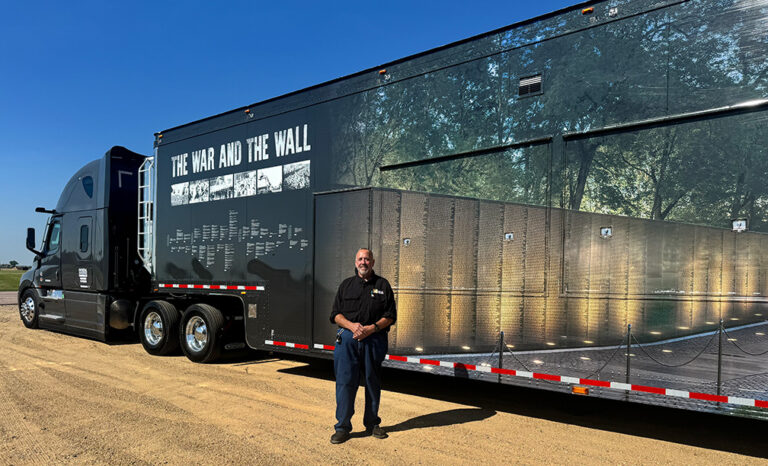
When Marty Ellis, a tour truck operator for the Owner-Operator Independent Drivers Association (OOIDA), got the chance to be a part of hauling The Wall That Heals, he didn’t have to mull it over.
“I know a lot of veterans that were in Vietnam. My uncle was in the Coast Guard, and he got wounded over there,” Ellis said. “So many people from Vietnam were treated so poorly when they came back. I felt that this is a way to show my respect for what they had to go through. Not only serving, but also when they got back — how they were treated.”
The Wall That Heals is replica of the Vietnam Memorial that travels the country, along with an education center. Transporting The Wall to communities throughout the United States also allows the souls enshrined on the Memorial to exist once more among family and friends, in the peace and comfort of familiar surroundings.
The traveling exhibit provides thousands of veterans who have been unable to cope with the prospect of facing The Wall to find the strength and courage to do so within their own communities, thus allowing the healing process to begin.
“A lot of our members are veterans from all branches,” said Norita Taylor, OOIDA’s director of public relations and membership. “We’ve been focused on making sure that we can honor that aspect of our membership.”
Marty Ellis: Transitioning from the Army to trucking
After serving in the U.S. Army, Ellis was looking for a new career. He initially joined his father-in-law’s beekeeping business, hauling bees from California to South Dakota. While this job didn’t involve driving a semi-truck, once he left the bee business, he realized that trucking might be the perfect answer for the next stage of his career. He joined A&A Express in South Dakota.
A journey to remember
For Ellis, The Wall That Heals is unlike anything he’s ever transported before.
“Hauling the wall — you don’t think it’s going to be an emotional thing,” Ellis told The Trucker.
“You’re just pulling around another trailer … until you’re driving along, thinking about all the names on that wall. It really hits hard,” he shared. “You get all the fanfare when you come through on the parade.
“But and realizing that all the people that sacrificed that went through what they did and weren’t honored like they should have been, the whole trip gets kind of heavy,” he continued. “It was more emotional than I thought it would be because of what the wall represents.”
Ellis recalls meeting many people along his journey. One in particular stands out: A man told Ellis that the name of one of his good friends is memorialized on The Wall. Ellis says he invited the man to see the wall at its next stop.
“I sure hope he did,” Ellis said. “I’m sure it would have been very meaningful to him. During the trip itself, I’d get honks and waves.”
Ellis recalls another unique experience along the way.
“I had a motorcycle that kind of stayed beside the truck for a minute; then he backed off and I could see him alongside the trailer,” Ellis said. “I could see the guy on the bike reaching out to touch the trailer. I don’t know if he ever touched it, but it was like he felt so strongly about connecting to it.
“I felt I just needed to drive straight and hold it steady,” he continued. “After a couple minutes he took off, and he waved as he went past. It’s pretty amazing that somebody feels that connected to what’s on the outside of that trailer — and what’s inside the trailer.”
Connecting the drivers of America, one truck at a time
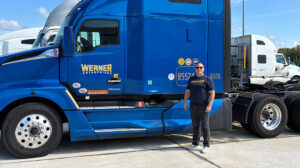
In his everyday role at OOIDA, Ellis travels around the country, transporting “The Spirit of the American Trucker,” a specialized mobile education and tour trailer that travels to major truck shows, rest areas and industry events across the country to connect face-to-face with professional drivers.
Ellis says he loves his job, adding that he feels uniquely positioned in his role, as it allows him to connect with truckers and show them that OOIDA’s work is not just conducted behind desks in air-conditioned buildings or in Washington, D.C.
“Not everybody can get to the OOIDA office; some people are hesitant to call in,” Ellis said, referring to the association’s headquarters in Grain Valley, Missouri.
“With this truck and trailer, we’re able to see them where they’re at, whether it’s a truck show or truck stops,” he said. “I think it means a lot to our members to be able to see us and talk about some of the issues they have going on.”
Ellis feels this one-on-one connection with drivers throughout the nation is vitally important, especially since he’s a trucker himself.
“I have to deal with the same things that every driver out here has to do, whether it’s pass a physical, DOT regulations and that type of thing,” he said. “It does make a difference when I talk to people, because some of the time they think I’m an office guy and somebody else brings the truck to a location.
“I talk to people, and once they realize that I drive this all over the country — it’s a different conversation after that,” he concluded.

Dana Guthrie is an award-winning journalist who has been featured in multiple newspapers, books and magazines across the globe. She is currently based in the Atlanta, Georgia, area.